Montessori Sensorial lessons
Each Sensorial material isolates a single quality, such as dimension, length or weight, so the child can notice differences, put things in order and later attach precise words to them. The work refines perception and lays groundwork for math and language.
The first lesson in this area is Knobbed Cylinders, typically from 2 to 4 years.
In order
- 1
Knobbed Cylinders
2 to 4 yearsRemoving ten knobbed cylinders from a wooden block and fitting each back into its own socket, discriminating size by sight and touch.
Materials: Knobbed Cylinders
- 2
Pink Tower
2.5 to 4 yearsBuilding a tower of ten pink cubes, from 10 cm down to 1 cm, to see and feel differences in size across three dimensions.
Materials: Pink Tower, Work Rug
- 3
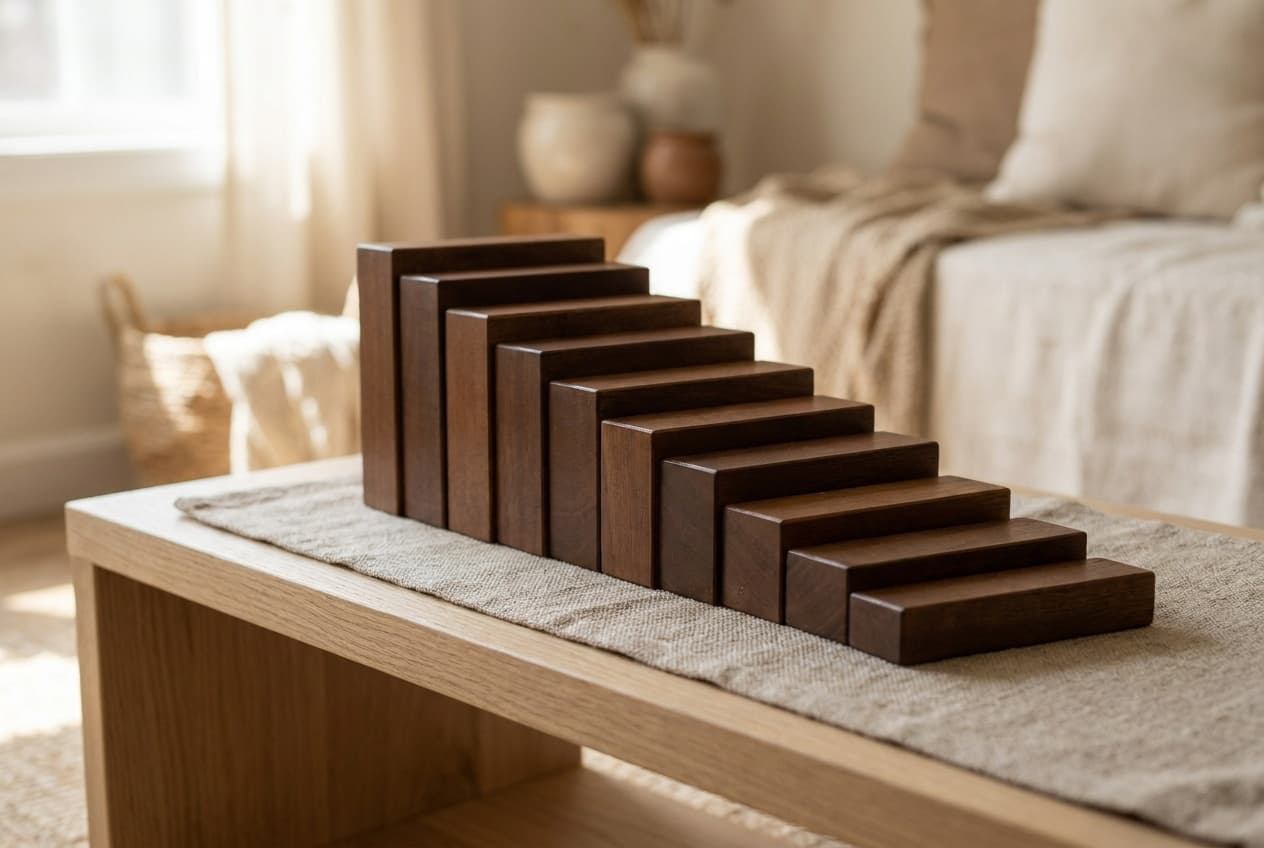
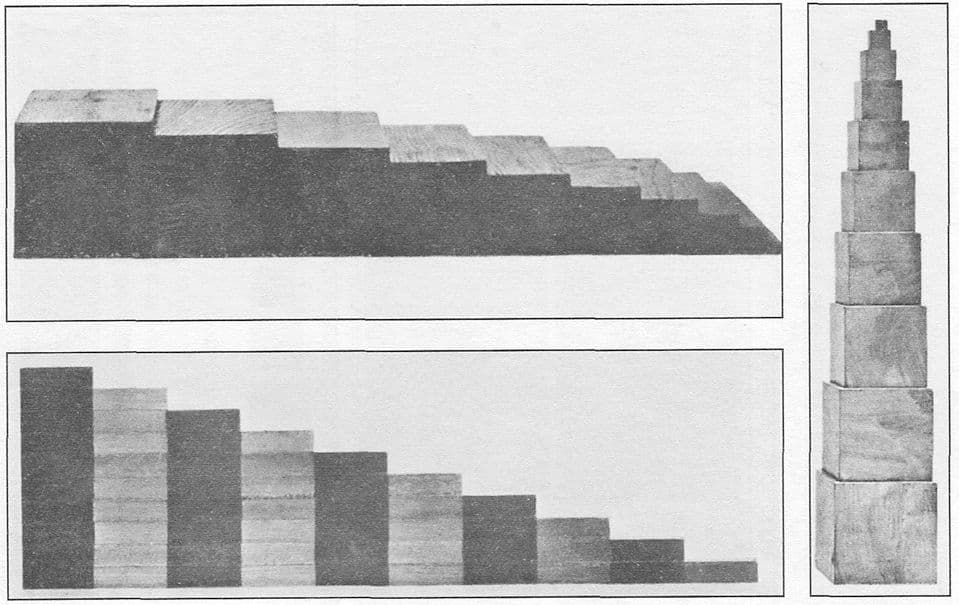
Brown Stair (Broad Stair)
2.5 to 4.5 yearsArranging ten brown prisms, all the same length but growing in thickness, into a stair from thickest to thinnest.
Materials: Brown Stair, Work Rug
- 4
Touch Boards (Rough and Smooth Boards)
2.5 to 4.5 yearsFeeling the difference between rough and smooth with washed, light fingertips on three wooden boards, the first exercise for the sense of touch.
Materials: Touch Boards
- 5
Red Rods (Long Rods)
3 to 5 yearsLaying ten rods, 10 cm to 1 m long, side by side from longest to shortest, to judge differences in length by eye.
Materials: Red Rods, Work Rug
- 6
Color Tablets: Boxes 1, 2 and 3
3 to 5 yearsPairing colored tablets by sight, three colors and then eleven, and later grading seven shades of one color from darkest to lightest.
Materials: Color Tablets
- 7
Sound Cylinders (Sound Boxes)
3 to 5 yearsShaking closed cylinders to pair those that sound the same, then grading six of them from loudest to softest.
Materials: Sound Cylinders
- 8
Geometric Cabinet (Plane Geometric Insets)
3 to 5 yearsLifting flat wooden shapes out of their frames, tracing each edge with two fingers, and fitting them back, from three contrasting shapes to drawers of near twins.
Materials: Geometric Cabinet
- 9
Mystery Bag (Stereognostic Bag)
3 to 5.5 yearsReaching into a cloth bag, feeling one hidden object at a time, and naming it before pulling it out to look.
Materials: Mystery Bag (Stereognostic Bag)
- 10
Binomial Cube
3.5 to 6 yearsTaking apart and rebuilding a cube of eight colored blocks, matching faces by color and size, a puzzle that years later shows (a + b)³.
Materials: Binomial Cube
- 11
Geometric Solids
3.5 to 6 yearsHandling ten pale blue wooden solids, feeling each with closed eyes, rolling them to see which roll and which stand still, and learning their names.
Materials: Geometric Solids
- 12
Trinomial Cube
4 to 6 yearsTaking apart and rebuilding a cube of 27 blocks in three colors, layer by layer, the harder sequel to the binomial cube.
Materials: Trinomial Cube
Sensorial materials
- Knobbed Cylinders
Four wooden blocks, each holding ten knobbed cylinders that vary in diameter, height or both.
- Pink Tower
Ten pink wooden cubes from 1 cm to 10 cm on a side.
- Brown Stair
Ten brown wooden prisms, each 20 cm long, with square ends from 1 cm to 10 cm.
- Red Rods
Ten red wooden rods of the same square section, 10 cm to 1 m long in 10 cm steps.
- Color Tablets
Small flat tablets in matched pairs and graded shades, sold as box 1 (3 pairs), box 2 (11 pairs) and box 3 (63 shades).
- Binomial Cube
A hinged wooden box of eight painted blocks that build a cube.
- Sound Cylinders
Two boxes of six sealed cylinders, one with red lids and one with blue, graded from loud to almost silent.
- Touch Boards
Three small wooden boards of sandpaper and smooth wood: half and half, alternating strips, and strips graded fine to coarse.
- Geometric Cabinet
A wooden chest of six drawers holding about 35 flat blue shapes in square frames, each lifted by a small knob.
- Trinomial Cube
A hinged wooden box of 27 painted blocks in red, blue, yellow and black that build a cube in three layers.
- Geometric Solids
Ten pale blue wooden solids, from the sphere and cube to the ovoid and ellipsoid, usually with stands for the rounded ones.
- Mystery Bag (Stereognostic Bag)
An opaque cloth bag, sold empty or with small wooden solids, for naming and matching objects by touch.
These lessons run from the youngest starting age. To see what sits beside them on the shelf at one age, across all five areas, start with age 2.