Sound Cylinders (Sound Boxes)
Sound cylinders are two boxes of six closed wooden cylinders, one set with red lids and one with blue, that rattle from loud to almost silent. A child of about 3 shakes them to find matching pairs, then lines up one set from loudest to softest. Montessori's 1914 version was six cardboard cylinders in a double set.
Sourced from the texts, not yet presented at home
| Typical age | 3 to 5 years |
|---|---|
| Area | Sensorial |
| Before this | |
| Materials | |
| Direct aim | To match sounds of equal loudness, then to grade six sounds from loud to soft. |
| Control of error | The ear, and the second set. Every cylinder has one match, so a wrong pair leaves two odd ones at the end. When grading, the other color's row is the check: grade both sets and the pairs should line up across. |
| Leads to | Later lessons in this line are in preparation. |
| Time | About 10 minutes (our estimate). |
| Grouping | One child, in a quiet room |
| Parent prep | Low. A table, both boxes, and a few quiet minutes in the house. |
| Cost | Buy about $35 to $125. Make: easy to make at home. |
| Other names | Sound boxes, Noise boxes, Hearing cylinders |
What the work teaches
Direct aim. To match sounds of equal loudness, then to grade six sounds from loud to soft.
Indirect aims, the ones you will not see at once
- Listening in silence, which Montessori prepared with her silence game
- Preparation for hearing the separate sounds in spoken words, the work of the sandpaper letters
- Holding one sound in mind while listening for its match
- A small, controlled shake rather than a bang
Set it out before you invite the child
Two boxes of six sealed wooden cylinders, one set with red lids and one with blue. Each cylinder in one box has a twin in the other that sounds the same. Montessori Outlet, Alison's and Nienhuis all list it that way.
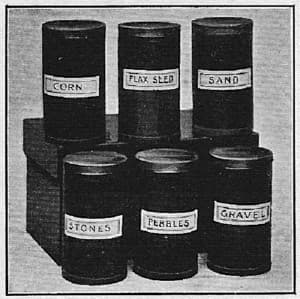
Montessori's 1914 version was a double set of six cardboard cylinders, some with wooden covers. In 1912 she used small boxes of sand or pebbles, shaken to make noises.
A table in a quiet room. Turn off music and screens first; the softest cylinder is close to silent.
A blindfold or a soft scarf, for later.
Presentation, step by step
- 1Bring both boxes to the table. Set the red-lidded cylinders in a row on the left and the blue in a row on the right.
- 2Pick up one red cylinder and shake it beside your ear, slowly, twice.
- 3Pick up a blue cylinder and shake it beside the other ear. Shake the two in turn.
- 4If they sound the same, stand them side by side in the middle. If not, put the blue one back and try another.
- 5Pair all six, then mix them and invite the child to pair them.
- 6On a later day, grade one set: find the loudest, then the next loudest, down to the softest, in a row.
Details that hold the child's attention
The softest cylinder, so quiet the child has to hold still to hear it.
One cylinder at each ear, shaken in turn.
The blindfold. Montessori's children did this exercise with their eyes covered.
Cylinders that won't open: the sound can't be seen, only heard.
How the child sees a mistake
The ear, and the second set. Every cylinder has one match, so a wrong pair leaves two odd ones at the end. When grading, the other color's row is the check: grade both sets and the pairs should line up across.
The words come after the hands
| Words | Shown with |
|---|---|
| loud and soft | The two ends of the series, given first. |
| louder, softer | Any two cylinders compared. |
| loudest, softest | For choosing from the row when grading. |
| same, different | For pairing. |
The three-period lesson, scripted
You need the loudest and the softest cylinder of one set.
| Period | What you do and say |
|---|---|
| 1. Naming | Shake the loudest: "This is loud." Shake the softest: "This is soft." |
| 2. Recognition | "Give me the loud one." "Give me the soft one." Mix them and ask again; the child has to shake to tell. |
| 3. Recall | Shake one and ask "What is this?" |
Montessori's order for every sense was identities, then contrasts, then fine differences. The three periods use the contrast: the two ends of the series.
Extensions and variations
- Pairing blindfolded
- Grading both sets, then pairing across the two rows
- Pairing at a distance: one set on a table across the room, each match found by memory
- Montessori's silence game: the room so still that a name whispered from the next room can be heard
- Naming loud and soft sounds on a walk around the house or garden
Variations
- Starting with three pairs only: the loudest, one from the middle and the softest
Make it or buy it
| Material | Make it | Buy, approx. |
|---|---|---|
| Sound Cylinders | Easy | $35 to $125 |
Prices noted . Approximate US street prices for home-use versions; they vary by maker and change often, so recheck before buying.
Making it at home
Twelve identical opaque containers filled in matching pairs with rice or dried beans, lids glued shut. Mark one set's lids red and the other blue.
What to check when buying a set
Bought sets are sealed and evenly graded. Shake each pair in the shop or on arrival: a pair that doesn't match makes the lesson impossible.
Printables for this age
This work needs only the material, so it has no printable of its own. The shelf plan below places it among the other works for the same age.
- Shelf plan for age 3PDF, 1 page, 250 KBEvery work for this age on one page, in order, with a column to date each presentation.
Every printable for one age, by email
The shelf plan and the lesson printables for your child's age in one email, then three short emails on the first lesson, what to make or buy, and what comes next.
Signs the child is ready, and signs it is done
Ready for the first presentation
- Pairs the box 1 and box 2 color tablets.
- Sits still and quiet for a minute when asked.
- Points out sounds around the house, like a clock or a bird.
- Shakes something gently on purpose rather than banging it.
Ready for the next lesson
- Pairs all six blindfolded.
- Grades one set loudest to softest, then checks it by pairing the other set.
- Uses loud and soft correctly, and later the comparatives.
- Hears the softest cylinder without being told to listen hard.
Fitting it into a home, not a classroom
| If you have | Do this |
|---|---|
| A noisy house | Use nap time or the early morning. Montessori found hearing exercises worked best in silence, and even in darkness. |
| A tight budget | Twelve identical opaque containers, such as spice jars wrapped in paper, filled in pairs with rice, dried beans, sand, salt and a few paper clips, one pair left almost empty. Glue every lid shut. |
| Two children | One shakes and the other says louder or softer. Swap after six turns. |
| A child who never hears the softest cylinder | Mention it at the next checkup. Montessori used whispered names and a ticking clock to get a rough idea of each child's hearing. |
When it does not go to plan
| When | Try this |
|---|---|
| The child bangs the cylinders together. | End the turn calmly and show the small shake again on another day. |
| The middle pairs go wrong. | That's normal: the ends are easy and the middle sounds are close. Start again with three pairs. |
| The child tries to open a cylinder. | Bought ones are sealed. Glue the lids on homemade ones, so the child has to listen rather than look. |
| The house is never quiet. | Play Montessori's silence game first: everyone holds still until the ticking of a clock can be heard. Then bring out the boxes. |
Hazards to check before each session
Seal homemade cylinders with glue. Rice, beans and salt are choking and inhaling hazards for a toddler.
Shake beside the ear, never pressed against it.
Where other sequences and standards place it
We have not bought the paid homeschool curricula, so they are not listed here.
| Framework | Where it sits |
|---|---|
| This site's Sensorial sequence | Lesson 7 of 12 published, after Color Tablets: Boxes 1, 2 and 3. Checked in: the scope and sequence |
| Montessori, The Montessori Method (1912) | Third grade: once the gradations of color and touch begin, sounds and noises are presented for the ear. Checked in: Chapter XX, Sequence of Exercises |
| Montessori, Dr. Montessori's Own Handbook (1914) | A double set of six cardboard cylinders. The child pairs them first and later grades them by loudness, blindfolded. Checked in: Sensory Education, Fig. 26 |
| Head Start Early Learning Outcomes Framework, preschool | P-SCI 3: the child compares and categorizes observable phenomena. P-LIT 1: awareness that spoken language is made of smaller segments of sound, which careful listening prepares for. Checked in: www.in.gov |
Sound cylinders: questions parents ask
What are Montessori sound cylinders?
Two boxes of six closed cylinders, each making a rattle from loud to nearly silent. The child pairs cylinders that sound the same, then grades one set from loudest to softest. Eyes are often closed or blindfolded, so the ear does all the work.
What age are sound cylinders for?
About 3, after the first pairing work with the color tablets, and on this site they run to 5. Montessori's 1912 sequence brings in hearing in the third grade, once the child has paired colors.
How do I make sound cylinders at home?
Use twelve identical opaque containers and fill them in pairs, each pair with a different material: rice, beans, sand, salt, a few paper clips, almost nothing. Glue the lids shut and mark the pairs underneath where the child can check.
Sources cited by book and chapter
- Maria Montessori, Dr. Montessori's Own Handbook (1914)
Sensory Education, Fig. 26
A series of six cardboard cylinders, closed entirely or with wooden covers, which when shaken produce sounds varying in intensity from loud to almost imperceptible.
Sensory Education
There is a double set; the child first arranges cylinders of equal sound in pairs, then arranges the six cylinders in a series by loudness, seated at a table with his eyes blindfolded.
The sound exercise is analogous to the color spools, which are also paired and then arranged in gradation.
The order of sensory education is recognition of identities, then of contrasts, then discrimination between objects very similar to one another.
- Maria Montessori, The Montessori Method (1912)
Chapter XIII, Exercise for the Discrimination of Sounds
For the gradation of noises Montessori used small boxes filled with different substances, more or less fine, such as sand or pebbles, and the noises are produced by shaking the boxes.
When perfect silence is established, children listen to the ticking of the clock and are called one by one from an adjoining room in a low voice, which gives an approximate knowledge of the child's hearing.
Chapter XX, Sequence of Exercises
In the third grade the stimuli for the sense of hearing, sounds and noises, are presented together with the weight tablets.
Chapter XII, Education of the Senses
Exercises on the sense of hearing are given more successfully in silence and even in darkness, and the blindfold increases the children's interest.
Reviewed by
What to offer next
Once the child chooses this work unprompted and finishes it without help, the next lesson to prepare is Geometric Cabinet (Plane Geometric Insets).
- Red rods3 to 5 years
- Color tablets3 to 5 years
- Sound cylinders3 to 5 years
- Geometric cabinet3 to 5 years
- Mystery bag3 to 5.5 years