Montessori Math lessons
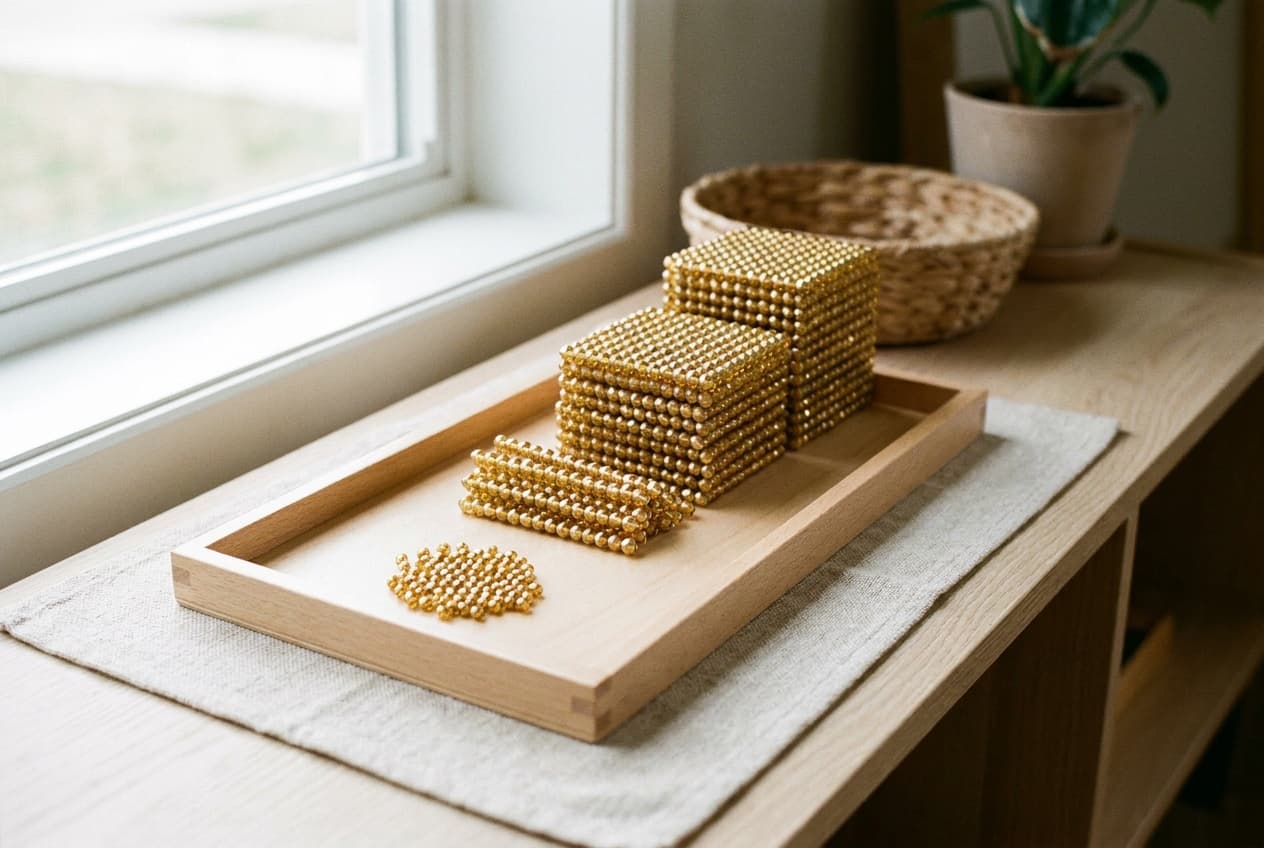
Montessori math moves from concrete quantity to abstract symbol. Children hold a ten bar before they write 10, and build a thousand from golden beads before they carry digits on paper. Lessons are sequenced so each material prepares the next.
The first lesson in this area is Number Rods, typically from 3.5 to 5 years.
In order
- 1
Number Rods
3.5 to 5 yearsTen red-and-blue segmented rods, from 10 cm to 1 meter, that let a child see, carry and count quantities one to ten as single objects.
Materials: Number Rods, Work Rug
- 2
Sandpaper Numerals
3.5 to 5 yearsTracing the numerals 0 to 9, cut from sandpaper on smooth boards, while saying each name, so the hand learns the shape of each figure.
Materials: Sandpaper Numerals
- 3
Golden Beads: Introduction to the Decimal System
4 to 5.5 yearsNaming a unit bead, a ten bar, a hundred square and a thousand cube, so the child can hold and compare the categories of the decimal system.
Materials: Golden Bead Material, Work Rug
- 4
Spindle Boxes: Counting 0 to 9
4 to 5.5 yearsCounting loose spindles into ten compartments marked 0 to 9, the first work where the numeral comes first and the child makes the quantity, and the first meeting with zero.
Materials: Spindle Boxes
- 5
Teen Boards (Seguin Board A)
4 to 6 yearsSliding number cards 1 to 9 over the zero of a printed 10 to make and read 11 to 19, with a ten bar and a colored bead bar beside each.
Materials: Teen Boards, Golden Bead Material
- 6
Cards and Counters: Odd and Even
4 to 5.5 yearsLaying out the numerals 1 to 10 in order and placing the right number of red counters under each in pairs, which shows odd and even.
Materials: Cards and Counters
- 7
Stamp Game: Static Addition
4.5 to 7.5 yearsAdding four-digit numbers with color-coded tiles for units, tens, hundreds and thousands, the step between golden beads and paper.
Materials: Stamp Game
- 8
Short Bead Chains (Squaring Chains)
4.5 to 6.5 yearsCounting the hundred chain bead by bead with a label at every ten and folding it into a square, then counting the shorter squaring chains of 2 to 9.
Materials: Bead Chains (Short Chains and the Hundred Chain)
- 9
Tens Boards (Seguin Board B)
4.5 to 6.5 yearsCounting by tens from 10 to 90 with golden ten bars, then sliding unit cards over the zeros to build and read every number from 11 to 99.
Materials: Tens Boards, Golden Bead Material
- 10
Fraction Insets (Fraction Circles)
4.5 to 7 yearsLifting the pieces of a circle cut into halves, thirds, fourths and on to tenths out of their frames, fitting them back, and learning the names of the parts.
Materials: Fraction Insets (Fraction Circles)
- 11
Hundred Board
5 to 7 yearsPlacing 100 numbered tiles on a 10 by 10 board in order, so the child sees the numbers 1 to 100 as rows of ten.
Materials: Hundred Board
- 12
Addition Strip Board
5 to 7.5 yearsLaying a blue strip and a red strip end to end on a board numbered 1 to 18 and reading the sum above, to learn the addition facts to 9 + 9 by heart.
Materials: Addition Strip Board
Math materials
- Number Rods
Ten rods from 10 cm to 1 m, divided into alternating red and blue 10 cm segments.
- Golden Bead Material
Golden unit beads, ten bars, hundred squares and thousand cubes for the decimal system.
- Stamp Game
A box of small color-coded tiles marked 1, 10, 100 and 1000 for calculating with place value.
- Sandpaper Numerals
The numerals 0 to 9 cut from sandpaper and mounted on smooth boards, traced with two fingers while the name is said.
- Spindle Boxes
A box of ten compartments marked 0 to 9 and a basket of 45 wooden spindles, for counting loose objects and learning zero.
- Teen Boards
Two boards printed with 10 nine times and nine number cards 1 to 9 that cover the zero to make 11 to 19.
- Bead Chains (Short Chains and the Hundred Chain)
Chains of colored bead bars joined end to end: the hundred chain of ten golden bars, and a short chain for the square of each number.
- Hundred Board
A board of 100 squares, 10 by 10, with tiles numbered 1 to 100 and a control chart.
- Cards and Counters
Numeral cards 1 to 10 and 55 red counters, for laying out each number's quantity in pairs.
- Tens Boards
Two wooden boards printed 10 to 90 with nine slide-in cards marked 1 to 9, for building every number from 11 to 99.
- Fraction Insets (Fraction Circles)
Ten frames, each holding a circle 10 cm across, whole or cut into 2 to 10 equal pieces with small knobs.
- Addition Strip Board
A board ruled 12 by 18 squares and numbered 1 to 18, with nine blue and nine red strips from 1 to 9 long.
These lessons run from the youngest starting age. To see what sits beside them on the shelf at one age, across all five areas, start with age 3.