Tens Boards (Seguin Board B)
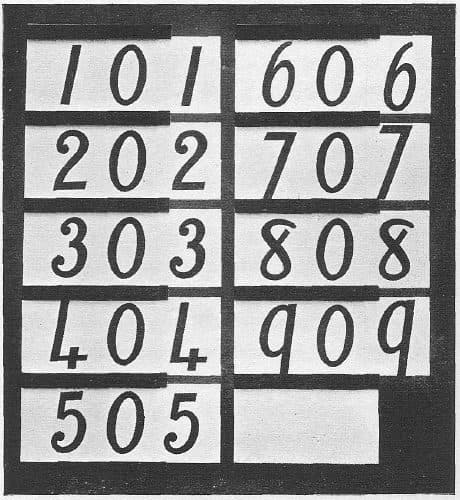
Tens boards are two wooden boards printed 10, 20, 30 up to 90, with nine cards marked 1 to 9 that slide over the zeros. A child of about 4.5 to 5 who knows the teens first counts ten bars along the boards, then builds numbers like 34 and 67 with beads and cards. It's the bridge from 19 to 99.
Sourced from the texts, not yet presented at home
| Typical age | 4.5 to 6.5 years |
|---|---|
| Area | Math |
| Before this | |
| Materials | |
| Direct aim | To learn the names and numerals of the tens, 10 to 90, and then every number from 11 to 99. |
| Control of error | The beads. The bars beside a panel count its tens, and the units count the card. A card that doesn't match the beads shows the mistake. The order of the panels also checks the counting. |
| Leads to | |
| Time | About 15 minutes per presentation (our estimate). |
| Grouping | One child |
| Parent prep | Medium. The boards, nine number cards, 45 ten bars or as many as you have, and nine unit beads. |
| Cost | Buy about $40 to $85. Make: easy to make at home. |
| Other names | Seguin board B, Ten boards, Tens board, Seguin boards |
What the work teaches
Direct aim. To learn the names and numerals of the tens, 10 to 90, and then every number from 11 to 99.
Indirect aims, the ones you will not see at once
- Seeing that the first digit counts tens and the second counts units
- Counting on past a ten: 39, 40, 41
- Preparation for the hundred board and the long bead chains
- Reading two-digit numbers anywhere: house numbers, page numbers, prices
Set it out before you invite the child
Two boards with nine panels in all, printed 10, 20, 30, 40, 50, 60, 70, 80 and 90. Alison's lists each at 19 by 4 inches; Nienhuis splits them 10 to 50 and 60 to 90.
Nine cards marked 1 to 9, the width of a zero, that slide in to cover it.
Golden ten bars and golden unit beads. Forty-five ten bars count out every ten at once; nine are enough if you count along one decade at a time.
Montessori's 1914 handbook describes frames holding cards printed 10 to 90, with the figures 1 to 9 slipped over the zero. Her 1912 book does the same on a long card, the numbers set out by tens.
A table or rug with room for the boards and a row of bead bars beside them.
Presentation, step by step
- 1Set the boards in front of the child, one above the other, 10 at the top.
- 2Lay one ten bar beside the 10: "Ten." Lay two beside the 20: "Two tens, twenty."
- 3Carry on to ninety, a new row of bars at each panel, saying each name.
- 4Give the three-period lesson on two or three of the tens at a time, especially the irregular ones: twenty, thirty, fifty.
- 5On another day, build 11 again with a ten bar and one unit bead, and slide the 1 card over the zero.
- 6Add one unit bead and change the card to 2: twelve. Carry on to 19.
- 7At 19, add one more unit. Exchange the ten units for a ten bar and move down to the 20 panel: twenty.
- 8Carry on through the boards, as far as the child's interest goes, and leave the boards out for counting alone.
Details that hold the child's attention
Nine tens lined up beside ninety: the most bars the child has handled.
The exchange at 19: ten loose units turning into one more ten bar.
Twenty-nine becoming thirty under one card change.
A two-digit number whose beads lie right beside it.
How the child sees a mistake
The beads. The bars beside a panel count its tens, and the units count the card. A card that doesn't match the beads shows the mistake. The order of the panels also checks the counting.
The words come after the hands
| Words | Shown with |
|---|---|
| twenty, thirty, forty, fifty | The decade names, a few at a time. |
| sixty to ninety | The regular decade names. |
| tens and units | How to say what 34 is: three tens and four units. |
| exchange | Swapping ten units for one ten bar. |
The three-period lesson, scripted
You need the 20, 30 and 40 panels with their ten bars.
| Period | What you do and say |
|---|---|
| 1. Naming | Point to each panel with its bars: "Twenty." "Thirty." "Forty." |
| 2. Recognition | "Show me thirty." "Put a bar by forty." |
| 3. Recall | Point to a panel and ask "What is this?" |
Our suggestion: give twenty, thirty and fifty extra time. Their names hide the two, three and five the way eleven and twelve hide the ten.
Extensions and variations
- Counting from 1 to 100 along the boards with beads, exchanging at every ten
- Building a number from the beads and finding its card: 4 tens and 7 units is 47
- Building a number from the card and fetching its beads
- The hundred board, where the same numbers sit in rows of ten
- Skip counting by ten from any number: 3, 13, 23, 33
Variations
- Using the boards with cards only, no beads, once the child counts by tens easily
- Two children: one builds the number with beads, the other sets the card
Make it or buy it
| Material | Make it | Buy, approx. |
|---|---|---|
| Tens Boards | Easy | $40 to $85 |
| Golden Bead Material | Hard to make accurately | $55 to $1,118 |
Prices noted . Approximate US street prices for home-use versions; they vary by maker and change often, so recheck before buying.
Making it at home
Write 10 to 90 in boxes on a strip of card and 1 to 9 on small cards or sticky notes to cover the zeros. Use the ten bars you already have.
What to check when buying a set
Check that the number cards slide in snugly and cover the zero completely. Beads are sold separately.
Printables for this age
This work needs only the material, so it has no printable of its own. The shelf plan below places it among the other works for the same age.
- Shelf plan for age 4PDF, 1 page, 248 KBEvery work for this age on one page, in order, with a column to date each presentation.
Every printable for one age, by email
The shelf plan and the lesson printables for your child's age in one email, then three short emails on the first lesson, what to make or buy, and what comes next.
Signs the child is ready, and signs it is done
Ready for the first presentation
- Builds and reads 11 to 19 on the teen boards without help.
- Counts to 20 by heart.
- Knows a ten bar holds ten beads, and can show it.
- Asks what comes after nineteen.
Ready for the next lesson
- Names every panel from 10 to 90.
- Builds any number from 11 to 99 with beads and cards.
- Counts on across a ten without stopping: 58, 59, 60, 61.
- Reads a two-digit number as tens and units without beads. That's the cue for the hundred board.
Fitting it into a home, not a classroom
| If you have | Do this |
|---|---|
| Not enough ten bars | Nine are enough. Count along one decade at a time and move the bars down as you go. |
| A tight budget | Write 10 to 90 on a strip of card in boxes the size of a sticky note, and write 1 to 9 on sticky notes to cover the zeros. |
| Teen boards already on the shelf | Keep both. The Montessori Room sells the two together, and the child moves from one to the other in the same sitting. |
| A child who races ahead | Let them count to 99. Come back to the exchange later and check the child can show it with beads. |
When it does not go to plan
| When | Try this |
|---|---|
| The child says "twenty-ten" after 29. | Do the exchange slowly with beads: ten units go, one bar comes. Then slide the card off the 20 and move to 30. |
| Fifty and fifteen get mixed up. | Put the 15 on the teen board and 50 on the tens board side by side, with their beads. One bar and five units against five bars. |
| Cards go over the wrong zero. | Build the beads first and the card second for a while. |
| Interest fades halfway up. | Stop at the decade you reached and leave the boards out. Next time, start there. |
Hazards to check before each session
Loose unit beads are choking-size. Keep them in a cup and the work off the floor with a toddler about.
Where other sequences and standards place it
We have not bought the paid homeschool curricula, so they are not listed here.
| Framework | Where it sits |
|---|---|
| This site's Math sequence | Lesson 9 of 12 published, after Teen Boards (Seguin Board A), before Hundred Board. Checked in: the scope and sequence |
| Montessori, Dr. Montessori's Own Handbook (1914) | Frames hold cards printed 10 to 90, and the figures 1 to 9 slide over the zero; the child passes from ten to ten, starting with the number rods. Checked in: Arithmetic, Fig. 42 |
| Montessori, The Montessori Method (1912) | Card B, on which the number cards are set in progression by tens. Almost all the children counted to 100. Checked in: Chapter XIX, Lessons on Decimals |
| Common Core, Grade 1 math | 1.NBT.B.2.c: the numbers 10, 20, 30, 40, 50, 60, 70, 80, 90 refer to one to nine tens (and 0 ones). Checked in: tasks.illustrativemathematics.org |
| Head Start Early Learning Outcomes Framework, preschool | P-MATH 1: the child knows number names and the count sequence. Checked in: www.in.gov |
Tens boards: questions parents ask
What are Montessori tens boards?
Two boards printed 10 to 90, with nine cards marked 1 to 9 that cover the zeros. With golden ten bars and unit beads beside them, the child counts by tens and then builds every number from 11 to 99.
What is the difference between the teen boards and the tens boards?
The teen boards are printed 10 nine times, for 11 to 19. The tens boards are printed 10, 20 and so on to 90, for 11 to 99. Albums call them Seguin board A and B.
What age are tens boards for?
Around 4.5 to 5, after the teen boards, and on this site they run to 6.5. Montessori's 1912 book says almost all her children counted to 100.
How many ten bars do I need?
Forty-five lets you lay out every panel at once, 1 + 2 + ... + 9 tens. Nine is enough if you count along one decade at a time.
Sources cited by book and chapter
- Maria Montessori, Dr. Montessori's Own Handbook (1914)
Arithmetic, Fig. 42
Frames hold cards printed with the numbers 10 to 90, and the figures 1 to 9 can be slipped in to cover the zero, passing from ten to ten.
Arithmetic
Taking pieces as long as rod 10 instead of the piece 1, we could count 10, 20, 30 up to 90, and two rods of 10 are needed to make 20.
The children show much enthusiasm for these exercises, which demand two sets of activities from them.
- Maria Montessori, The Montessori Method (1912)
Chapter XIX, Lessons on Decimals
On card B the rectangular number cards are superimposed in numerical progression by tens.
Almost all the children count to 100, a number given to them in response to the curiosity they showed in learning it.
To distinguish the higher 1 from the first, a zero, a sign that means nothing, is put near it to make 10, and covering the zero with the number cards forms 11 to 19.
- Maria Montessori, The Montessori Elementary Material (1917)
Part III, Arithmetic
Children choose the ten-bead bars to count the tens in succession, 10, 20, 30, 40, and put together ten-bead bars to match small cards on which 10, 20 and so on are written.
Reviewed by
What to offer next
Once the child chooses this work unprompted and finishes it without help, the next lesson to prepare is Hundred Board.
- Stamp game4.5 to 7.5 years
- Short bead chains4.5 to 6.5 years
- Tens boards4.5 to 6.5 years
- Fraction insets4.5 to 7 years
- Hundred Board5 to 7 years