Short Bead Chains (Squaring Chains)
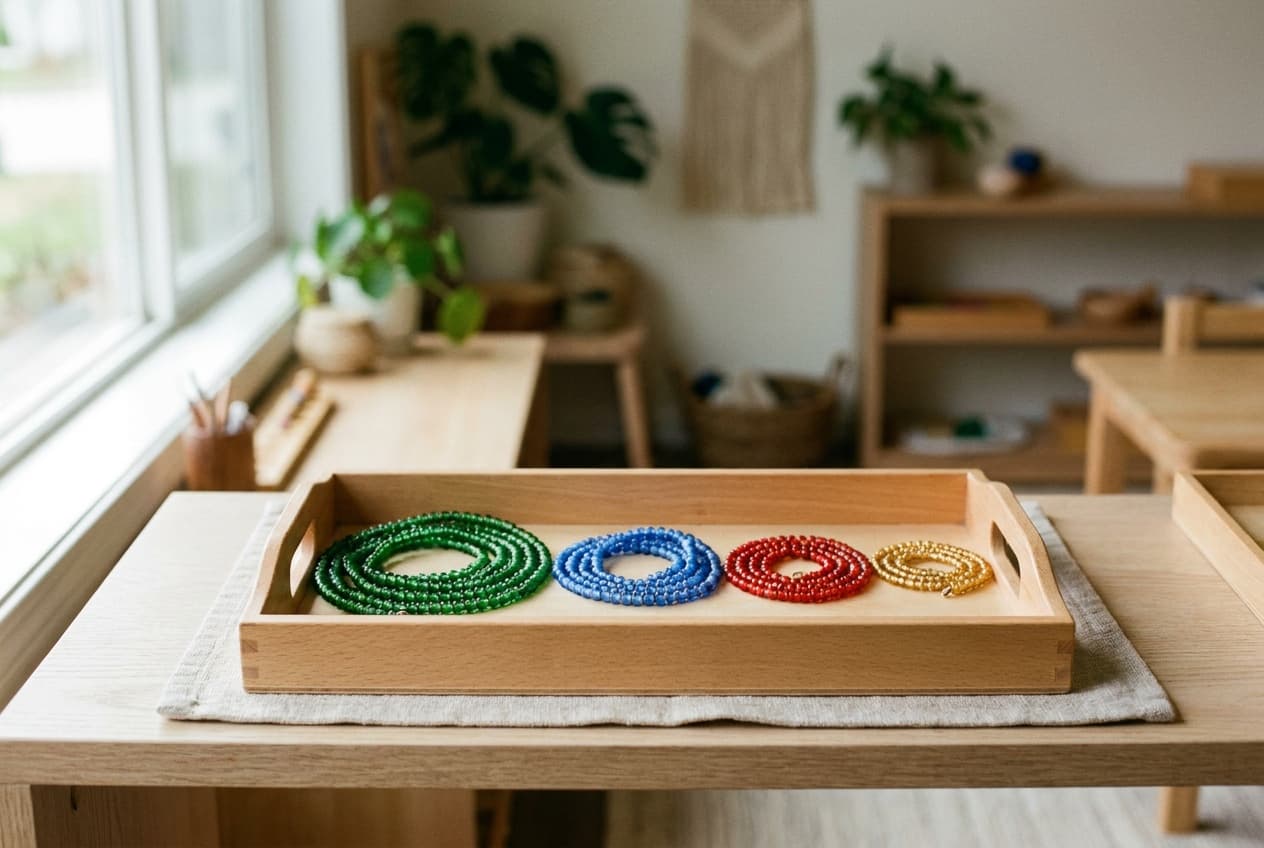
The short bead chains are one chain for each number up to 10, each that number squared: the 5 chain is five bars of five. Children of about 4.5 to 5 start with the hundred chain, count it to 100 with a label at every ten, and fold it into a square. The smaller chains follow, one at a time.
Sourced from the texts, not yet presented at home
| Typical age | 4.5 to 6.5 years |
|---|---|
| Area | Math |
| Before this | |
| Materials | |
| Direct aim | To count to 100 in a line, and then to count by each number up to its square. |
| Control of error | The labels and the square. The last label on each chain must read its number squared, 100 on the hundred chain, and the folded chain must match the bead square of the same color. |
| Leads to | |
| Time | About 20 minutes for the hundred chain (our estimate). |
| Grouping | One child, or two sharing the counting |
| Parent prep | Medium. A floor space about 1 m long, the chain, and ten labels marked 10 to 100. |
| Cost | Buy about $22 to $146. Make: possible to make with some effort. |
| Other names | Squaring chains, Square chains, Hundred chain, Linear counting, Skip counting chains |
What the work teaches
Direct aim. To count to 100 in a line, and then to count by each number up to its square.
Indirect aims, the ones you will not see at once
- Counting by tens to 100
- Preparation for multiplication: the 4 chain counted four, eight, twelve
- Squares of numbers, seen as a chain and as a square of the same beads
- One quantity in two shapes, a line and a square
Set it out before you invite the child
The hundred chain: ten golden ten bars joined end to end, about 70 cm long in Montessori's 1917 material. Nienhuis sells it on its own.
The short chains: for each number, as many bars as beads on a bar, joined end to end, with a bead square of the same color. Montessori's 1917 squares run 2 green, 3 pink, 4 yellow, 5 pale blue, 6 gray, 7 white, 8 lavender, 9 dark blue and 10 orange.
Labels: one small card or arrow per bar, marked with the running count, 10, 20, 30 to 100 for the hundred chain. Montessori's 1917 children matched cards marked 10, 20 and so on to ten bars; printed arrows are the later form.
A strip of floor or a long table, so the chain lies straight.
Presentation, step by step
- 1Lay the hundred chain out straight, with the golden hundred square at its top end.
- 2Count the first bar bead by bead with the child, one to ten. Set the 10 label at the tenth bead.
- 3Count on, eleven to twenty, and set down the 20 label. Carry on to 100.
- 4Read the labels back: ten, twenty, thirty, up to a hundred.
- 5Fold the chain at each bar so the bars lie side by side, and lay the hundred square beside it: the same beads, in a square.
- 6On later days, give the short chains one at a time, from the smallest, counting each by its own number.
Details that hold the child's attention
Folding the chain into a square that matches the hundred square exactly.
The row of labels along the floor, a number line made by the child.
The 2 chain, four beads, lying next to the hundred chain.
The discovery Montessori recorded: "The hundred chain has ten ten-bead bars!"
How the child sees a mistake
The labels and the square. The last label on each chain must read its number squared, 100 on the hundred chain, and the folded chain must match the bead square of the same color.
The words come after the hands
| Words | Shown with |
|---|---|
| chain | Bars joined end to end. |
| square | The same bars laid side by side. |
| twenty to ninety | The tens names, read off the labels. |
| counting by fours | Skip counting along the 4 chain. |
The three-period lesson, scripted
You need the 10, 20 and 30 labels on the hundred chain.
| Period | What you do and say |
|---|---|
| 1. Naming | Point to each: "Ten." "Twenty." "Thirty." |
| 2. Recognition | "Show me twenty." "Put your finger on thirty." |
| 3. Recall | Point and ask "What is this?" |
Our suggestion: use the three periods only for the tens names. The counting is the lesson.
Extensions and variations
- Counting the hundred chain backward, 100 down to 1
- Skip counting each short chain without the labels
- Writing the running count on a paper strip as long as the chain
- Writing the squares, 5² = 25, as Montessori's 1917 children did
- The thousand chain: ten hundred chains, about 7 m long, counted in a hallway over several days
- The long chains, one for the cube of each number, folded from square chains
Variations
- Counting the hundred chain with only the 50 and 100 labels at first
Make it or buy it
| Material | Make it | Buy, approx. |
|---|---|---|
| Bead Chains (Short Chains and the Hundred Chain) | With effort | $22 to $146 |
Prices noted . Approximate US street prices for home-use versions; they vary by maker and change often, so recheck before buying.
Making it at home
A hundred chain from 100 pony beads on strong cord, a new color every ten beads, and card labels for 10 to 100. The short chains take more beads and patience.
What to check when buying a set
Short chain sets usually include the squares and sometimes a hanging frame. Labels or arrows are often extra; card ones are easy to make.
Printables for this age
This work needs only the material, so it has no printable of its own. The shelf plan below places it among the other works for the same age.
- Shelf plan for age 4PDF, 1 page, 248 KBEvery work for this age on one page, in order, with a column to date each presentation.
Every printable for one age, by email
The shelf plan and the lesson printables for your child's age in one email, then three short emails on the first lesson, what to make or buy, and what comes next.
Signs the child is ready, and signs it is done
Ready for the first presentation
- Builds and names the teens on the teen boards.
- Counts to 20 without help.
- Knows the golden ten bar as ten.
- Works on the floor for 20 minutes.
Ready for the next lesson
- Counts the hundred chain to 100 and places all ten labels.
- Skip counts the 2, 5 and 10 chains without labels.
- Folds a chain and names its square.
- Asks how long the thousand chain is.
Fitting it into a home, not a classroom
| If you have | Do this |
|---|---|
| A tight budget | Thread 100 pony beads on strong cord, switching color every ten. Card labels marked 10 to 100 do the rest. |
| Short of floor space | A hallway or a long table is enough. The hundred chain is about 70 cm long. |
| Two children | Montessori's children counted the long chains together in small groups. One counts and the other lays the labels. |
| A child who tires at 60 | Montessori's 1917 child stopped at seven hundred on the thousand chain, marked the place, and came back the next day. Leave a ribbon at the stopping point. |
When it does not go to plan
| When | Try this |
|---|---|
| The child loses count partway. | Touch every bead. Start again from the last label, not from 1. |
| A label lands in the wrong place. | Count from the previous label to this one; the gap shows the slip. |
| Interest in the short chains fades. | Offer one chain a day, smallest first, the order Montessori offered the 1917 material in. |
| The chains tangle in storage. | Hang them on hooks or lay each in its own long box. |
Hazards to check before each session
Beads on a homemade chain need strong cord and secure knots. A loose bead is a choking hazard.
Keep chains out of a toddler's reach. A long chain can wrap around a neck.
Where other sequences and standards place it
We have not bought the paid homeschool curricula, so they are not listed here.
| Framework | Where it sits |
|---|---|
| This site's Math sequence | Lesson 8 of 12 published, after Teen Boards (Seguin Board A), before Hundred Board. Checked in: the scope and sequence |
| Montessori, The Montessori Elementary Material (1917) | Arithmetic: the hundred and thousand chains of ten-bead bars, then square chains and bead squares for 2 to 10, written as 5² = 25. Checked in: Part III, Arithmetic |
| Common Core, Kindergarten math | K.CC.A.1: count to 100 by ones and by tens. The hundred chain does both on one string. Checked in: tasks.illustrativemathematics.org |
| Common Core, Grade 2 math | 2.NBT.A.2: count within 1000; skip-count by 5s, 10s and 100s. The 5 and 10 chains, and later the thousand chain. Checked in: tasks.illustrativemathematics.org |
| Head Start Early Learning Outcomes Framework, preschool | P-MATH 3: the child understands the relationship between numbers and quantities. Checked in: www.in.gov |
Short bead chains: questions parents ask
What are bead chains in Montessori?
Chains of colored bead bars joined end to end. The short chains are the squares of 1 to 10, the 3 chain being three bars of three; the long chains are the cubes. Children count along them, labeling as they go, which is skip counting with something to hold.
Why start with the hundred chain?
It's made of golden ten bars the child already knows, so counting it to 100 joins the decimal work to the chains. Folded, it matches the hundred square, the idea every short chain repeats with a smaller number.
Short chains or long chains first?
Short. Each short chain is a square, the 5 chain holding 25 beads; each long chain is a cube built from square chains, the 5 chain holding 125. Montessori's 1917 book gives the squares first.
What age are short bead chains for?
About 4.5 to 5 for the hundred chain in most albums, and on this site up to 6.5. Montessori's 1917 book reports her bead bars working with children of five and a half.
Sources cited by book and chapter
- Maria Montessori, The Montessori Elementary Material (1917)
Part III, Tens, Hundreds, and Thousands
Ten ten-bead bars joined end to end make the hundred chain, about seventy centimeters long, and ten hundred chains joined by flexible links make the thousand chain, about seven meters.
Children counted bead by bead from 1 to 100, and a child counting the thousand chain stopped at seven hundred to mark the place and come back the next day.
Children cried out that the thousand chain has ten hundred chains and that the hundred chain has ten ten-bead bars.
Part III, Numbers 1 to 10
Small cards marked 10, 20 and so on are matched by putting together the number of ten-bead bars each card calls for.
Part III, Square and Cube of Numbers
For each number there are as many bars as beads, joined in a chain or laid side by side as a square, in the counting colors: pink for 3, yellow for 4, pale blue for 5, gray for 6, white for 7, lavender for 8, dark blue for 9, orange for 10.
The ten bars of the square of ten placed end to end make the hundred chain; the 5 × 5 chain holds the same 25 beads as its square, and the child writes 5 squared = 25.
The square material is offered beginning with the smaller numbers, and the child is left free to work the idea into his consciousness.
The chain of the cube of a number is made of chains of the square joined by links so that it can be folded into squares.
Reviewed by
What to offer next
Once the child chooses this work unprompted and finishes it without help, the next lesson to prepare is Hundred Board.
- Cards and counters4 to 5.5 years
- Stamp game4.5 to 7.5 years
- Short bead chains4.5 to 6.5 years
- Tens boards4.5 to 6.5 years
- Fraction insets4.5 to 7 years