Teen Boards (Seguin Board A)
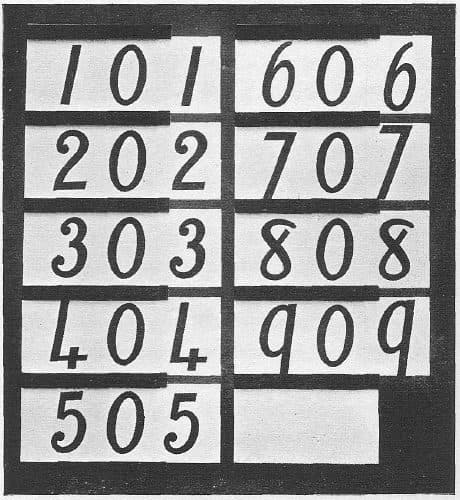
Teen boards are two wooden boards printed with 10 nine times, plus nine cards marked 1 to 9. The child slides a card over a zero to make 11 to 19, and lays a golden ten bar and a colored bead bar beside it. Albums give them at about 4 to 4.5. Montessori's 1912 book did the same with cards.
Sourced from the texts, not yet presented at home
| Typical age | 4 to 6 years |
|---|---|
| Area | Math |
| Before this | |
| Materials | |
| Direct aim | To learn the names and numerals 11 to 19, each as one ten and some units. |
| Control of error | The beads. Counting the colored bar beside a card checks the card, and every teen has exactly one ten bar. A card on the wrong 10 shows when the beads don't match. |
| Leads to | |
| Time | About 15 minutes (our estimate). |
| Grouping | One child |
| Parent prep | Medium. The boards, nine number cards, nine golden ten bars and a colored bead bar for each of 1 to 9. |
| Cost | Buy about $45 to $87. Make: easy to make at home. |
| Other names | Seguin board A, Seguin boards, Teens board |
What the work teaches
Direct aim. To learn the names and numerals 11 to 19, each as one ten and some units.
Indirect aims, the ones you will not see at once
- Seeing that the 1 in 13 stands for a ten
- Preparation for the ten boards and counting to 100
- Linking a bead quantity to a written two-digit numeral
- Place value with two digits
Set it out before you invite the child
Two boards, each with five panels printed 10: nine panels in all, and one blank. Alison's lists each board at 19 by 4 inches.
Nine wooden cards marked 1 to 9, each the width of the zero, so a card slid in turns 10 into 11, 12 and so on.
Beads: nine golden ten bars and one colored bar for each of 1 to 9. Current sets sell the colored bars separately, as a teen bead box.
Montessori's 1917 bead bars are 2 green, 3 pink, 4 yellow, 5 light blue, 6 gray, 7 white, 8 lavender and 9 dark blue. Children soon read the bars by color.
Montessori's 1912 material was cards: square cards printed 10, and rectangular cards half that size with 1 to 9, laid over the zero. Her 1914 handbook calls them frames. The wooden boards sold today are the later form, and albums call them Seguin boards, for Édouard Séguin, whose methods she built on.
Presentation, step by step
- 1Lay out the beads: the ten bars in a row, and the colored bars 1 to 9 as a stair. Set the boards in front of the child, one above the other.
- 2Put a ten bar on the table: "Ten." Lay the 1 bar beside it: "Ten and one make eleven."
- 3Slide the 1 card over the zero of the first 10: "This says eleven." Point from the beads to the card.
- 4Carry on with twelve and thirteen, a ten bar and the matching colored bar beside each card.
- 5Give the three-period lesson on two or three teens at a time.
- 6On later days, go on to nineteen, then let the child build the board alone: card first, then beads.
Details that hold the child's attention
The zero disappearing under a card.
A ten bar and a colored bar side by side, matching the two digits.
Eleven and twelve, the two teens whose names hide the ten.
The finished boards, 11 to 19, each with its beads alongside.
How the child sees a mistake
The beads. Counting the colored bar beside a card checks the card, and every teen has exactly one ten bar. A card on the wrong 10 shows when the beads don't match.
The words come after the hands
| Words | Shown with |
|---|---|
| eleven to nineteen | The teen names, two or three at a time. |
| ten and three | How to say thirteen with beads in hand. |
| teen | The family name for 13 to 19. |
| ten bar | The golden bar of ten beads, the 1 in every teen. |
The three-period lesson, scripted
You need 11, 12 and 13 on the board, each with its beads.
| Period | What you do and say |
|---|---|
| 1. Naming | Point to each: "Eleven." "Twelve." "Thirteen." |
| 2. Recognition | "Show me twelve." "Put your finger on thirteen." |
| 3. Recall | Point and ask "What is this?" |
Our suggestion: give eleven and twelve their own session, since their names don't say ten and one.
Extensions and variations
- Building a teen from the beads first, then finding its card
- Writing the teens on paper after building them
- Montessori's 1912 version with the number rods: rod 10 and rod 6 make 16, written 10 + 6 = 16
- The ten boards (Seguin board B): 10, 20, 30 up to 90, the same cards covering the zeros
- Counting the hundred chain, the next lesson here
Variations
- Without a teen bead box: golden unit beads counted into small dishes stand in for the colored bars
Make it or buy it
| Material | Make it | Buy, approx. |
|---|---|---|
| Teen Boards | Easy | $45 to $87 |
| Golden Bead Material | Hard to make accurately | $55 to $1,118 |
Prices noted . Approximate US street prices for home-use versions; they vary by maker and change often, so recheck before buying.
Making it at home
Write 10 nine times down a long strip of card, and 1 to 9 on nine half-width cards that cover the zero exactly.
What to check when buying a set
Most sets are the boards and cards only; the bead bars are sold separately. Check that each card covers the zero completely.
Printables for this age
This work needs only the material, so it has no printable of its own. The shelf plan below places it among the other works for the same age.
- Shelf plan for age 4PDF, 1 page, 248 KBEvery work for this age on one page, in order, with a column to date each presentation.
Every printable for one age, by email
The shelf plan and the lesson printables for your child's age in one email, then three short emails on the first lesson, what to make or buy, and what comes next.
Signs the child is ready, and signs it is done
Ready for the first presentation
- Names at least the unit and the ten of the golden beads.
- Names and reads the numerals 1 to 9.
- Counts to 20 aloud.
- Builds 1 to 10 with the number rods.
Ready for the next lesson
- Builds and names any teen with beads and card.
- Reads 11 to 19 on sight.
- Says which part of 17 is the ten.
- Asks what comes after 19, the cue for the ten boards.
Fitting it into a home, not a classroom
| If you have | Do this |
|---|---|
| A tight budget | Cards do the job Montessori first gave them: write 10 on nine large cards and 1 to 9 on half-size cards, and lay a half card over each zero. |
| Number rods but no beads | Use rod 10 and a short rod, as Montessori did in 1912: rod 10 and rod 6 make 16. |
| Two children | One builds the beads and the other places the card. Then swap. |
| A child who wants to keep going past 19 | Write 20 on a card and show two ten bars. That's the opening of the ten boards. |
When it does not go to plan
| When | Try this |
|---|---|
| The child reads 13 as thirty. | Build 13 and 30 side by side on another day: one ten bar against three. |
| Eleven and twelve don't stick. | Practice those two on their own, then add the rest. |
| Cards land on the wrong 10. | Fill the board in order first, 11 at the top. |
| The child counts every bead each time. | Let them. Montessori saw children move from counting the beads to knowing each bar by its color, without being told. |
Hazards to check before each session
Unit beads and colored bars are small. Keep them in a dish on a tray when a toddler is around.
Where other sequences and standards place it
We have not bought the paid homeschool curricula, so they are not listed here.
| Framework | Where it sits |
|---|---|
| This site's Math sequence | Lesson 5 of 12 published, after Golden Beads: Introduction to the Decimal System, before Short Bead Chains (Squaring Chains) and Tens Boards (Seguin Board B). Checked in: the scope and sequence |
| Montessori, The Montessori Method (1912) | Lessons on decimals: square cards printed 10 and half-size cards 1 to 9 laid over the zero make 11 to 19, built alongside with rod 10 and a shorter rod. Checked in: Chapter XIX, Lessons on Decimals |
| Montessori, Dr. Montessori's Own Handbook (1914) | Arithmetic: frames with cards 10 to 90 and the figures 1 to 9 slipped in over the zero, begun with rod 10 and a small rod. Checked in: Arithmetic, Fig. 42 |
| Common Core, Kindergarten math | K.NBT.A.1: compose and decompose numbers from 11 to 19 into ten ones and some further ones, and record it, such as 18 = 10 + 8. Checked in: tasks.illustrativemathematics.org |
| Head Start Early Learning Outcomes Framework, preschool | P-MATH 3: the child understands the relationship between numbers and quantities. Checked in: www.in.gov |
Teen boards: questions parents ask
What are the teen boards in Montessori?
Two boards printed with 10 nine times and nine cards marked 1 to 9. A card slid over a zero makes 11 to 19, and beads beside it show one ten and that many units. They teach the teen names and how to write them.
What is the difference between Seguin board A and B?
Board A is the teen boards, 11 to 19. Board B is the ten boards, printed 10 to 90, where the same cards make any number up to 99. Montessori's 1912 book has both as cards, A for the teens and B by tens.
Do I need the teen bead box?
It helps, because each colored bar is one object. Golden unit beads counted into dishes work too, and Montessori's 1912 version used the number rods instead of beads.
What age are teen boards for?
About 4 to 4.5 in most albums, after the golden bead introduction, and on this site up to 6. A child who counts to 20 aloud and knows the ten bar is ready.
Sources cited by book and chapter
- Maria Montessori, The Montessori Method (1912)
Chapter XIX, Lessons on Decimals
The material for decimals is square cards with the figure ten printed in large type and rectangular cards half the size bearing the numbers one to nine.
Covering the zero of ten with the separate number cards forms 11 to 19, and the same numbers are composed by adding rods 1 to 9 to rod 10.
The directress shows the card for 16 and the child places rod 6 after rod 10; each act is recorded, as 10 + 6 = 16.
On a second long card the number cards are superimposed in numerical progression by tens.
- Maria Montessori, Dr. Montessori's Own Handbook (1914)
Arithmetic, Fig. 42
Frames hold cards printed with 10 to 90 so that the figures 1 to 9 can be slipped in to cover the zero, and 10 covered by 1 becomes 11.
Arithmetic
The exercise with the cards marking the tens begins with the rods: rod 10, then rod 1 placed beside it as the figure 1 covers the zero, and so on up to 9.
- Maria Montessori, The Montessori Elementary Material (1917)
Part III, Numbers 1 to 10
Bead bars for 1 to 10 have different colors: 9 dark blue, 8 lavender, 7 white, 6 gray, 5 light blue, 4 yellow, 3 pink, 2 green.
Little by little the child stops counting the beads and recognizes the numbers by their color, the dark blue as 9 and the yellow as 4.
Reviewed by
What to offer next
Once the child chooses this work unprompted and finishes it without help, the next lesson to prepare is Short Bead Chains (Squaring Chains).
- Golden beads4 to 5.5 years
- Spindle boxes4 to 5.5 years
- Teen boards4 to 6 years
- Cards and counters4 to 5.5 years
- Stamp game4.5 to 7.5 years