Spindle Boxes: Counting 0 to 9
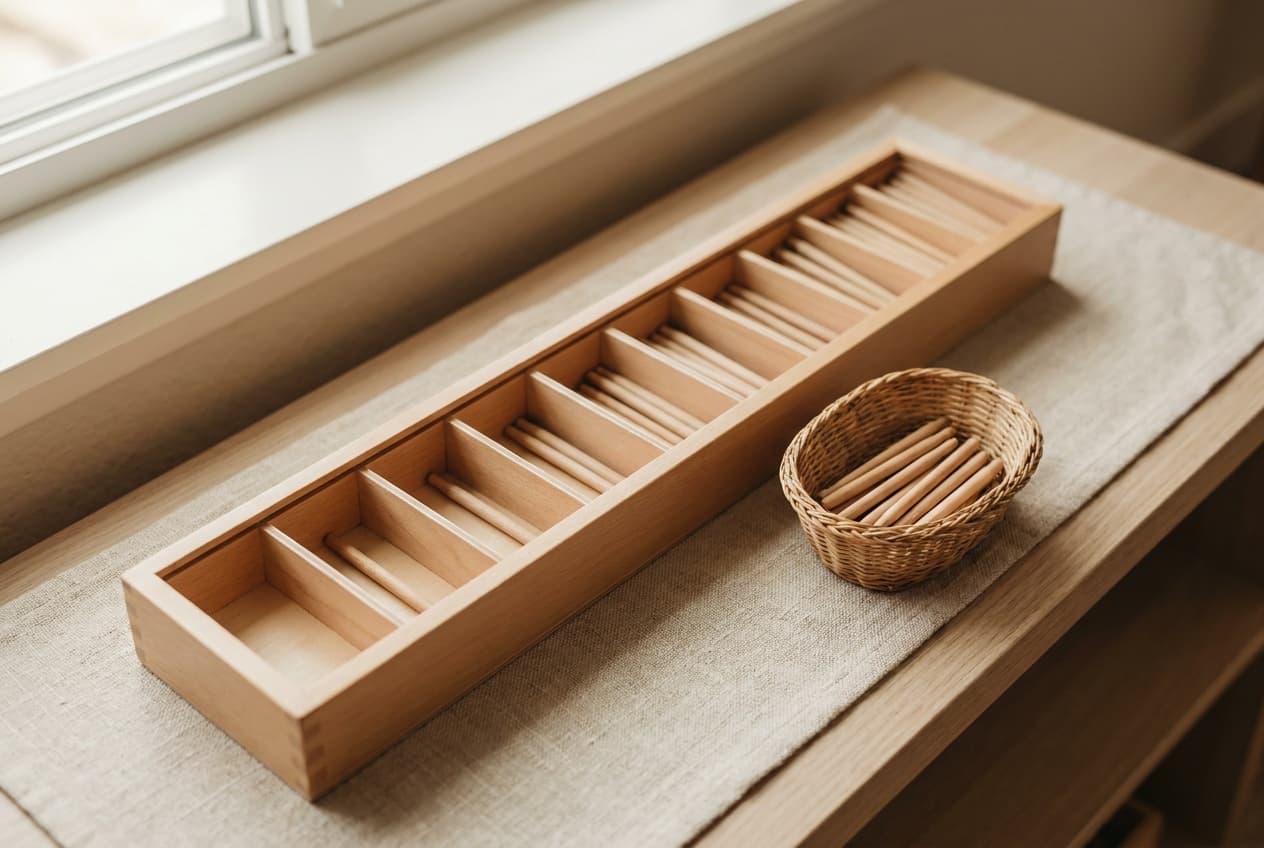
Spindle boxes are ten compartments marked 0 to 9 and a basket of 45 wooden spindles. A child of about 4 reads each numeral, counts that many spindles into its compartment, and finds that 0 gets nothing. Montessori's 1912 version was two trays of five compartments filled with large wooden pegs.
Sourced from the texts, not yet presented at home
| Typical age | 4 to 5.5 years |
|---|---|
| Area | Math |
| Before this | |
| Materials | |
| Direct aim | To count out the quantity a numeral asks for, 0 to 9, and to meet zero as the numeral for nothing. |
| Control of error | The basket. There are 45 spindles and the box takes exactly 45. Spindles left over, or a compartment still waiting when the basket is empty, show a mistake somewhere. |
| Leads to | |
| Time | About 15 minutes (our estimate), most of it counting. |
| Grouping | One child |
| Parent prep | Low. The box, the basket of 45 spindles, and nine ribbons or hair ties if you use them. |
| Cost | Buy about $45 to $139. Make: easy to make at home. |
| Other names | Spindle box, Counting boxes, The zero lesson |
What the work teaches
Direct aim. To count out the quantity a numeral asks for, 0 to 9, and to meet zero as the numeral for nothing.
Indirect aims, the ones you will not see at once
- Counting loose things one at a time, after the number rods where each quantity was one piece
- Zero as a numeral with a place in the line
- Preparation for the cards and counters and the golden beads
- Self-checking: the spindles come out exactly even
Set it out before you invite the child
A long box with ten compartments marked 0 to 9, or two boxes, 0 to 4 and 5 to 9. The Montessori Room's long box is 53 by 18 by 7 cm.
45 spindles in a basket, because 0 + 1 + 2 and so on up to 9 makes 45. The Montessori Room lists them at 15 cm long.
Nine ribbons or small hair ties, so each group can be bundled before it goes in. Many albums use them; Montessori's books don't mention them.
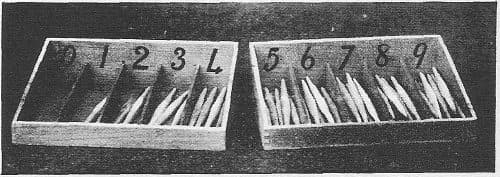
Montessori's 1912 version was two trays of five compartments each, with a card at the back of every compartment, 0 to 4 and 5 to 9, and large wooden pegs shaped so they wouldn't roll off the desk.
Presentation, step by step
- 1Set the box on the table with 0 at the left, and the basket of spindles beside it.
- 2Pass over 0 for now. Point to 1, say "one", take one spindle and lay it in the compartment.
- 3Point to 2. Count two spindles into your other hand, "one, two", tie them with a ribbon, and lay them in.
- 4Go on to 9 the same way, counting every spindle aloud.
- 5When the basket is empty, point to 0. If the child asks what goes there, say "Nothing. Zero is nothing."
- 6Count the spindles back into the basket, group by group, and invite the child to fill the box.
Details that hold the child's attention
The empty basket at the end, with not one spindle over.
Compartment 0 staying empty while all the others fill.
Tying a bundle: a handful of spindles held as one amount.
Montessori's game of "Come to me zero times", and the child working out that it means staying put.
How the child sees a mistake
The basket. There are 45 spindles and the box takes exactly 45. Spindles left over, or a compartment still waiting when the basket is empty, show a mistake somewhere.
The words come after the hands
| Words | Shown with |
|---|---|
| zero | Nothing: the compartment that stays empty. |
| spindle | One of the wooden sticks. |
| compartment | Each section of the box. |
| how many | The question each numeral asks. |
The three-period lesson, scripted
You need the compartments marked 0 and 1, once the box is filled.
| Period | What you do and say |
|---|---|
| 1. Naming | Point to 0: "This is zero. Zero is nothing." Point to 1: "This is one." |
| 2. Recognition | "Show me zero." "Show me the compartment with one." |
| 3. Recall | Point to 0 and ask "What is this?" |
Montessori waited for the child to ask what goes in the 0 compartment, answered "Nothing; zero is nothing", and then played games until the idea held.
Extensions and variations
- Montessori's zero games: "Come to me zero times", "Throw me zero kisses"
- Her memory game: each child draws a folded numeral, keeps it secret, fetches that many objects and lays them out in columns of two; whoever draws zero takes nothing
- Cards and counters: numerals 1 to 10 in a row, counters laid beneath in pairs, which shows odd and even
- Filling the compartments out of order, 7 then 3 then 9
- The golden beads, the step into the decimal system
Variations
- Two short boxes, 0 to 4 and 5 to 9, as in Montessori's 1912 trays
- Craft sticks or new pencils in place of spindles
Make it or buy it
| Material | Make it | Buy, approx. |
|---|---|---|
| Spindle Boxes | Easy | $45 to $139 |
Prices noted . Approximate US street prices for home-use versions; they vary by maker and change often, so recheck before buying.
Making it at home
An egg carton or ten small dishes labeled 0 to 9, and 45 craft sticks in a basket. Count the sticks before every lesson.
What to check when buying a set
One long box or two short ones work the same. Check that the set has exactly 45 spindles, since the count is the control.
Printables for this age
This work needs only the material, so it has no printable of its own. The shelf plan below places it among the other works for the same age.
- Shelf plan for age 4PDF, 1 page, 248 KBEvery work for this age on one page, in order, with a column to date each presentation.
Every printable for one age, by email
The shelf plan and the lesson printables for your child's age in one email, then three short emails on the first lesson, what to make or buy, and what comes next.
Signs the child is ready, and signs it is done
Ready for the first presentation
- Names the sandpaper numerals 0 to 9.
- Counts ten objects, touching each once.
- Names the number rods 1 to 10 in order.
- Sits for fifteen minutes with one material.
Ready for the next lesson
- Fills all ten compartments with nothing left over, without help.
- Explains in their own words why 0 stays empty.
- Counts out any amount up to 9 from a pile on request.
- Plays the memory game holding a secret numeral.
Fitting it into a home, not a classroom
| If you have | Do this |
|---|---|
| A tight budget | An egg carton cut to ten cups, marked 0 to 9, and 45 craft sticks make a working set. |
| Two children | Play Montessori's memory game with folded numerals. Whoever draws zero sits still while the other fetches, which she found was the hardest part. |
| A child who counts too fast | Have them say each number as the spindle drops in, not before. |
| A toddler sibling | Spindles are too long to swallow but good for poking. Keep them at the table, and put the basket up high afterward. |
When it does not go to plan
| When | Try this |
|---|---|
| Spindles are left over at the end. | Let the child find it. Ask them to count each compartment again until the extra turns up. |
| The child puts a spindle in 0. | Ask what the card says, then wait. Montessori explained only when asked: zero is nothing. |
| The child grabs a handful and guesses. | Show the one-at-a-time count again, a spindle in hand and the number said aloud. |
| Counting goes wrong past 6. | Fill 0 to 5 for a few days, then the rest. |
Hazards to check before each session
Check the spindle ends on a new set and sand any splinter.
Keep spindles at the table. A 15 cm stick near a younger child's eyes is a risk.
Where other sequences and standards place it
We have not bought the paid homeschool curricula, so they are not listed here.
| Framework | Where it sits |
|---|---|
| This site's Math sequence | Lesson 4 of 12 published, after Sandpaper Numerals, before Golden Beads: Introduction to the Decimal System and Cards and Counters: Odd and Even. Checked in: the scope and sequence |
| Montessori, The Montessori Method (1912) | Exercises with numbers, straight after the sandpaper figures: two trays of five compartments with cards 0 to 9 and large wooden pegs, then the lesson on zero. Checked in: Chapter XIX, Teaching of Numeration |
| Montessori, Dr. Montessori's Own Handbook (1914) | Arithmetic: a box divided into compartments, each with a printed figure, filled with pegs; the 0 compartment takes nothing. Checked in: Arithmetic, Fig. 41 |
| Common Core, Kindergarten math | K.CC.A.3: represent a number of objects with a written numeral 0 to 20, with 0 representing a count of no objects. That last clause is the zero compartment. Checked in: tasks.illustrativemathematics.org |
| Head Start Early Learning Outcomes Framework, preschool | P-MATH 3: the child understands the relationship between numbers and quantities. Checked in: www.in.gov |
Spindle boxes: questions parents ask
What is the spindle box in Montessori?
A box of ten compartments marked 0 to 9 and a basket of loose wooden spindles. The child reads each numeral and counts that many spindles in. It turns the numeral into a request for a quantity, and it's where zero is taught.
Why are there 45 spindles?
Because 0 + 1 + 2 + 3 + 4 + 5 + 6 + 7 + 8 + 9 = 45. With exactly that many, the box checks itself: nothing should be left over and no compartment short.
What age is the spindle box for?
About 4, after the sandpaper numerals, and on this site up to 5.5. Montessori gave her trays once the child recognized the written figures.
How do I teach zero?
Wait for the question. Montessori answered "Nothing; zero is nothing" when a child asked what went in the 0 compartment, then played games such as "Come to me zero times" until the children laughed and stayed in their seats.
Sources cited by book and chapter
- Maria Montessori, The Montessori Method (1912)
Chapter XIX, Teaching of Numeration
Two trays each divided into five compartments, with a card bearing a figure at the back of each, 0 to 4 and 5 to 9; the child places the corresponding number of objects, chiefly large wooden pegs that will not roll.
When the child has finished arranging the pegs he takes his tray to the directress so that she may verify his work.
In the lesson on zero the teacher waits until the child, pointing to the zero compartment, asks what to put in it, and replies, Nothing; zero is nothing.
Games such as come to me zero times, or throw me zero kisses, make the children feel what nothing means until they cry out that zero is nothing.
Chapter XIX, Exercises for the Memory of Numbers
In the memory game children draw folded figures, keep them secret, collect that number of objects and arrange them in columns of two, the odd piece at the bottom.
The child who draws zero must stay in his place while his companions take objects, so the game is an exercise of will power more than of numeration.
- Maria Montessori, Dr. Montessori's Own Handbook (1914)
Arithmetic, Fig. 41
The box in the material is divided into compartments, above each of which a figure is printed, and the child places in each compartment the corresponding number of pegs.
Arithmetic
In the box containing the pegs one compartment is marked 0, inside which nothing must be put, and then we begin with one.
Reviewed by
What to offer next
Once the child chooses this work unprompted and finishes it without help, the next lesson to prepare is Golden Beads: Introduction to the Decimal System.
- Sandpaper Numerals3.5 to 5 years
- Golden beads4 to 5.5 years
- Spindle boxes4 to 5.5 years
- Teen boards4 to 6 years
- Cards and counters4 to 5.5 years