Golden Beads: Introduction to the Decimal System
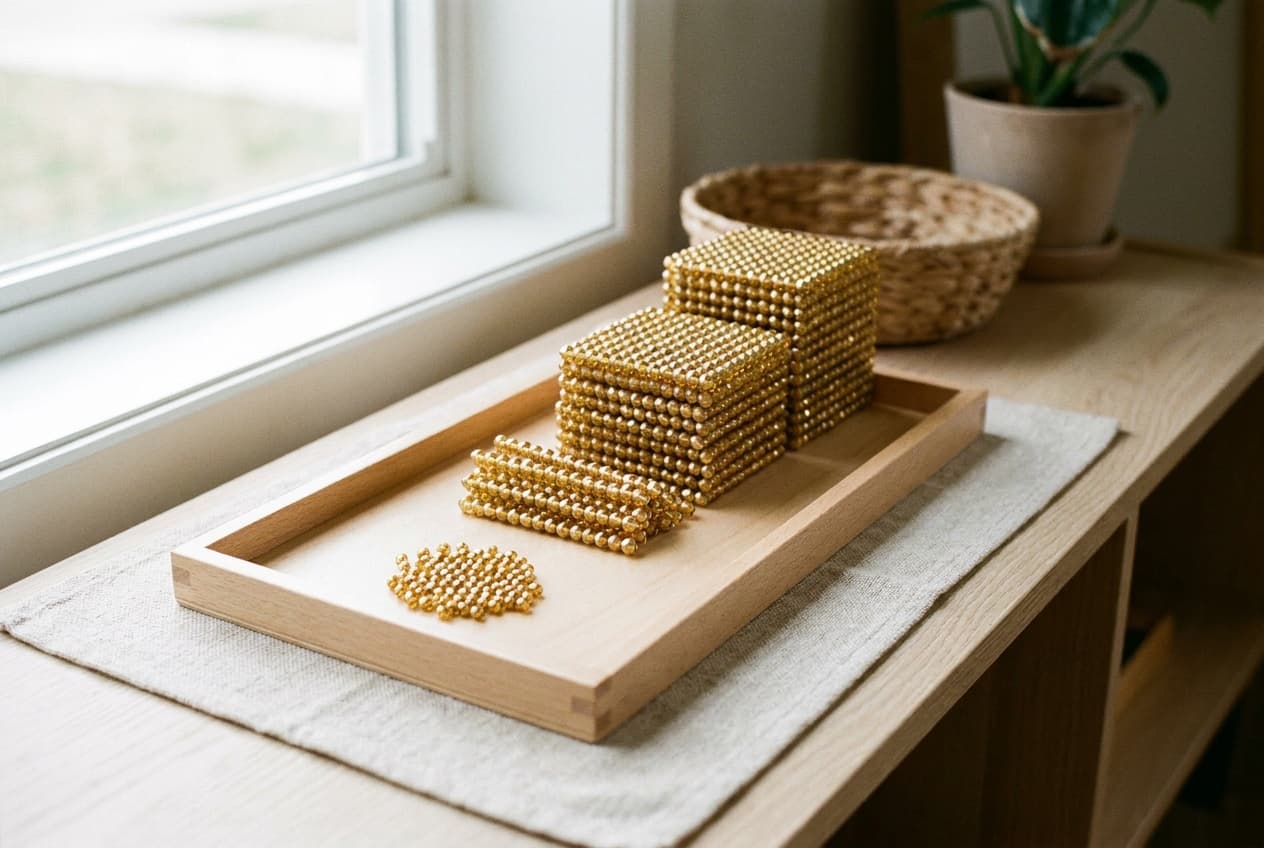
Golden beads show a child what one, ten, a hundred and a thousand look like: a single bead, a bar of 10 beads, a square of 100 and a cube of 1,000. The child holds each one, counts how ten of one make the next, and learns the four names. Most start at about 4, after the number rods.
Sourced from the texts, not yet presented at home
| Typical age | 4 to 5.5 years |
|---|---|
| Area | Math |
| Before this | |
| Materials | |
| Direct aim | To learn the four names, unit up to thousand, and how their sizes compare. |
| Control of error | Comparing size and weight. The categories are visibly and physically different, and counting the parts confirms each name. |
| Leads to | |
| Time | 10 to 15 minutes (our estimate). Most of it is counting, and the counting is the point. |
| Grouping | One child, or two of a similar age |
| Parent prep | Medium. A tray with one unit, one ten bar, one hundred square and one thousand cube, and a rug. |
| Cost | Buy about $55 to $1118. Make: hard to make accurately. |
| Other names | Introduction to the decimal system, Golden bead material, Decimal system: quantity, Bead material |
What the work teaches
Direct aim. To learn the four names, unit up to thousand, and how their sizes compare.
Indirect aims, the ones you will not see at once
- Understanding that ten of one category makes one of the next
- Preparation for place value and the four operations
- Preparation for geometry, since the four pieces run from a point to a cube
- A feel for how fast quantities grow: a thousand beads weigh a thousand times one
Set it out before you invite the child
Unit: one gold bead. Ten bar: ten beads on a wire, about 7 cm long in Montessori's 1917 material.
Hundred square: ten bars wired side by side, so about 7 cm by 7 cm. Thousand cube: ten squares stacked, about 7 cm on every edge.
For the first lesson, one of each on a small tray, with a dish for the unit bead so it can't roll away.
A bank, with many of each, comes later for fetching and exchanging. Some home sets use a solid wooden or plastic cube for the thousands.
Why gold: Montessori's 1917 bars of ten were orange. When war shortages made some colors hard to get, she approved gold for the ten bar and the single bead, and later sets kept it.
Presentation, step by step
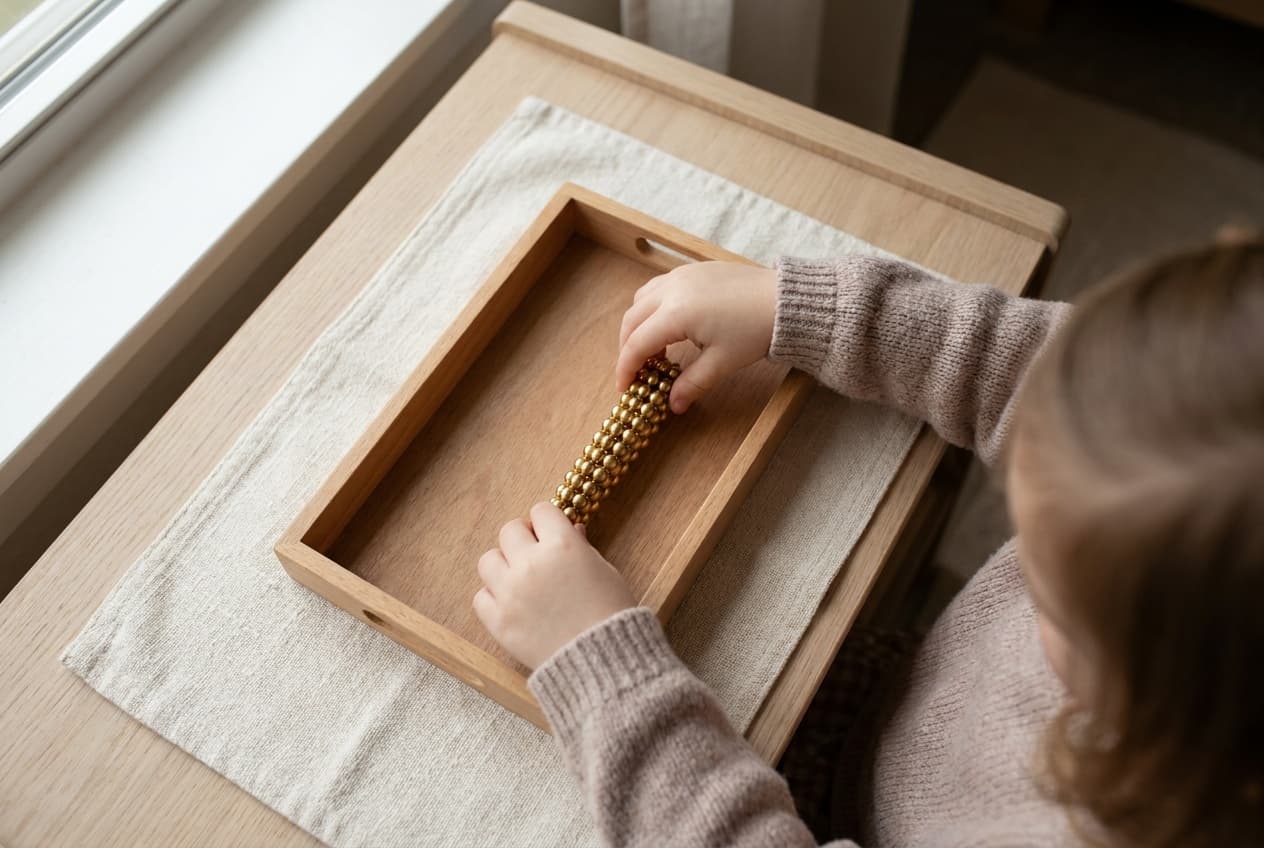
- 1On a tray, bring a single unit bead, a ten bar, a hundred square and a thousand cube to a rug or table.
- 2Hold the unit bead in the child's palm. "This is one unit."
- 3Place the ten bar in the child's hands. Count the beads together. "This is one ten."
- 4Place the hundred square in front of the child and count ten bars along it. "This is one hundred."
- 5Place the thousand cube in front of the child and show it is made of ten hundred squares stacked. "This is one thousand."
- 6Second period: "Show me a hundred. Put the ten in my hand."
- 7Third period: point to each and ask "What is this?"
Details that hold the child's attention
The weight of the thousand in two hands, straight after one bead in a palm.
Ten tens counted along the hundred square, one bar at a time.
Seeing that the cube is just squares stacked, ten of them.
The unit bead, small enough to lose, set beside a cube made of a thousand of it.
The moment a child says it first: Montessori recorded a child counting a chain and shouting that the hundred chain had ten ten-bead bars.
How the child sees a mistake
Comparing size and weight. The categories are visibly and physically different, and counting the parts confirms each name.
The words come after the hands
| Words | Shown with |
|---|---|
| unit | One bead. Use unit rather than one, so the four names match as categories. |
| ten | The bar of ten beads. |
| hundred | The square of ten bars. |
| thousand | The cube of ten squares. |
| category | The adult word for the four kinds. Albums use it; the child doesn't need it yet. |
| bank | The tray or box that holds many of each, for later fetching games. |
The three-period lesson, scripted
You need a unit bead, a ten bar, a hundred square and a thousand cube.
| Period | What you do and say |
|---|---|
| 1. Naming | Hand each over in turn: "This is a unit." "This is a ten." "This is a hundred." "This is a thousand." |
| 2. Recognition | "Show me a thousand." "Put the hundred on the rug." "Give me the ten." |
| 3. Recall | Point to each in a new order and ask "What is this?" |
Our suggestion: four names at once is more than the usual two or three. If the child mixes them, drop back to unit and ten, then add hundred and thousand on later days.
Extensions and variations
- Counting out ten units, then trading them for one ten bar
- Fetching quantities from a "bank": "Bring me three hundreds and two tens"
- Matching the beads to the large number cards to build and read numbers
- Counting the hundred chain and the thousand chain, ten bars and a hundred bars joined end to end. The thousand chain is about 7 m long
- Golden bead addition, the start of the four operations
Variations
- Using paper or printed bead cards for the hundreds and thousands when a full bank is not available
Make it or buy it
| Material | Make it | Buy, approx. |
|---|---|---|
| Golden Bead Material | Hard to make accurately | $55 to $1,118 |
| Work Rug | Easy | $10 to $20 |
Prices noted . Approximate US street prices for home-use versions; they vary by maker and change often, so recheck before buying.
Making it at home
Ten bars can be made from beads strung on stiff wire, and hundred squares from ten bars wired together. Making thousand cubes this way is slow, so buying the thousands, or printing them, is the usual shortcut.
What to check when buying a set
Introduction trays are inexpensive, but extended work needs a bank with dozens of tens and hundreds and several thousands. Plastic bead sets are lighter and cheaper than glass.
Printables for this lesson
- Golden bead picture cards and a paper bankPDF, 3 pages, 1.2 MBCards naming the four kinds of bead piece, from unit to thousand. Then real-size hundred squares and thousand cards for a paper bank, when you have only a few bead pieces.
- Golden beads work sheet: quantity to numeralPDF, 1 page, 445 KBEight quantities drawn in bead pieces. The child writes each number in boxes colored like the large number cards.
- Shelf plan for age 4PDF, 1 page, 248 KBEvery work for this age on one page, in order, with a column to date each presentation.
Every printable for one age, by email
The shelf plan and the lesson printables for your child's age in one email, then three short emails on the first lesson, what to make or buy, and what comes next.
Signs the child is ready, and signs it is done
Ready for the first presentation
- Names every number rod and builds tens with them.
- Counts ten objects accurately, touching each once.
- Reads the numerals 1 to 9.
- Asks about big numbers, such as a hundred or a million.
- Sits with one material for 15 minutes.
Ready for the next lesson
- Names all four categories in any order.
- Shows, with any two neighbors, that ten of one make one of the next.
- Fetches "three hundreds, two tens and four units" from a bank without a mistake.
- Asks to write the number down, which is the cue for the large number cards.
Fitting it into a home, not a classroom
| If you have | Do this |
|---|---|
| A tight budget | Buy an introduction tray, about one of each, and print the hundreds and thousands on card for the bank. Units and tens are the ones a child needs to handle in quantity. |
| An older and a younger child | The older one keeps the bank and fills the younger one's orders. Montessori's children counted the chains together in small groups. |
| A small table | The introduction fits on a tray. Only the thousand chain needs a hallway. |
| A child under 4 who wants the beads | Let them handle the bars and squares with you there. Loose unit beads stay in the dish. |
| No golden beads at all | Craft beads threaded on pipe cleaners make ten bars, and ten bars taped side by side make a hundred. A thousand is the slow part; a card cube drawn as ten squares will do for a start. |
When it does not go to plan
| When | Try this |
|---|---|
| The child counts every bead, every time. | Let them. Montessori saw children count the thousand chain bead by bead, mark their place when tired, and come back the next day. |
| The thousand gets called "the big cube". | Name it again in the first period on another day. A pet name for a quantity is common at first. |
| Unit beads go missing. | Keep them in a small dish on the tray, and count them back in with the child. |
| The child wants to pull a hundred square apart. | Show instead how ten loose bars, laid side by side, make the same square. |
Hazards to check before each session
A loose unit bead is about 7 mm across: choking-size for a younger sibling. Keep the dish on the tray and the tray off the floor.
Check wire ends on homemade or worn bars. A sharp end catches a finger.
Where other sequences and standards place it
We have not bought the paid homeschool curricula, so they are not listed here.
| Framework | Where it sits |
|---|---|
| This site's Math sequence | Lesson 3 of 12 published, after Number Rods and Spindle Boxes: Counting 0 to 9, before Stamp Game: Static Addition and Teen Boards (Seguin Board A). Checked in: the scope and sequence |
| Montessori, The Montessori Elementary Material (1917) | Bead bars of 1 to 10, the hundred and thousand chains, and bead squares and cubes, followed by the counting frame. Montessori reports the bars working with children of five and a half. Checked in: Part III, Arithmetic |
| Common Core, Grade 1 math | 1.NBT.B.2: understand that the two digits of a two-digit number represent amounts of tens and ones; 10 can be thought of as a bundle of ten ones. Checked in: tasks.illustrativemathematics.org |
| Common Core, Grade 2 math | 2.NBT.A.1: a three-digit number is an amount of hundreds plus tens plus ones, and 100 is a bundle of ten tens. 2.NBT.A.3: read and write numbers to 1000. Children often meet the golden beads two to three years before second grade. Checked in: tasks.illustrativemathematics.org |
Golden beads: questions parents ask
What do the golden beads symbolize?
Each piece is the quantity it names: one bead is one, a bar is ten, a square is a hundred, a cube is a thousand. Nothing stands in for anything else. The shapes also run point, line, square, cube, which is why albums describe the material as a preparation for geometry.
What is the purpose of golden beads in Montessori teaching?
To give the decimal system a body before it gets digits. Montessori wrote that the symbols of the counting frame come more easily to a child who has first counted the bead chains without being hurried. Ten of one making one of the next is then something he has handled.
When to introduce golden beads?
After the number rods, once the child counts ten objects accurately. On this site that's from about 4. Montessori's 1917 book reports the bead bars working with children of five and a half; later albums moved the introduction earlier.
Do I need a full golden bead bank?
Not for the introduction. One of each is enough to learn the names. The bank, with enough units and tens to exchange, matters once addition starts, and printed hundreds and thousands cut the cost.
Sources cited by book and chapter
- Maria Montessori, The Montessori Elementary Material (1917)
Part III, Numbers 1 to 10
Bead bars strung on wire represent 1 to 10, each number a different color, the ten-bead bar orange, and the material succeeded with children of five and a half years.
Part III, Arithmetic
Ten ten-bead bars joined end to end make the hundred chain and ten hundred chains make the thousand chain; the ten-bead bar is about seven centimeters long, the hundred chain about seventy, the thousand chain about seven meters.
Children counting the thousand chain discovered for themselves that it has ten hundred chains and that the hundred chain has ten ten-bead bars.
Two bead bars of two can be joined in a chain or in the form of a square, and if as many bars as there are beads on a bar are placed side by side they form a square.
A cube of the beads is formed by placing as many bead squares one on top of the other as there are units in the number, ten squares for 10.
Part III, Footnotes
Because of war conditions, Dr. Montessori approved gold for the 10 bead bar and the single bead in place of the original colors, and the same colors are kept for the bead squares and cubes.
Part III, Counting-frames
On the counting frame each bead of the second wire stands for ten, of the third for a hundred and of the fourth for a thousand, and ten beads of one wire equal one bead of the next.
- Maria Montessori, The Montessori Method (1912)
Chapter XIX, Lessons on Decimals
Almost all the children count to 100, a number given to them in response to the curiosity they showed about it.
- Maria Montessori, Dr. Montessori's Own Handbook (1914)
Arithmetic
Zero is placed next to one to count beyond nine, and frames hold cards of 10 to 90 whose zero can be covered by the figures 1 to 9.
Reviewed by
What to offer next
Once the child chooses this work unprompted and finishes it without help, the next lesson to prepare is Stamp Game: Static Addition.
- Number Rods3.5 to 5 years
- Sandpaper Numerals3.5 to 5 years
- Golden beads4 to 5.5 years
- Spindle boxes4 to 5.5 years
- Teen boards4 to 6 years