Number Rods
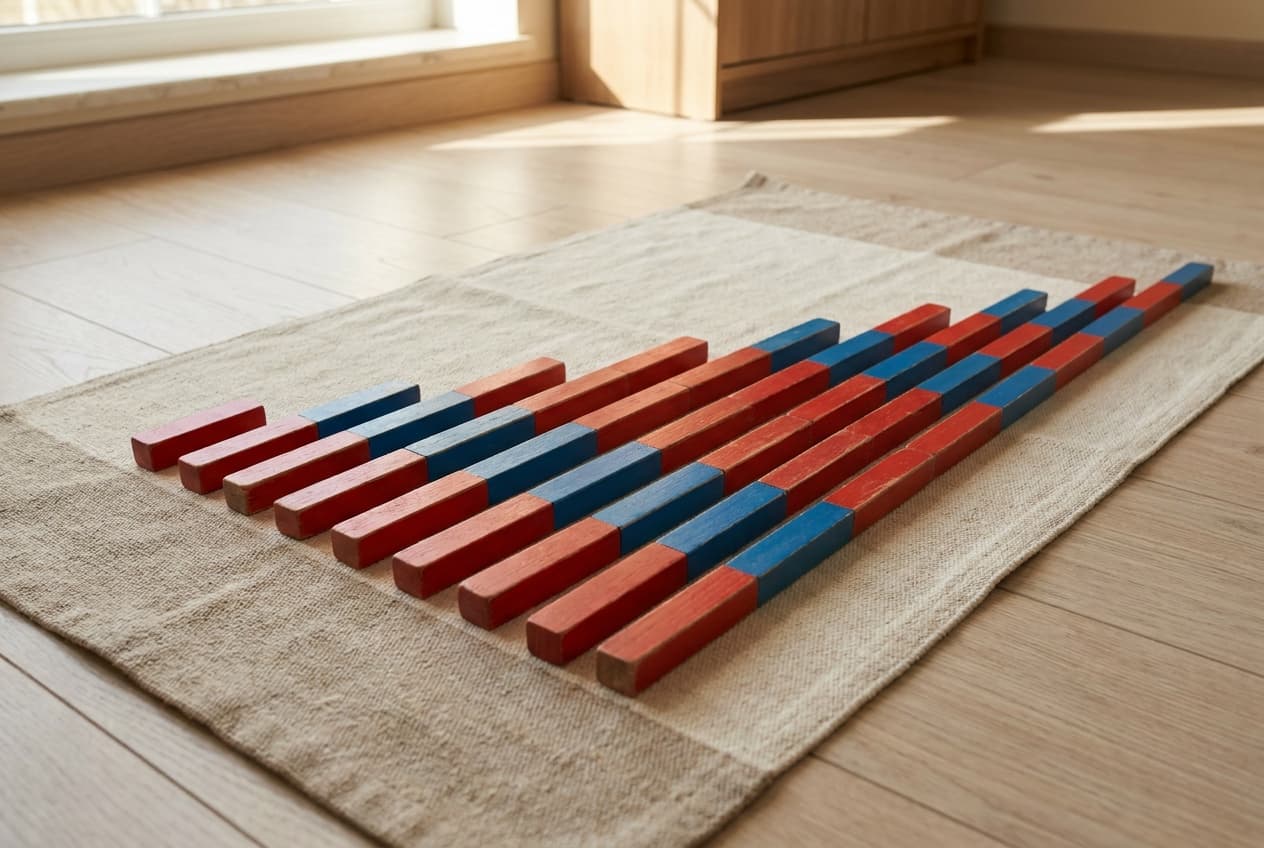
Number rods are ten wooden rods from 10 cm to 1 meter, painted in alternating red and blue 10 cm sections, so a child can carry "seven" as one object and count its parts. They come at about 3.5 to 4, after the long rods of Sensorial. Montessori built her first arithmetic on them.
Sourced from the texts, not yet presented at home
| Typical age | 3.5 to 5 years |
|---|---|
| Area | Math |
| Before this | |
| Materials | |
| Direct aim | To learn the names of the quantities one to ten and their sequence, with each quantity held as a single whole. |
| Control of error | Counting the segments. If a rod is named wrongly, counting it shows the true quantity, and in the stair a misplaced rod breaks the steps. |
| Leads to | |
| Time | About 10 minutes for the first three rods (our estimate). The other seven come over later sessions. |
| Grouping | One child, or two taking turns to fetch |
| Parent prep | Medium. A long rug or a clear stretch of floor at least 1.2 m long. |
| Cost | Buy about $64 to $204. Make: hard to make accurately. |
| Other names | Numerical rods, Red and blue rods |
What the work teaches
Direct aim. To learn the names of the quantities one to ten and their sequence, with each quantity held as a single whole.
Indirect aims, the ones you will not see at once
- Preparation for addition, subtraction and the idea of ten
- Coordination in carrying long objects
- Order and sequence
- The teens, built later by laying a short rod after the 10
Set it out before you invite the child
Ten rods: 10, 20, 30 and so on up to 100 cm long, each divided into 10 cm sections painted red and blue in turn. Most sets begin every rod with red, so the reds line up at one end.
Montessori gave the cross-section as 3 cm square in 1912 and 4 cm in 1914. Current sets vary; any section works if every rod shares it.
Laid end to end, the ten rods measure 5.5 m. Built as a stair they need a rug at least 1.2 m long.
A set of numeral cards 1 to 10, or sandpaper numerals, kept aside for the later lesson that matches figures to rods.
Presentation, step by step
- 1A child usually builds the plain red rods (the long stair) in Sensorial before this lesson. Unroll a long rug and carry the rods one at a time, holding the longer rods at both ends.
- 2Arrange the rods in a stair, longest to shortest, with the red ends aligned on the left.
- 3Take the 1 rod and place it in front of the child. "This is one." Take the 2 rod and count its segments, touching each: "One, two. This is two." Do the same with the 3 rod.
- 4Second period, recognition: "Show me two. Put three by the window. Give me one."
- 5Third period, recall: point to a rod and ask "How many is this?"
- 6In later sessions, continue in groups of three until all ten rods are named.
Details that hold the child's attention
The 10 rod, a full meter, about as tall as a four-year-old.
Laying the 1 after the 9 and finding it exactly as long as the 10.
Turning the 5 end over end along the 10: two fives make ten.
The stripes lining up across the stair when every red end is on the same side.
How the child sees a mistake
Counting the segments. If a rod is named wrongly, counting it shows the true quantity, and in the stair a misplaced rod breaks the steps.
The words come after the hands
| Words | Shown with |
|---|---|
| one to ten | The names of the rods, given as names of whole objects. |
| rod | Each piece. |
| how many | The question the rods answer. |
| longer, shorter | Words the child already has from the red rods. |
| ten | The longest rod, and the number every pair in the making-ten game reaches. |
The three-period lesson, scripted
You need rods 1, 2 and 3, laid in front of the child.
| Period | What you do and say |
|---|---|
| 1. Naming | Point to each: "This is one." "This is two." "This is three." Touch the sections as you count: "One, two: this is two." |
| 2. Recognition | "Give me two." "Give me one." "Give me three." |
| 3. Recall | Point to a rod and ask "What is this?" When the child answers "Three", count it together: "One, two, three." |
These are Montessori's own words for the lesson. She taught the rest of the rods in order, adding one or two at a time according to how the child responded.
Extensions and variations
- Matching numeral cards 1 to 10 to the rods
- Making ten by combining rods: 9 and 1, 8 and 2, 7 and 3
- Taking the tens apart again: 10 less 4 is 6, and so on, which is subtraction
- Teens: the 10 rod with the 6 rod after it is sixteen, matched to a 10 card with a 6 laid over the zero
- Simple addition and subtraction with the rods
Variations
- Small table-top number rods for families without floor space
Make it or buy it
| Material | Make it | Buy, approx. |
|---|---|---|
| Number Rods | Hard to make accurately | $64 to $204 |
| Work Rug | Easy | $10 to $20 |
Prices noted . Approximate US street prices for home-use versions; they vary by maker and change often, so recheck before buying.
Making it at home
A home version can be painted on 2.5 cm square dowel cut to 10 cm increments, alternating red and blue every 10 cm. Keep the colors and lengths exact.
What to check when buying a set
Full-size rods need a long rug and floor space. Small-scale sets are available and are easier to store but give less sense of size.
Printables for this lesson
- Numeral cards 1 to 10PDF, 1 page, 101 KBTen cards with large numerals, sized to lay at the end of each rod for the matching lesson.
- Table-top number rods to cut outPDF, 1 page, 109 KBAll ten rods at one fifth of real size, in 2 cm sections of red and blue, laid out in the pairs that make ten. Glue the sheet to card and cut.
- Number rods work sheet: quantity to numeralPDF, 2 pages, 120 KBTwo pages for after the rods are named: match each drawn rod to its numeral, then count the sections and write the number.
- Shelf plan for age 3PDF, 1 page, 250 KBEvery work for this age on one page, in order, with a column to date each presentation.
Every printable for one age, by email
The shelf plan and the lesson printables for your child's age in one email, then three short emails on the first lesson, what to make or buy, and what comes next.
Signs the child is ready, and signs it is done
Ready for the first presentation
- Builds the red rods (long stair) into an even stair. Montessori found it the hardest of the three dimension materials.
- Counts aloud from one to ten in order.
- Carries a 1 m rod across the room without swinging it.
- Points to one object per number when counting a small group.
Ready for the next lesson
- Names any rod on sight, then confirms it by counting.
- Places numeral cards on the right rods.
- Makes ten with every pair, 9 and 1 through 6 and 4, and shows the 5 turned over.
- Builds sixteen or nineteen with the 10 rod and a short one.
Fitting it into a home, not a classroom
| If you have | Do this |
|---|---|
| No floor space | Table-top rods, or strips of card 2 cm wide cut to 2 to 20 cm and colored in 2 cm sections, keep the idea at a fifth of the size. |
| Two children | One builds the stair, the other fetches: "Bring me seven." Montessori's game of fetching from a distance works the same way here. |
| A child who already counts to 100 | Still start with three rods. Rote counting and knowing that seven is one quantity are different skills, and the rods teach the second. |
| No red rods | Skip them and present the number rods as a stair first. Montessori's own number rods were the long stair with stripes added. |
When it does not go to plan
| When | Try this |
|---|---|
| The child counts the sections but can't say the rod's name. | Count, then name: "One, two, three. This is three." The name of the whole comes after the count, every time, until it sticks. |
| Counting skips or doubles a section. | Count together, your finger guiding theirs onto each section. Slow down rather than correcting. |
| Rods get swung like swords. | End the turn calmly and put the rods away together. Show the two-hand carry again next time. |
| Interest fades by rod 6. | Stop there. Montessori taught the rest over later lessons, one or two at a time. |
Hazards to check before each session
A 1 m rod swung at child height reaches faces. Carry rods level, close to the body, and keep younger siblings off the rug.
Rods left on the floor trip people. They go back on the shelf before the next work comes out.
Where other sequences and standards place it
We have not bought the paid homeschool curricula, so they are not listed here.
| Framework | Where it sits |
|---|---|
| This site's Math sequence | Lesson 1 of 12 published, after Brown Stair (Broad Stair) and Red Rods (Long Rods), before Golden Beads: Introduction to the Decimal System and Sandpaper Numerals. Checked in: the scope and sequence |
| Montessori, The Montessori Method (1912) | Fourth grade of the sequence: the long stair is brought back with a new aim, counting its red and blue sections from one to ten. Checked in: Chapter XX, Sequence of Exercises; Chapter XIX, Teaching of Numeration |
| Montessori, Dr. Montessori's Own Handbook (1914) | The start of arithmetic: the long rods, divided into red and blue sections, taught in three periods and then matched to sandpaper figures. Checked in: Arithmetic |
| Common Core, Kindergarten math | K.CC.B.5: count to answer "how many?" for up to 20 things in a line. K.OA.A.4: for any number from 1 to 9, find the number that makes 10, which is the making-ten game with the rods. Checked in: tasks.illustrativemathematics.org |
| Head Start Early Learning Outcomes Framework, preschool | P-MATH 3: the child understands the relationship between numbers and quantities. Checked in: www.in.gov |
Number Rods: questions parents ask
What is the Montessori method for mathematics?
Quantity first, in objects the child can hold, then the written figure, then the two together. Montessori's argument for the rods was that seven, as one rod with seven parts, is clearer than seven loose beans the child must hold together in their head.
What is the order of math lessons in Montessori?
On this site: number rods for one to ten, then the golden beads for the decimal system, then the stamp game for adding four-digit numbers. Sandpaper numerals, the teen boards and the bead chains fill in between; those lessons aren't on the site yet.
Do I need the red rods before the number rods?
They help. Montessori's number rods were the long stair with red and blue stripes added, and she found the long stair the hardest of her dimension materials. A child who can build it already knows the rods by length.
Sources cited by book and chapter
- Maria Montessori, Dr. Montessori's Own Handbook (1914)
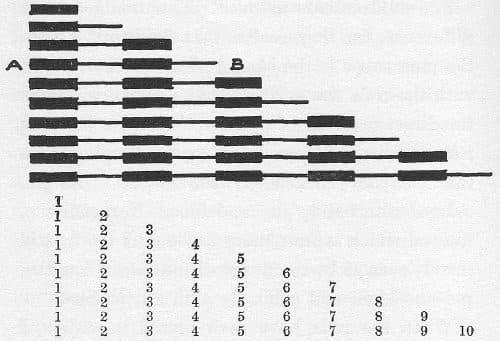
Arithmetic, Fig. 40
For number, the long rods are divided into ten-centimeter spaces colored alternately red and blue, and the first three rods are taught in three periods: "This is one", "Give me two", "What is this?".
Arithmetic
A rod is one object made of equal parts that can be counted, so adding 8 and 2 means placing two rods together, while eight marbles and two marbles leave the child to hold the group of eight together in his mind.
Laying rod 1 beside 9, 2 beside 8, 3 beside 7 and 4 beside 6 makes rods all as long as the longest; putting them back is a series of subtractions.
Sandpaper figures from one to nine are touched in the direction of writing and then placed on the corresponding rods arranged in gradation.
- Maria Montessori, The Montessori Method (1912)
Chapter XIII, Education of the Sense of Vision
Ten rods with faces of 3 centimetres, the first a metre long and the last a decimetre, each decimetre painted alternately red or blue, arranged like organ pipes.
Chapter XX, Sequence of Exercises
The children are attracted by the long stair but make the most errors with it, and arrange it perfectly only after the cubes and prisms.
Chapter XIX, Addition and Subtraction From One to Twenty
Five, turned end over end along ten, shows that two times five makes ten.
Chapter XIX, Lessons on Decimals
Rod 10 with rod 6 placed after it makes sixteen, shown with a card of 10 and a card of 6 laid over its zero.
- Maria Montessori, The Montessori Elementary Material (1917)
Part III, Numbers 1 to 10
The rods of the long stair are too few and too large for a room full of children, so smaller bead bars of 1 to 10 were prepared on the same principle.
Reviewed by
What to offer next
Once the child chooses this work unprompted and finishes it without help, the next lesson to prepare is Golden Beads: Introduction to the Decimal System.
- Number Rods3.5 to 5 years
- Sandpaper Numerals3.5 to 5 years
- Golden beads4 to 5.5 years
- Spindle boxes4 to 5.5 years
- Teen boards4 to 6 years