Brown Stair (Broad Stair)
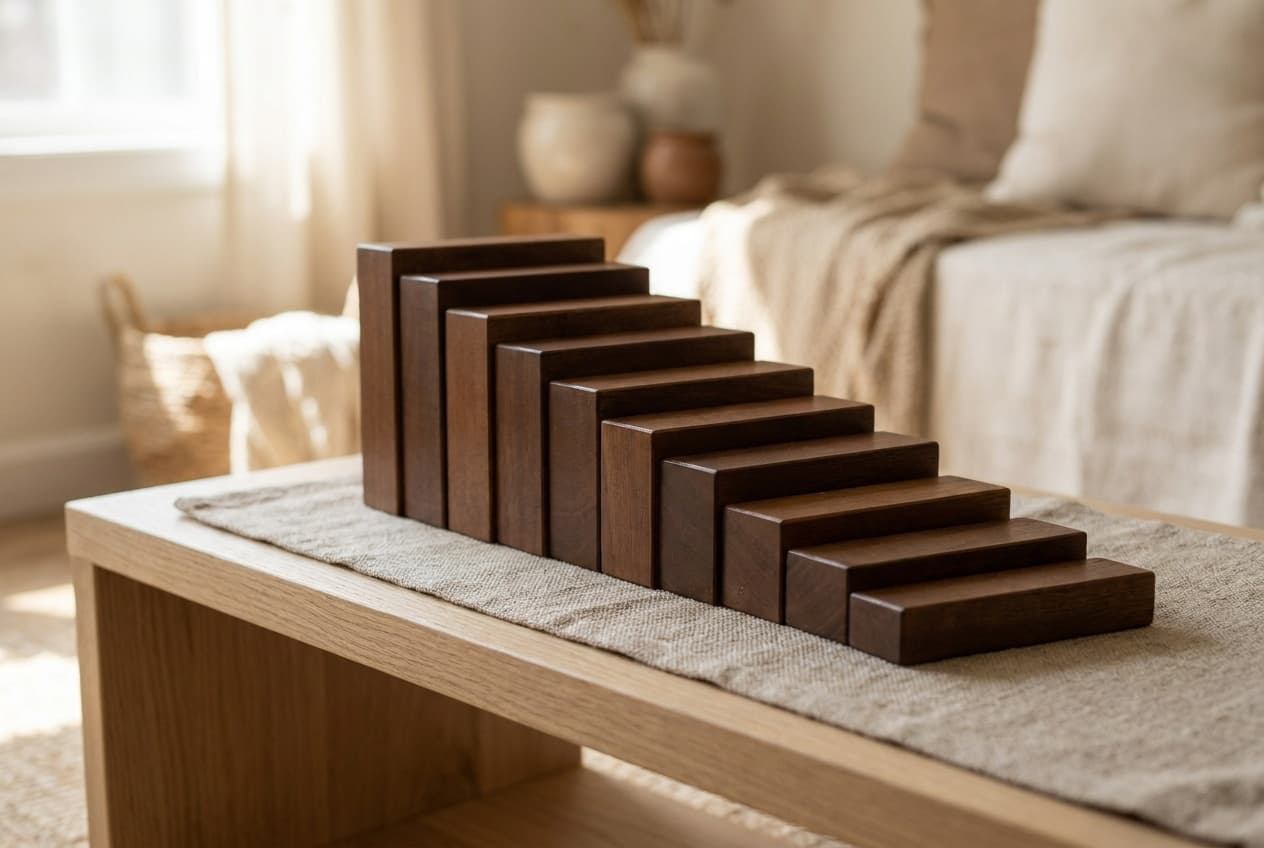
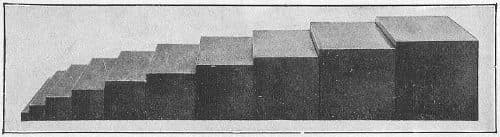
The brown stair is ten brown wooden prisms, each 20 cm long, with square ends from 1 cm to 10 cm. A child lays them side by side from thickest to thinnest, and they step down like a staircase. It comes after the pink tower, at around 2.5 to 4, and trains the eye to judge thickness.
Sourced from the texts, not yet presented at home
| Typical age | 2.5 to 4.5 years |
|---|---|
| Area | Sensorial |
| Before this | |
| Materials | |
| Direct aim | To discriminate differences in two dimensions (width and height), while length stays constant. |
| Control of error | Visual. A prism out of order breaks the even run of steps, leaving a high step behind which the next one drops, which the child can see and feel by running a hand along the stair. Montessori called this a looser control than the cylinder blocks give. |
| Leads to | |
| Time | About 10 minutes to present (our estimate). Ten carries, and the thickest takes two hands. |
| Grouping | One child |
| Parent prep | Low. A light-colored rug beside the shelf. |
| Cost | Buy about $88 to $203. Make: hard to make accurately. |
| Other names | Broad stair, Big stair, Brown prisms |
What the work teaches
Direct aim. To discriminate differences in two dimensions (width and height), while length stays constant.
Indirect aims, the ones you will not see at once
- Coordination of movement in carrying and placing heavier objects
- Vocabulary for thickness, from thick and thin to thickest and thinnest
- Indirect preparation for squares of numbers and geometry
- A second series of ten after the tower, with the same 1 cm step
Set it out before you invite the child
Ten prisms, all 20 cm long, with square ends of 1, 2, 3 and so on up to 10 cm on a side. Montessori stained hers dark brown.
The thickest prism is 10 by 10 by 20 cm, 2,000 cubic centimeters of solid wood. In beech that comes to well over a kilogram, heavier than a liter of water.
Each square end matches a face of the pink tower cube of the same number, which is why the two pair so well.
A light-colored rug, so the dark brown shows clearly. Montessori asked for a light carpet.
On the shelf, keep the prisms in order, thickest at the bottom or at the back, so the child starts from a finished stair.
Presentation, step by step
- 1Unroll a work rug. Carry the prisms one at a time, the largest with both hands, and place them randomly on the rug.
- 2Choose the thickest prism and place it at the left of the rug, lengthwise toward you.
- 3Find the next thickest and place it beside the first, edges aligned at the end nearest you.
- 4Continue until the stair is complete. Run your hand down the steps, from thickest to thinnest.
- 5Show the 1 cm step: use the thinnest prism to step down each level of the stair.
- 6Mix the prisms and invite the child to build the stair.
Details that hold the child's attention
The thinnest prism walking down the stair, one 1 cm step at a time.
The weight of the thickest prism after the light ones.
A hand run down the stair, bumping over each step.
Standing the stair next to the pink tower and finding the cube that matches each end.
How the child sees a mistake
Visual. A prism out of order breaks the even run of steps, leaving a high step behind which the next one drops, which the child can see and feel by running a hand along the stair. Montessori called this a looser control than the cylinder blocks give.
The words come after the hands
| Words | Shown with |
|---|---|
| thick, thin | The thickest and thinnest prism, given first as a pair. |
| thicker, thinner | Any two prisms side by side. |
| thickest, thinnest | The ends of the series, used when the child picks from the scattered pile. |
| prism | The shape. Name it later, with the geometric solids. |
| stair | The finished arrangement. |
The three-period lesson, scripted
You need the thickest and the thinnest prism, once the child builds the stair on their own.
| Period | What you do and say |
|---|---|
| 1. Naming | Hold up the thickest: "This is thick." Then the thinnest: "This is thin." Say each a few times, then pause. |
| 2. Recognition | "Give me the thick one." "Give me the thin one." Change the order and ask again. |
| 3. Recall | Point and ask "What is this?" The child answers "Thick" or "Thin." |
After the three periods, Montessori scattered the prisms on the carpet and asked for "the thickest of all", laying each choice on a table next to the last. The superlative becomes a way to build the stair.
Extensions and variations
- Building the stair vertically, standing prisms on end
- Matching the brown stair with the pink tower cubes, which share the same cross-sections
- Fetching a prism from across the room on request
- "Give me the thickest of all", repeated until the stair is built on a table
- Measuring and computing the volume of each prism, years later. Montessori's older children did this with a ruler
Variations
- Three-period lesson with thick and thin, then the comparative and superlative forms
Make it or buy it
| Material | Make it | Buy, approx. |
|---|---|---|
| Brown Stair | Hard to make accurately | $88 to $203 |
| Work Rug | Easy | $10 to $20 |
Prices noted . Approximate US street prices for home-use versions; they vary by maker and change often, so recheck before buying.
Making it at home
The prisms are 20 cm long with square cross-sections from 1 cm to 10 cm. Making them from solid timber is possible for a confident woodworker, but accuracy matters.
What to check when buying a set
Buying it together with the pink tower is common, since the two are designed to work together. Solid wood is heavy, so store it low on the shelf.
Printables for this age
This work needs only the material, so it has no printable of its own. The shelf plan below places it among the other works for the same age.
- Shelf plan for age 2PDF, 1 page, 325 KBEvery work for this age on one page, in order, with a column to date each presentation.
Every printable for one age, by email
The shelf plan and the lesson printables for your child's age in one email, then three short emails on the first lesson, what to make or buy, and what comes next.
Signs the child is ready, and signs it is done
Ready for the first presentation
- Builds the pink tower with the largest cube at the base, every time.
- Carries something of about a kilogram across the room with two hands.
- Kneels and stands again at the rug without losing track of the work.
- Returns a material to its shelf in order.
Ready for the next lesson
- Builds the stair from scattered prisms with no misplaced step.
- Spots a swapped pair and fixes it without being told.
- Uses the words thick and thin, and later thickest, without prompting.
- Fetches the prism that's next in the series from across the room.
Fitting it into a home, not a classroom
| If you have | Do this |
|---|---|
| Only room for one big material | Start with the pink tower and add the stair later. The tower is the one Montessori placed first among the large graded materials. |
| A small apartment | The finished stair is about 55 cm wide and 20 cm deep. A bath towel on the floor gives enough room. |
| Two children close in age | Let one build while the other brings prisms on request: "the thickest of all", then the next. Two jobs, one stair. |
| A tight budget | A confident woodworker can cut it from 20 cm lengths of square stock; the 1 cm step has to be exact. |
When it does not go to plan
| When | Try this |
|---|---|
| Two neighboring prisms are swapped near the thick end. | Leave it. The difference between 9 and 10 cm is a tenth, the step Montessori found children confuse longest. Repetition fixes it. |
| The child stacks the prisms into a tower. | Let the stacking be. Show the stair again on another day, ends lined up, and run your hand down it. |
| A heavy prism is dropped. | Show the two-hand carry again, from underneath. Keep the rug close to the shelf so the carry is short. |
| The ends aren't lined up, so the steps don't show. | Present again with one slow move: slide each new prism until its end touches the straight edge you made. |
Hazards to check before each session
The thickest prism weighs over a kilogram in hardwood. Build on the floor, never on a table edge, and keep bare toes clear.
Store the stair on the lowest shelf.
Where other sequences and standards place it
We have not bought the paid homeschool curricula, so they are not listed here.
| Framework | Where it sits |
|---|---|
| This site's Sensorial sequence | Lesson 3 of 12 published, after Pink Tower, before Red Rods (Long Rods) and Number Rods. Checked in: the scope and sequence |
| Montessori, The Montessori Method (1912) | Second grade of the sequence, with the cubes and the long stair, after the cylinders. Here only the eye controls the error, and the child carries heavy objects between table and carpet. Checked in: Chapter XX, Sequence of Exercises |
| Montessori, Dr. Montessori's Own Handbook (1914) | The second of the three sets of solids that follow the cylinders: cubes, prisms, rods. Checked in: Sensory Education |
| Montessori, The Montessori Elementary Material (1917) | Comes back years later in geometry, when children calculate the volume of the broad stair prisms with a ruler. Checked in: Part IV, Solid Geometry |
| Common Core, Kindergarten math | K.MD.A.2: directly compare two objects with a measurable attribute in common, and describe the difference. Checked in: tasks.illustrativemathematics.org |
Brown stair: questions parents ask
What is the brown stair in Montessori?
A Sensorial material: ten brown prisms, each 20 cm long, with square ends from 1 cm to 10 cm. Laid in order they make a stair of even 1 cm steps. It teaches the eye to judge thickness while length stays fixed.
Does the brown stair come before or after the pink tower?
After, on this site. Montessori grouped the cubes, the prisms and the rods in the same grade and gave the tower to the youngest children. The two share their 1 cm to 10 cm squares, so the tower makes the stair easier to read.
Why is it called the broad stair?
Montessori's English editions call it the Big Stair (1912) and the broad stair (1914). Brown stair names it by its color instead. All three are the same ten prisms.
What do the prisms have to do with math?
Each prism's cross-section is a square: 1, 4, 9 and so on up to 100 square centimeters. Montessori pointed out that the ten prisms stand in that ratio, so the stair is an early, unspoken look at square numbers.
Sources cited by book and chapter
- Maria Montessori, Dr. Montessori's Own Handbook (1914)
Sensory Education, Fig. 11
Ten brown prisms 20 cm long, their square section shrinking from 10 cm to 1 cm, scattered on a light-colored carpet and set in order from thickest to thinnest or the reverse.
Language and Knowledge of the World
After the three periods with thick and thin, the teacher scatters the prisms and asks for the thickest of all, laying each piece chosen next to the one before.
Arithmetic
The brown prisms keep their length while the square section grows, so they stand in the proportion of the squares of the numbers, 1, 4, 9 up to 100.
- Maria Montessori, The Montessori Method (1912)
Chapter XIII, Education of the Sense of Vision
Ten quadrilateral prisms stained dark brown, 20 centimetres long, the largest with a base of 10 centimetres and the others decreasing by 1 centimetre; a misplaced prism shows as an irregular step, a less certain control than the cylinders give.
Chapter XX, Sequence of Exercises
In the second grade come the long stair, the prisms or big stair, and the cubes; here only the eye of the child controls the errors, and the child carries heavy objects between table and carpet.
- Maria Montessori, The Montessori Elementary Material (1917)
Part IV, Solid Geometry
Children use the double decimeter to calculate the volume of the rods, the prisms of the broad stair and the cubes of the pink tower.
Reviewed by
What to offer next
Once the child chooses this work unprompted and finishes it without help, the next lesson to prepare is Red Rods (Long Rods).
- Knobbed Cylinders2 to 4 years
- Pink Tower2.5 to 4 years
- Brown stair2.5 to 4.5 years
- Touch boards2.5 to 4.5 years
- Red rods3 to 5 years