Knobbed Cylinders
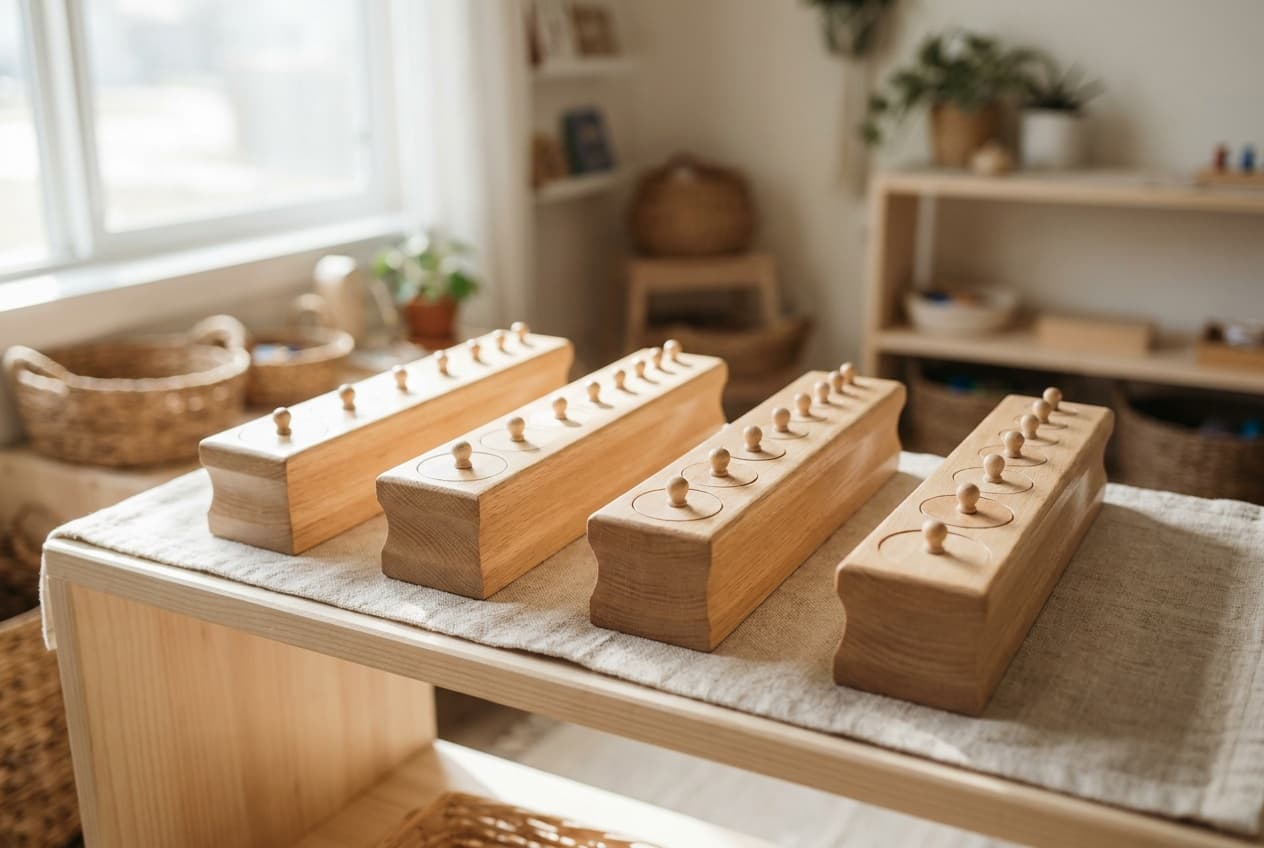
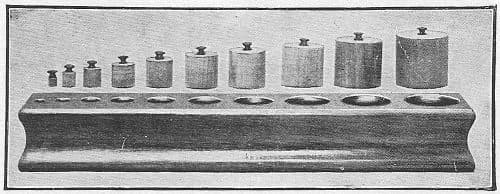
The knobbed cylinders are wooden blocks, each holding ten cylinders that a child lifts out by a small knob and fits back into the right socket. They open the Sensorial sequence; Montessori found they drew children of 2.5 to 3. A cylinder put in the wrong hole leaves another with nowhere to go, so the block itself shows the mistake.
Sourced from the texts, not yet presented at home
| Typical age | 2 to 4 years |
|---|---|
| Area | Sensorial |
| Before this | Nothing. This lesson can come first. |
| Materials | |
| Direct aim | To discriminate differences in dimension, judged by sight and confirmed by fit. |
| Control of error | The block itself. Each cylinder fits only its own socket, so a wrong choice leaves a cylinder at the end with no place to go. |
| Leads to | |
| Time | About 5 minutes to present one block (our estimate). Children of 3 have repeated it dozens of times in one sitting. |
| Grouping | One child per block. Montessori had three children share three blocks around one table, swapping as they finished. |
| Parent prep | None. The blocks live on a low shelf. |
| Cost | Buy about $40 to $311. Make: better bought than made. |
| Other names | Cylinder blocks, Solid insets, Knobbed cylinder blocks |
What the work teaches
Direct aim. To discriminate differences in dimension, judged by sight and confirmed by fit.
Indirect aims, the ones you will not see at once
- Pincer grip on the knobs, the same three fingers used to hold a pencil
- Concentration and careful, deliberate movement
- Preparation for math through ordered series of ten. Montessori traced a child's first idea of a missing one to the cylinder left without a hole
- Self-correction: the child finds the mistake without being told
Set it out before you invite the child
Montessori's 1912 blocks were 55 cm long, 6 cm high and 8 cm wide, in polished hard pine, each holding ten cylinders.
Her first block: ten cylinders all 55 mm tall, the thinnest 1 cm across and each one 5 mm wider, up to 5.5 cm.
Her second block kept the diameter at 27 mm and changed only the height, from a 1 cm disc to 55 mm. The third grew in height and diameter together. Current sets add a fourth block, where one dimension grows as the other shrinks.
The order she gave runs from easiest to hardest: diameter only, then all dimensions, then height only.
A table and chair. The block goes lengthwise in front of the child, knobs up, with clear table space in front of it for the cylinders.
Presentation, step by step
- 1Carry one block to the table with both hands, holding it at the ends. Most albums start with the block where only the diameter changes.
- 2Take out the cylinders one at a time, from left to right, holding each knob with the thumb and first two fingers. Place them in random order in front of the block.
- 3Pick up one cylinder, look from it to the sockets, and lower it gently into a socket to test the fit. If it does not fit, try another socket.
- 4Before lowering a cylinder in, you can trace the rim of the socket with a finger and then the base of the cylinder, to show that size can be felt as well as seen.
- 5Continue until every cylinder is back in place, then invite the child to take a turn.
Details that hold the child's attention
The soft drop as a cylinder slides into a socket that fits.
The last cylinder with nowhere to go, and the frown that follows. Montessori described that moment in detail.
The smallest cylinder in the first block, 1 cm across, the hardest to grip.
The disc at the end of the second block, only 1 cm tall.
How the child sees a mistake
The block itself. Each cylinder fits only its own socket, so a wrong choice leaves a cylinder at the end with no place to go.
The words come after the hands
| Words | Shown with |
|---|---|
| thick, thin | For the first block, where the cross-section changes and the height stays the same. |
| tall, short | For the block where only the height changes. |
| large, small | For the block where every dimension changes together. |
| cylinder | The shape. Name it once the size words are secure. |
| knob | What the fingers hold. |
The three-period lesson, scripted
You need the thickest and the thinnest cylinder from the first block, once the child completes it easily.
| Period | What you do and say |
|---|---|
| 1. Naming | Hold up the thickest: "This is thick." Then the thinnest: "This is thin." Say each a few times, then pause. |
| 2. Recognition | "Give me the thick one." "Give me the thin one." Swap their places on the table and ask again. |
| 3. Recall | Point to one and ask "What is this?" The child answers "Thick" or "Thin." |
Montessori kept thick and thin for objects whose cross-section changes while the length stays the same, so the words match the first block exactly. Our suggestion: one pair of words per session.
Extensions and variations
- Using two blocks at once, then three, then all four mixed together
- Working blindfolded, finding sockets by touch
- Lining up one block's cylinders on the table from largest to smallest, without the block
- Moving on to the knobless cylinders, which are graded and stacked without a block
Variations
- Each of the four blocks varies dimension differently: diameter only, height only, or diameter and height together or in opposite directions
Make it or buy it
| Material | Make it | Buy, approx. |
|---|---|---|
| Knobbed Cylinders | Buy instead | $40 to $311 |
Prices noted . Approximate US street prices for home-use versions; they vary by maker and change often, so recheck before buying.
Making it at home
Not practical to make at home with the needed precision. Nesting cups or a simple shape sorter are useful earlier, but they do not isolate dimension the same way.
What to check when buying a set
Sets of four blocks are the standard. A single block is a reasonable start for home use. Check that cylinders slide in without sticking, since cheap versions sometimes swell.
Printables for this age
This work needs only the material, so it has no printable of its own. The shelf plan below places it among the other works for the same age.
- Shelf plan for age 2PDF, 1 page, 325 KBEvery work for this age on one page, in order, with a column to date each presentation.
Every printable for one age, by email
The shelf plan and the lesson printables for your child's age in one email, then three short emails on the first lesson, what to make or buy, and what comes next.
Signs the child is ready, and signs it is done
Ready for the first presentation
- Sits at a table for a few minutes with one thing.
- Picks up small objects between thumb and fingers.
- Puts things into containers and takes them out again, on purpose.
- Carries a block with both hands without tipping the cylinders out.
Ready for the next lesson
- Completes any one block with no trial fits.
- Notices a cylinder sitting too low or too high and fixes it unprompted.
- Works two blocks mixed together.
- Uses thick and thin for the first block's cylinders.
Fitting it into a home, not a classroom
| If you have | Do this |
|---|---|
| A budget that covers one block | Buy the first block, diameter only. It's the one Montessori listed first, and it carries the whole lesson. |
| A toddler sibling | The 1 cm cylinder is choking-size. Use the blocks at a table the toddler can't reach, and count ten back in before the block goes on the shelf. |
| No table at child height | The floor works if the block sits on a tray or a rug. Montessori's children sat comfortably at a little table, so a low coffee table is closer to the original. |
| A child who wants to work alone | Let them. Montessori noticed children sometimes work the cylinders almost in private, for fear of help they didn't ask for. |
When it does not go to plan
| When | Try this |
|---|---|
| The child forces a cylinder into a hole that's too small. | Say nothing about the mistake. Show again on another day, lowering each cylinder gently and lifting it out if it sticks. |
| Cylinders get tipped out with a clatter. | Present again, taking each one out separately. Montessori asked for the cylinders to be mixed without letting them fall and without too much noise. |
| The child repeats the same block 30 or 40 times. | That's the exercise working. Montessori recorded children of 3 to 3.5 repeating it up to forty times without losing interest. |
| Interest fades after one block. | Offer a different block. A change of shape reawakens interest, Montessori found, more than a repeat of the same one. |
Hazards to check before each session
The smallest cylinders, 1 cm across, are choking-size for a child under 3. Count them back into the block after every turn.
A loaded block is heavy enough to hurt a foot if dropped. Carry it at table height.
Where other sequences and standards place it
We have not bought the paid homeschool curricula, so they are not listed here.
| Framework | Where it sits |
|---|---|
| This site's Sensorial sequence | Lesson 1 of 12 published, before Pink Tower and Color Tablets: Boxes 1, 2 and 3 and Geometric Cabinet (Plane Geometric Insets) and Metal Insets. Checked in: the scope and sequence |
| Montessori, The Montessori Method (1912) | First grade of the sequence, given as soon as the child comes to school; she calls the cylinders the most useful exercise of that grade. Checked in: Chapter XX, Sequence of Exercises |
| Montessori, Dr. Montessori's Own Handbook (1914) | The first three objects of sensory education, followed by the pink cubes, the brown prisms and the rods. Checked in: Sensory Education |
| Common Core, Kindergarten math | K.MD.A.2: directly compare two objects with a measurable attribute in common and describe the difference. Each trial fit is that comparison, made with the hands. Checked in: tasks.illustrativemathematics.org |
| Head Start Early Learning Outcomes Framework, preschool | P-MATH 8: the child measures objects by their attributes and uses differences in attributes to make comparisons. Checked in: www.in.gov |
Knobbed Cylinders: questions parents ask
What are some examples of Montessori sensorial materials?
The knobbed cylinders, the pink tower, the brown stair and the red rods for dimension; color tablets; rough and smooth boards and fabrics for touch; weight tablets; sound boxes. Montessori's 1914 list starts with three sets of cylinders, then three sets of graded solids.
What age are knobbed cylinders for?
Montessori wrote that the cylinders are likely to be the first thing to attract a child of 2.5 to 3, and she recorded children of 3 to 3.5 repeating them up to forty times. On this site they stay on the shelf until about 4, with blocks added as the child is ready.
Which cylinder block should come first?
The block where only the diameter changes. Montessori ordered them from easiest to hardest: diameter only, then all dimensions together, then height only.
Can I make knobbed cylinders at home?
Not well. The lesson depends on each cylinder fitting only its own socket, with 5 mm between neighbors, and that takes machine accuracy. Buy one good block rather than four that stick.
Sources cited by book and chapter
- Maria Montessori, Dr. Montessori's Own Handbook (1914)
Sensory Education, Fig. 5 to 7
The first three objects likely to attract a child of two and a half to three are three blocks of wood, each with ten cylinders that have a button for a handle, varying in diameter, in all dimensions, or in height.
Sensory Education
The child takes out the cylinders, mixes them without letting them fall or making much noise, and puts each back in its place; children often learn by watching companions and like to work alone.
A cylinder put in a hole too big for it leaves one cylinder with no place at the end, so the child sees the mistake and corrects it himself, and children of three repeat it up to forty times.
The control of the error lies in the material itself, so the child corrects himself without a teacher pointing out the mistake.
Arithmetic
A child of two and a half who leaves one cylinder without a place absorbs the idea of the absence of one from a continuous series, a preparation for number.
Language and Knowledge of the World
Thick and thin are the words for objects whose section changes while the length stays the same, taught in the usual three periods.
- Maria Montessori, The Montessori Method (1912)
Chapter XIII, Education of the Sense of Vision
Three blocks 55 centimetres long, each with ten cylinders handled by a button; in the first set the cylinders are 55 millimetres high and the smallest is 1 centimetre across, the others increasing by half a centimetre.
Chapter XX, Sequence of Exercises
As soon as the child comes to school he may be given the cylinders, the most useful exercise of the first grade, in which he makes his first comparison and his first selection and exercises judgment.
The solid insets progress from easy to difficult: cylinders of the same height and decreasing diameter, then cylinders decreasing in all dimensions, then those decreasing only in height.
Reviewed by
What to offer next
Once the child chooses this work unprompted and finishes it without help, the next lesson to prepare is Pink Tower.
- Knobbed Cylinders2 to 4 years
- Pink Tower2.5 to 4 years
- Brown stair2.5 to 4.5 years
- Touch boards2.5 to 4.5 years
- Red rods3 to 5 years