Knobbed Cylinders
Knobbed cylinders are wooden blocks, each holding ten cylinders lifted by a small knob, for children of 2 to 4. A single block costs $39.95 to $94.35, and a set of four $311.00, at the US sellers we checked on October 2, 2026. Buy rather than make: the fit between each cylinder and its hole is the lesson.
The first lesson with it is Knobbed Cylinders. Not sure your child is ready for it? Two minutes of questions place your child on the sequence.
| Area | Sensorial |
|---|---|
| Used in | |
| From age | 2 to 4 years |
| Make it | Better bought than made |
| Buy it | About $40 to $311 (noted ) |
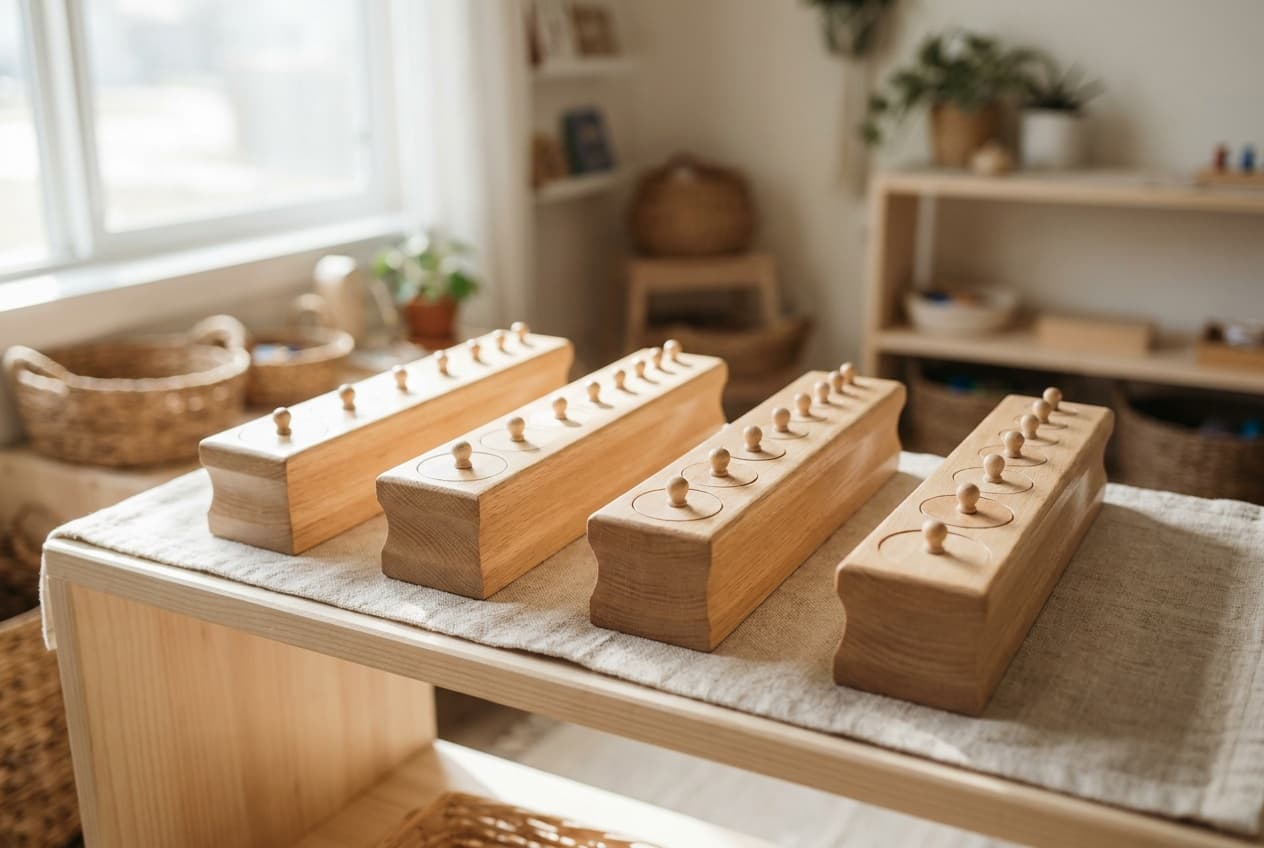
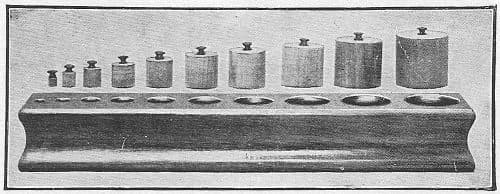
What the knobbed cylinders are for
Each block corrects itself. Put a cylinder in a hole too big for it and, at the end, one cylinder has nowhere to go. The child sees the mistake without being told; Montessori wrote that the control of the error lies in the material itself.
Her 1912 set had three blocks, each 55 cm long, 6 cm high and 8 cm wide, in polished hard pine. In the first, ten cylinders all 55 mm tall widen from 1 cm across in half-centimetre steps. Current sets add a fourth block, where one dimension grows as the other shrinks.
| Part | What it looks like |
|---|---|
| First 1912 block | All 55 mm tall; diameter 1 cm to 5.5 cm. Montessori called it the easiest |
| Second 1912 block | All 27 mm across; height 1 cm to 55 mm |
| Third 1912 block | Height and diameter grow together, from 1 by 1 cm in half-centimetre steps |
| Fourth block (later) | Diameter grows as height shrinks; not in the 1912 book |
| Knobs | Wooden or brass, fixed in the centre of each cylinder's top |
The lessons that use the knobbed cylinders
Knobbed Cylinders
2 to 4 yearsRemoving ten knobbed cylinders from a wooden block and fitting each back into its own socket, discriminating size by sight and touch.
Buying one: 4 listings checked October 2, 2026
| Seller and set | Made of | Price |
|---|---|---|
| Montessori OutletCylinder Block (Part 4) (510300040)One block only; the four are sold separately. This one changes height, not diameter. Market price shown $92.50. In stock. | Not stated | $39.95 |
| NienhuisCylinder Block No. 1 (001900)One block only. Ten cylinders, 10 by 10 mm to 55 by 55 mm in 5 mm steps. US store price. | Beech | $94.35 |
| Alison's MontessoriKnobbed Cylinder Blocks, Premium Quality (PS01)Four blocks of ten cylinders. Made in Sri Lanka; stand sold separately. | Hardwood, lacquered | $311.00 |
| The Montessori RoomMontessori Cylinder Blocks (Set of 4)Canadian store. Four blocks, sold as a budget version made by Adena Montessori; the stand is $189.99 CAD extra. | Beech | $89.99 CAD |
- Buy these; don't make them. Each cylinder has to fit its own hole and no other. A hole half a millimetre too big lets the wrong cylinder in, and then the block can't show the child anything.
- One block is a fair start at home, and Montessori began with the block where only the diameter changes. Sellers number the blocks differently, so read the description, not the number: Montessori Outlet's "Part 4" changes height, and Nienhuis's "No. 1" changes both.
- Alison's Montessori also sells a toddler set with four cylinders to a block. That is a different material and isn't in the table. Kid Advance's page would not load for us.
Keeping a full set on the shelf
- Count ten cylinders back into each block before it goes on the shelf. The smallest are 1 cm across and choking-size for a child under 3.
- Keep the blocks dry. Wood that swells makes a cylinder stick, and a sticking cylinder looks like a wrong answer.
- Carry a loaded block level, at table height. It's heavy enough to hurt a foot.
Questions parents ask about the knobbed cylinders
What are some examples of Montessori sensorial equipment?
The knobbed cylinders usually come first, then the pink tower, the brown stair and the long rods. Montessori's 1914 Handbook names the cylinder blocks as the first objects likely to draw a child of two and a half to three.
Three blocks or four?
Montessori's 1912 and 1914 books describe three. Current sets add a fourth, where one dimension grows as the other shrinks, and it comes last. Start with one block.
Can my 2-year-old use them?
The lesson on this site starts at 2, with one block and an adult nearby. Count the cylinders back in after every turn; the smallest are choking-size.
The Sensorial lessons page shows where the knobbed cylinders sits in the order.