How to homeschool Montessori
Yes, you can homeschool Montessori without training. You need a low shelf, about twelve works to start, and a sequence that says what comes next. Then protect a morning of about three hours. The sequence is free here, and most of the first shelf can come from the kitchen.
The sequence tells you what goes on the shelf and in what order. The free Montessori scope and sequence lists every published lesson by area, with the age and the lesson that comes first. Put two or three works from each area on the shelf and you have the first month.
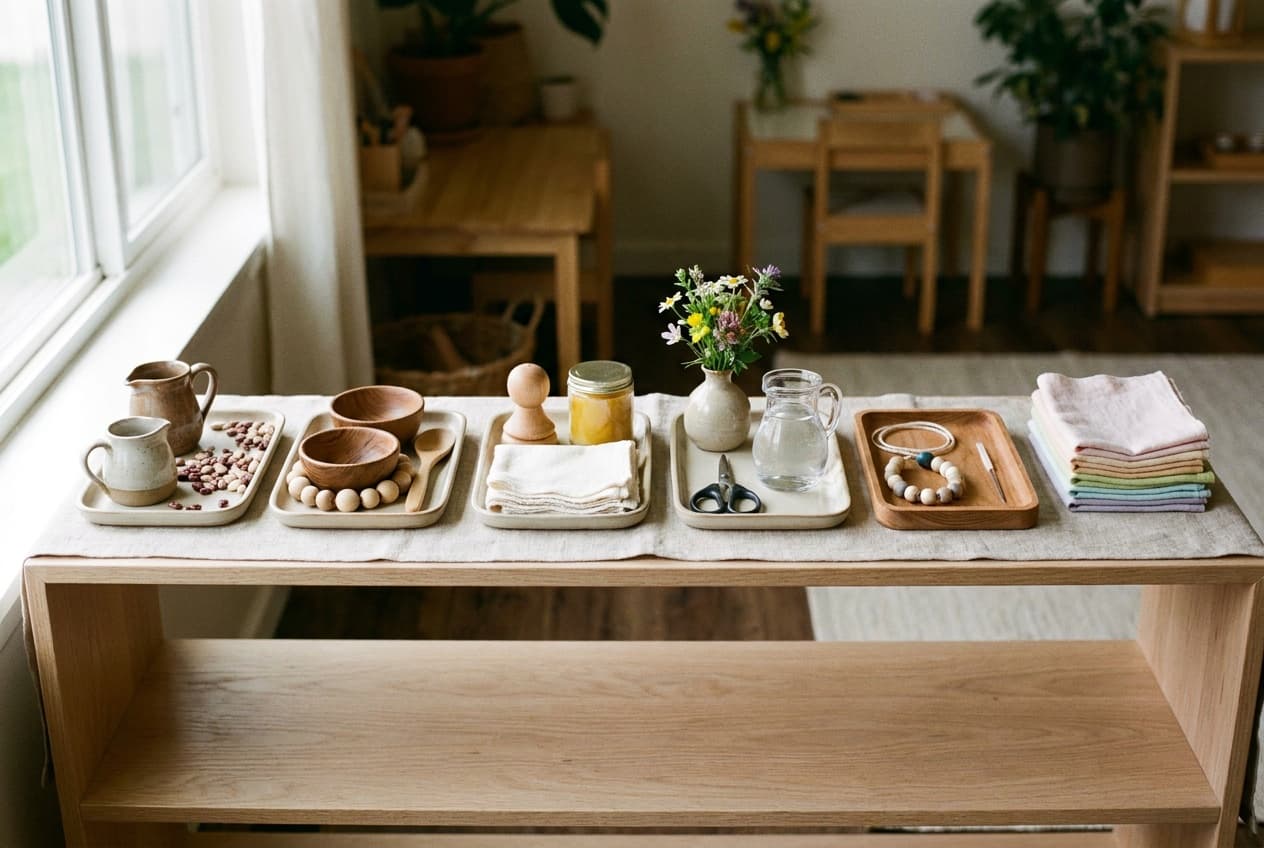
What you need, and what it costs
Twelve works is a working number, enough for two or three choices in each area without crowding the shelf. It isn't a rule from the books. Here is the whole list for a first shelf, with the price range for each material and whether it's sensible to make.
| Item | Cost, approx. | Make or buy |
|---|---|---|
| A low open shelfChild height, with one work to a space. | $0 with a bookcase you own | Use what you have; a short bookcase laid on its side works |
| TraysOne per work, so the child carries the whole work in one trip. | $18 to $27 | Easy |
| A work rugMarks the child's floor space for the pink tower and the long rods. | $10 to $20 | Easy |
| Practical lifeTwo small pitchers for pouring; the family sink and a stool for hand washing. | $8 to $34 | Easy |
| The first sensorial worksKnobbed cylinders, then the pink tower. The fit and the sizes have to be exact. | $95 to $459 | Knobbed Cylinders: Buy instead; Pink Tower: Hard to make accurately |
| The first language workSandpaper letters, a few sounds at a time. | $32 to $113 | With effort |
| The sequenceWhat goes on the shelf, in what order, with the next lesson for each. | $0, free here | Read it or print it |
| A notebookOne line per lesson: the date, the work, and what the child did. | $0 with one you own | Any notebook |
| A protected morningAbout three hours with no errands, calls or outings in the middle. | Your time | Block it on the calendar |
For scale: buying new every one of the 58 materials the 60 published lessons use comes to about $2,317 to $8,557. Of those, 36 are easy to make at home, and nobody needs all of them in the first month.
The work cycle: one long morning
A Montessori day is built around one long block of free work, usually the morning. The child chooses from the shelf, and nobody calls them away.
Association Montessori Internationale calls it the three-hour work cycle and says there is no magic in the number 3. At home, pick a start time, keep the block clear of errands, and present new lessons inside it.
Montessori drew the shape of a good morning in 1917. The child starts with something easy, then settles into longer work, about half an hour with the moveable letters in her example.
Around 10 a.m. comes a restless spell, with walking about and a tired look. She called it false fatigue. A few minutes later the child picks the hardest work of the morning and finishes calm.
Her warning was about the adult. A teacher who reads the restless spell as disorder and gathers the children loses the hard work that would have come next.
The three-period lesson in one paragraph
Every naming lesson uses three steps, which Montessori took from Seguin. Name it: hold up the red tablet and say “This is red,” then “This is blue.” Recognition: “Give me the red.” Recall: point and ask “What is this?” If the child gets the second step wrong, don't repeat or correct. Smile, put the tablets away and try another day.
Record keeping: a line per lesson
Montessori's teachers noted each child's mistakes as they showed up and kept a record of progress to guide the next lesson. The home version is one line per lesson in a notebook. Write the date, the work, and one word for where it stands (presented, practicing or mastered).
Mastery is the hard word to call. The pink tower lesson lists the signs for one work. The same idea holds for the rest: the child works it alone and catches their own mistakes. If your state asks for records, this notebook is where they start.
State rules start at the compulsory school age
Homeschool law is state law, so the rules depend on where you live. The age that matters is the compulsory school age. In the NCES table of state attendance laws for 2017 it ran from 5 to 8, depending on the state.
What you file, and whether you keep records or test, is also set by your state. Laws change after a table is printed, so check the current rules with your state's department of education before your oldest reaches that age. The years before it are yours to plan.
Six mistakes that cost the first month
Buying the whole catalog before the first lesson
A shelf of twelve works is plenty for the first month. Buy the pieces that have to be exact, like the knobbed cylinders, and make the trays, the rug and the pouring work from the kitchen.
Starting with the famous materials
Montessori's first exercises for a new child were practical life and the cylinders. The golden beads and the moveable alphabet come years later in the sequence. A 3 year old who has never poured water isn't ready for them yet.
Talking through the presentation
Montessori asked for lessons with few words, each one weighed. Show the movement slowly and say almost nothing. The material does the explaining.
Correcting the child's mistakes in the work
In the handbook, the adult corrects rough handling, never the order. A cube out of place is the child's next thing to notice, and repetition fixes it without you.
Repeating a lesson that didn't land
Montessori's rule was blunt: don't insist, and don't let the child feel the mistake. Put the work away and offer it on another day.
Calling everyone together at the restless point
Mid-morning, children often wander for a few minutes before their hardest work of the day. Montessori called it false fatigue. An adult who ends the work period there loses the best part of it.
If you're still choosing a method
Two side-by-side pages set Montessori against the methods homeschool families weigh it with most: Montessori vs Waldorf and Montessori vs Charlotte Mason. If you'd rather buy a packaged program, the Montessori homeschool curricula comparedpage puts seven of them in one table. Each price there was read on the seller's own site.
Questions about Montessori at home
Can Montessori be taught at home?
Yes. Montessori wrote her 1914 handbook as a little book "intended to enter families where children are growing up." At home you need a low shelf, the materials for your child's age, a sequence to follow and a long morning work period. Training helps, but the order of the lessons and how to present each one are public.
What are the 5 principles of Montessori?
Montessori didn't write a list of five. Two ideas from her 1912 book carry most of the method at home. The first is the prepared environment, with low cupboards the children open and keep in order. The second is auto-education, where the child corrects himself while the adult stays out of it. The three-period lesson and the work cycle on this page complete the core.
What is the Montessori 3 hour work cycle?
A long block of free work, usually the morning, where the child chooses and isn't called away. Association Montessori Internationale says there's no magic in the number 3. Montessori described the pattern inside it in 1917: easy work first, a restless spell around 10 a.m., then the hardest work of the morning.
Is 2 years old too early for Montessori?
No. Montessori's Children's Houses took children from two and a half. In the sequence here, practical life work like hand washing and pouring starts younger than that. At 2, the shelf is mostly real household tasks and the knobbed cylinders.
Where can I find a free Montessori curriculum?
The scope and sequence on this site is free to read and print, with no account and no email. Each lesson links to its own page with the age, the prerequisites, the steps and the next lesson. The paid curricula are compared on our curricula page, with prices read on their own sites.
Sources
- The Montessori Method, Maria Montessori (1912), chapters IV, VI, XII, XVII and XX: Long low cupboards cared for by the children (IV). Lessons are individual and brief, and a lesson that isn't understood is not repeated (VI). Seguin's three periods, and auto-education with a teacher who does not interfere (XII). The directress keeps a record of each child's progress (XVII). The first exercises are practical life and the cylinders; Children's Houses took children from two and a half (XX and VI).
- Dr. Montessori's Own Handbook, Maria Montessori (1914), Preface; Sensory Education; Language and Knowledge of the World: Written for families; the adult corrects rough use of the material, not mistakes in order; the three-period lesson with the largest and smallest cubes.
- Spontaneous Activity in Education, Maria Montessori (1917), ch. IX, the curve of ordered work: Easy work first, a restless spell around 10 a.m. called false fatigue, then the hardest work; interrupting at that point ends the cycle.
- The Value of the Three-Hour Work Cycle, Association Montessori Internationale (read ): No magic in the number 3; never interrupt children to gather them.
- State Education Practices, Table 5.1, compulsory school attendance laws by state, National Center for Education Statistics (2017) (read ): The minimum compulsory attendance age ranged from 5 to 8 by state in 2017.
Now pick your child's age and start there. Lessons by age lists the works for each band in order, with the first lesson to present:
If you aren't sure where your child fits, two minutes of questions give you a starting shelf for each child.