Montessori vs Waldorf
Montessori gives a 3 year old real tools and lets them choose the work. Waldorf leads the early years with imitation and play inside a steady daily rhythm, and starts formal reading in first grade, at about 6.
Pick Montessori if you want your child choosing hands-on work from a shelf and meeting letter sounds from about 2.5. Pick Waldorf if you want an adult's rhythm and imaginative play to lead until first grade.
For teaching at home, Montessori has one practical edge: its lessons are written down in order. To see what that asks of a 3 year old, open the sensorial sequence. It lists each work from the knobbed cylinders to the brown stair, with the age for each.
Montessori and Waldorf side by side
| Question | Montessori | Waldorf |
|---|---|---|
| Who started it | Maria Montessori, a physician. Her first Children's House opened in Rome on January 6, 1907. | Rudolf Steiner, in 1919. AWSNA says the method has its foundations in anthroposophy. |
| How a child under 6 learns | By working with real tools and graded materials the child chooses from a low shelf, one at a time. | Through imitation and play. WECAN: young children learn most appropriately through imitation. |
| Reading and writing | Letter sounds by touch from about 2.5 with the sandpaper letters; building words with the moveable alphabet from about 3.5. | Reading starts in the first months of first grade with consonant and vowel names and sounds. Waldorf UK: formal learning starts at age six. |
| Materials | Specific, graded materials that show the child their own mistakes, such as the knobbed cylinders. | Simple, open-ended things a child turns into whatever the play needs, like a stick for a magic wand. |
| The adult's job | Show the work in a few words, then step back and watch. The adult corrects rough handling, not the child's errors. | Be worth imitating. Steiner wrote that what grown-ups do visibly in front of the child shapes them more than moral talk. |
| Shape of the day | One long work period, usually the morning, with the child choosing what to do and for how long. | A steady daily rhythm and routine set by the adult, which WECAN says helps children feel secure. |
| Arts | Part of the material: drawing through the metal insets, music through the bells and rhythm work. | Integrated into every academic subject, preschool through grade 12, in AWSNA's words. |
| Screens | Montessori's books predate screens. The method's materials are physical objects. | A low-tech approach in the early years, before digital devices are introduced. |
| Teachers over time | Mixed ages in one room: the Children's Houses kept children from 2.5 to 6 together. | The same class teacher stays with a class for several years in the grades. |
| Written for home use | Montessori's 1914 handbook was written to enter families. The lessons are written down in order. | The AWSNA and WECAN pages we read describe schools and classrooms. We found no statement on homeschooling. |
AWSNA's own FAQ is fair about this. It says the two began with a similar goal, a curriculum that fits the child's development, and are otherwise very different. Every Waldorf line above comes from AWSNA, WECAN, the UK Steiner Waldorf Schools Fellowship or Steiner. Each is listed under Sources with the date we read it.
The real split is reading
Most of the table is a difference of emphasis. Reading is a difference of years. In a Montessori home, a child of about 2.5 traces sandpaper letters and says their sounds. From about 3.5, the child builds words with the moveable alphabet. Montessori reported two children of four in her Children's House writing a letter of thanks on note paper.
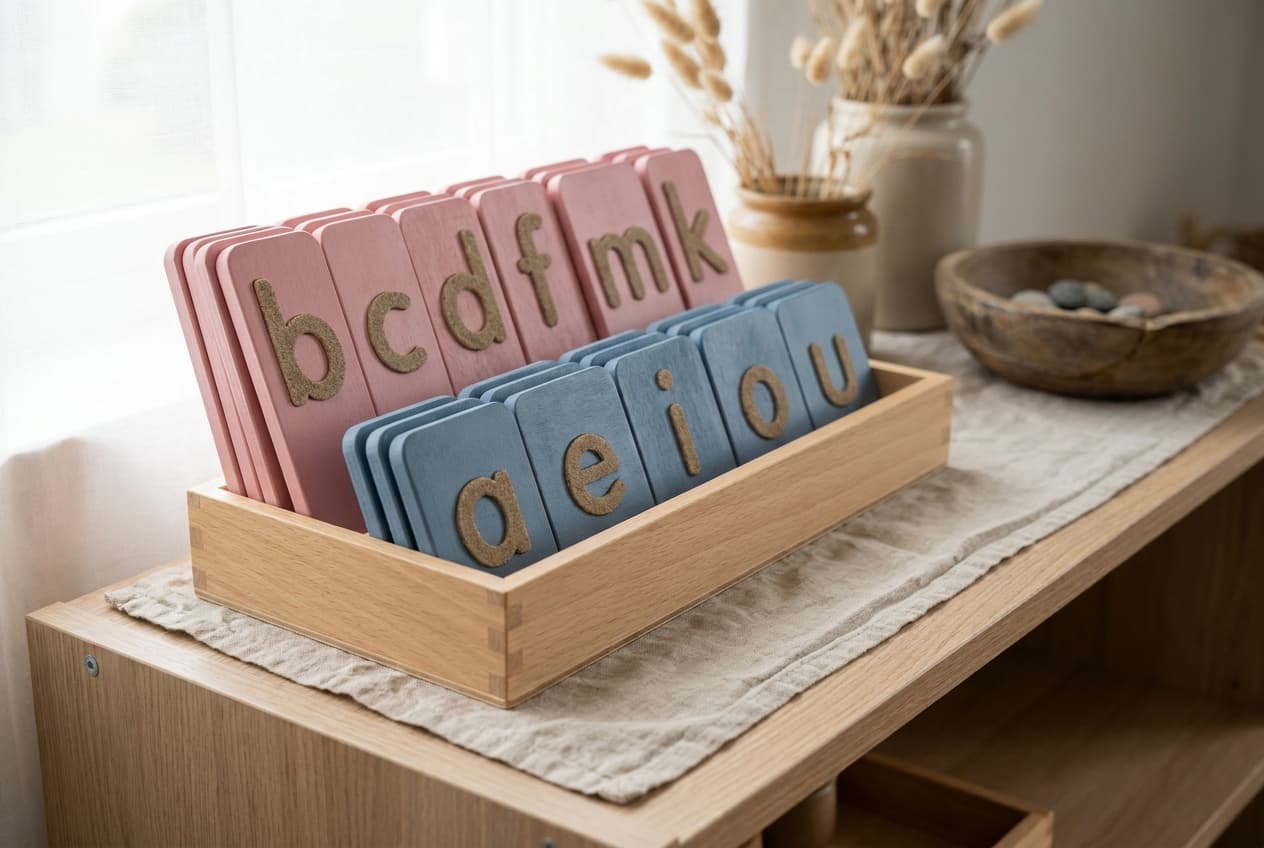
AWSNA says Waldorf teachers begin reading in the first couple of months of first grade, with consonant and vowel names and sounds. By the end of that year, children read and write sentences. Before that, the early years are for play and imitation. Your answer to “letters at 3, or letters at 6?” picks the method for you.
A model to copy, or a guide who steps back
Steiner wrote in 1907 that before the change of teeth a child learns by imitation. What grown-ups do visibly in front of the child counts for more than moral talk. So the Waldorf adult at home is a model, doing real work where the child can see it and join in.
Montessori's adult shows a work once, in very few words, and then stays out of it. Her handbook says corrections should aim at rough handling of the material, never at the child's mistakes in order; the child fixes those through repetition. Both methods give a young child real household work. They differ on who leads it.
Questions parents ask about Montessori and Waldorf
Is Waldorf or Montessori better for ADHD?
Neither one is an ADHD treatment, and we can't tell you which suits your child. We can describe the structure.
Montessori lets the child move about the room, choose the work and repeat it as long as they like. Its materials show the child their own mistakes. Waldorf gives a steady rhythm set by the adult, with imaginative play, hands-on work, outdoor time and art, and holds formal reading until first grade.
Take those two descriptions to your child's pediatrician or psychologist, who knows the child and can weigh them.
What are the drawbacks of Waldorf?
For a homeschool, three trade-offs stand out in Waldorf's own descriptions.
It rests on anthroposophy. AWSNA says Waldorf schools teach no particular religious doctrine. They are based on a belief in a spiritual dimension to the human being and to all of life. A family should know that before choosing.
Formal reading waits until first grade, which is a long wait for a child asking for letters at 4. And the model is a school with a class teacher for several years, so a parent at home takes on the whole role alone.
What is the downside of Montessori?
Cost and time. Buying new every material the published lessons here use runs to several hundred dollars at the low end, though many can be made. And Montessori lessons are individual: each child gets each presentation alone, so a parent with three children gives three lessons, not one. The sequence is long, and following it takes steady record keeping.
Can you combine Montessori and Waldorf at home?
Some parts sit together easily: a steady daily rhythm, stories read aloud, outdoor time and simple open-ended toys beside a Montessori shelf. The two disagree on reading. Montessori starts letter sounds at about 2.5 and Waldorf leaves them for first grade, so pick one answer and follow it.
Sources
- What is Waldorf Education?, Association of Waldorf Schools of North America (AWSNA) (read ): Arts integrated across subjects from preschool through 12th grade; low-tech early years; the same teacher for several years; imaginative play, hands-on work, outdoor and artistic activities.
- Waldorf FAQ, AWSNA (read ): Established by Rudolf Steiner in 1919 with foundations in anthroposophy; non-sectarian; reading begins in the first months of first grade; Waldorf and Montessori began with a similar goal and are otherwise very different.
- AWSNA Principles, AWSNA (read ): Rhythm and repetition, the artistic approach and relationships built over multiple years as core components.
- Early Childhood Education, AWSNA (read ): Daily rhythms and routines help children feel secure.
- The Child at Work and Play, Waldorf Early Childhood Association of North America (WECAN) (read ): Young children learn through imitation; simple materials such as a stick that becomes a magic wand; long hours at a screen or desk are not healthy for young children.
- Waldorf Education UK home page, Steiner Waldorf Schools Fellowship (Waldorf Education UK) (read ): Formal learning starts at age six.
- The Education of the Child in the Light of Anthroposophy, Rudolf Steiner (1907) (read ): Imitation before the change of teeth; what grown-ups do visibly before the child matters more than moral talk.
- The Montessori Method, Maria Montessori (1912), chapters II to XVII: The first Children's House opened January 6, 1907; children from two and a half to six together; children move about the room; lessons are individual; the teacher does not interfere; the bells and the metal insets for music and drawing; two children of four wrote a letter of thanks.
- Dr. Montessori's Own Handbook, Maria Montessori (1914), Preface; Sensory Education: A book intended to enter families; corrections aim at rough use of the material, not mistakes in order.
We are a homeschooling family building the open Montessori sequence; we have no tie to any Waldorf or Montessori organization. Waldorf is described here only in its own organizations' words.
A Montessori week has room for stories, a steady rhythm and long hours outside without losing the sequence. How to homeschool Montessori sets up that week: the shelf, the long morning and the first lessons. Then pick your child's age and start there.
If you're also weighing Charlotte Mason, Montessori vs Charlotte Mason has the same table. If you aren't sure where your child fits, two minutes of questions give you a starting shelf.