Montessori vs Charlotte Mason
Montessori puts graded materials on a low shelf and lets a child of 3 choose the work for a long morning. Charlotte Mason keeps lessons under twenty minutes, teaches from living books the child tells back, and sends young children outdoors for hours.
Choose Montessori if you want hands-on materials and letters by touch from about 2.5. Choose Charlotte Mason if you want books, narration and nature at the center, with little formal teaching before 6.
The biggest gap between them is reading. Every step is in the Montessori language sequence, from the sandpaper letters to the first words a child reads, with the age for each.
The two methods, question by question
| Question | Montessori | Charlotte Mason |
|---|---|---|
| Who started it | Maria Montessori, a physician, in Rome. Her first Children's House opened in 1907. | Charlotte Mason (1842 to 1923), an English educator. Home Education began as lectures to ladies, published in 1886. |
| Who it was written for | Her 1912 book describes her schools; the 1914 handbook was written to enter families. | Mothers, from the start. She held that the first six years belong in a mother's own hands. |
| Under 6 | Real household tasks and graded sensorial materials, chosen by the child from about 2.5. | Four to six hours outdoors on every fine day from April to October. Narration only when the child wants, until 6. |
| Reading | Letter sounds by touch from about 2.5; words with the moveable alphabet from about 3.5. | She called the age "an open question": early, or deferred to six or seven. Her reading lessons are short and use words the child knows. |
| Main tools | Graded materials with a control of error, the three-period lesson for names. | Living books read once, then narrated back; copywork, nature study, picture study. |
| Lesson length | A brief individual presentation, then as long as the child chooses inside a long work period. | Seldom more than twenty minutes for children under eight. |
| What the adult does | Shows the work in few words, then steps back and watches. | Reads aloud, sets short lessons and listens to the child tell it back. |
| Faith | Montessori framed the method as scientific pedagogy, built on her medical and anthropological work. | Christian. Principle 20 teaches children that the Divine Spirit has constant access to their spirits. |
| Free plan you can follow | This site's scope and sequence, free to read and print. | Ambleside Online, with no charge for its booklists. Year 1 starts with first grade. |
Mason is quoted from her own volumes as Ambleside Online hosts them, and from the Charlotte Mason Institute. Page numbers and dates are under Sources.
Where they agree more than you'd expect
Both wrote against talking too much. Montessori wanted lessons so brief that every word was counted, and if a lesson didn't land, the teacher was not to repeat it. Mason insisted on a single reading of a passage, then had the child tell it back. In her view, re-reading wastes a child's natural power of attention.
Both wrote for the home. Mason's first volume began as lectures to ladies in 1885. It says the first six years are hardly to be trusted to any hands but a mother's. Montessori wrote her 1914 handbook as a book to enter families. And both start from respect for the child: Mason's first principle is that children are born persons.
Where they part: things or books
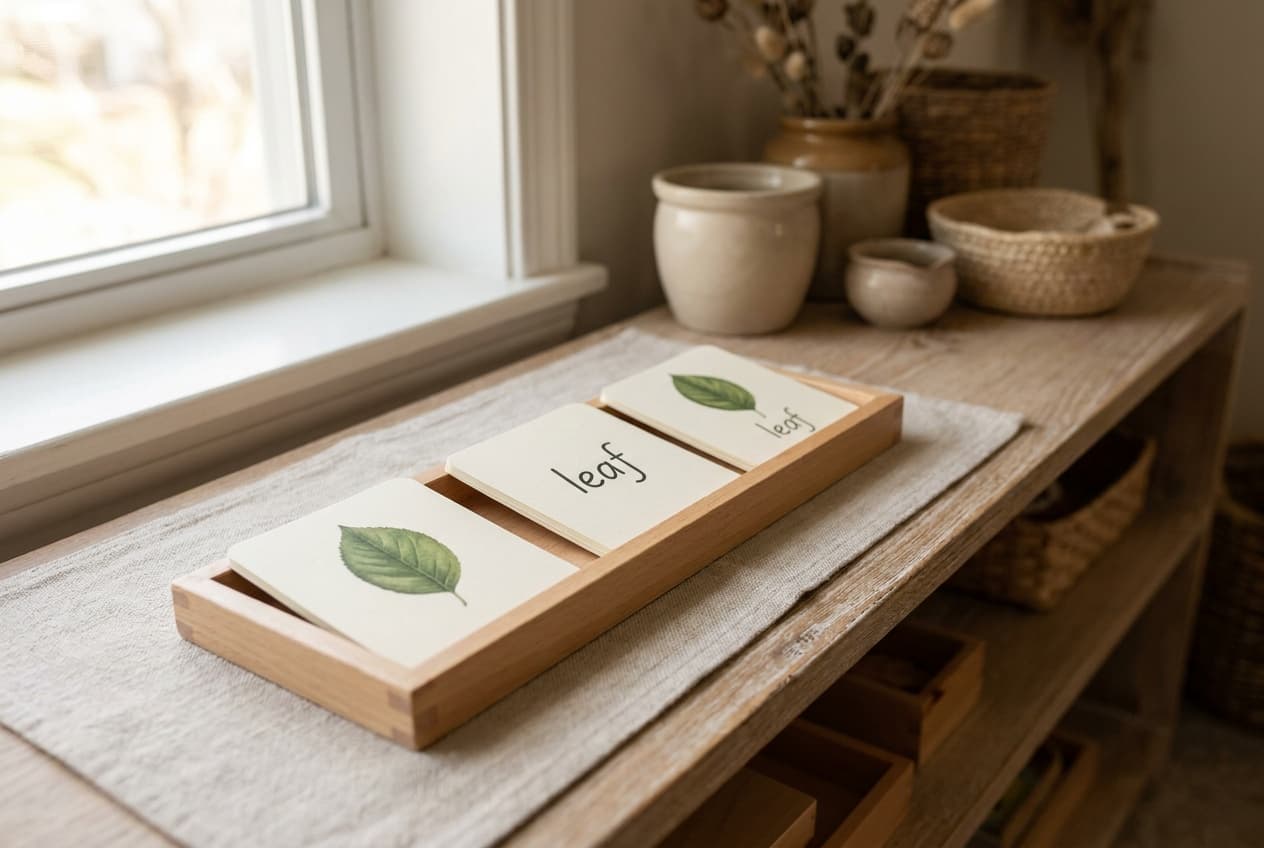
A Montessori child learns size from ten pink cubes and the names of things from cards matched to objects. The material carries the lesson, and it shows the child their own mistakes.
A Mason child learns from living books read aloud and from hours outside looking at real plants and birds, with a nature notebook. The book and the field carry the lesson, and narration shows what stuck.
Faith is the other dividing line. Mason's principles end with the Divine Spirit at work in every subject. Montessori presented her method as scientific pedagogy, and this site follows the method without a faith component. A Christian family can use either; a secular family will find Mason's own pages assume faith throughout.
Questions about Montessori and Charlotte Mason
Can you combine Montessori and Charlotte Mason?
Yes. Each asks for a different part of the day. Montessori wants a long work period, usually the morning, and Mason wants short lessons and hours outdoors. They pull apart on the age for formal reading, so decide that first. On the Montessori route, the sandpaper letters start at about 2.5.
Is Charlotte Mason religious?
Yes. Her twentieth principle teaches children that the Divine Spirit has constant access to their spirits. The Charlotte Mason Institute describes the educator as one who cooperates with God. A family that wants a secular plan can still borrow narration and nature study, though Mason allowed no separation between a child's intellectual and spiritual life.
At what age does Charlotte Mason start formal lessons?
Around 6. Ambleside Online starts Year 1 with first grade. In Home Education, Mason says that until 6 a child should narrate only when they want to. She wanted the years before spent largely outdoors, four to six hours on fine days.
Is there a free Charlotte Mason curriculum?
Yes. Ambleside Online publishes a full Charlotte Mason curriculum and charges nothing for it. The free Montessori counterpart is the scope and sequence on this site.
Sources
- Home Education (Home Education Series, vol. 1), annotated edition, Charlotte Mason (1886), pp. 2, 12, 44, 142, 199, 231 (read ): Lectures to ladies published in 1886; the first six years in the mother's hands; four, five or six hours outdoors on fine days, April to October; lessons seldom more than twenty minutes under eight; the time to teach reading an open question; narration only when the child wants until six.
- A Short Synopsis of Educational Theory (the twenty principles), Charlotte Mason (read ): Children are born persons; education is an atmosphere, a discipline, a life; narration after a single reading; principle 20 on the Divine Spirit.
- Copywork, Ambleside Online (read ): Mason's transcription as the start of spelling, quoting Home Education.
- Getting Started, Ambleside Online (read ): No charge for the curriculum; Year 1 for a child starting first grade.
- Resources, Charlotte Mason Institute (read ): Mason's dates (1842 to 1923); a relational education in a living environment, with the educator as one who cooperates with God.
- The Montessori Method, Maria Montessori (1912), ch. I, II, VI, XII: Scientific pedagogy; the first Children's House, 1907; brief individual lessons; the three periods; the teacher who does not interfere.
- Dr. Montessori's Own Handbook, Maria Montessori (1914), Preface: A book intended to enter families where children are growing up.
If Montessori mornings with Mason afternoons sounds right, start with the mornings. How to homeschool Montessoricovers the shelf, the long work period and the first lessons. The works for your child's age are in lessons by age.
The same table for the other common pairing is at Montessori vs Waldorf. If you aren't sure where your child fits, two minutes of questions give you a starting shelf.