Pink Tower
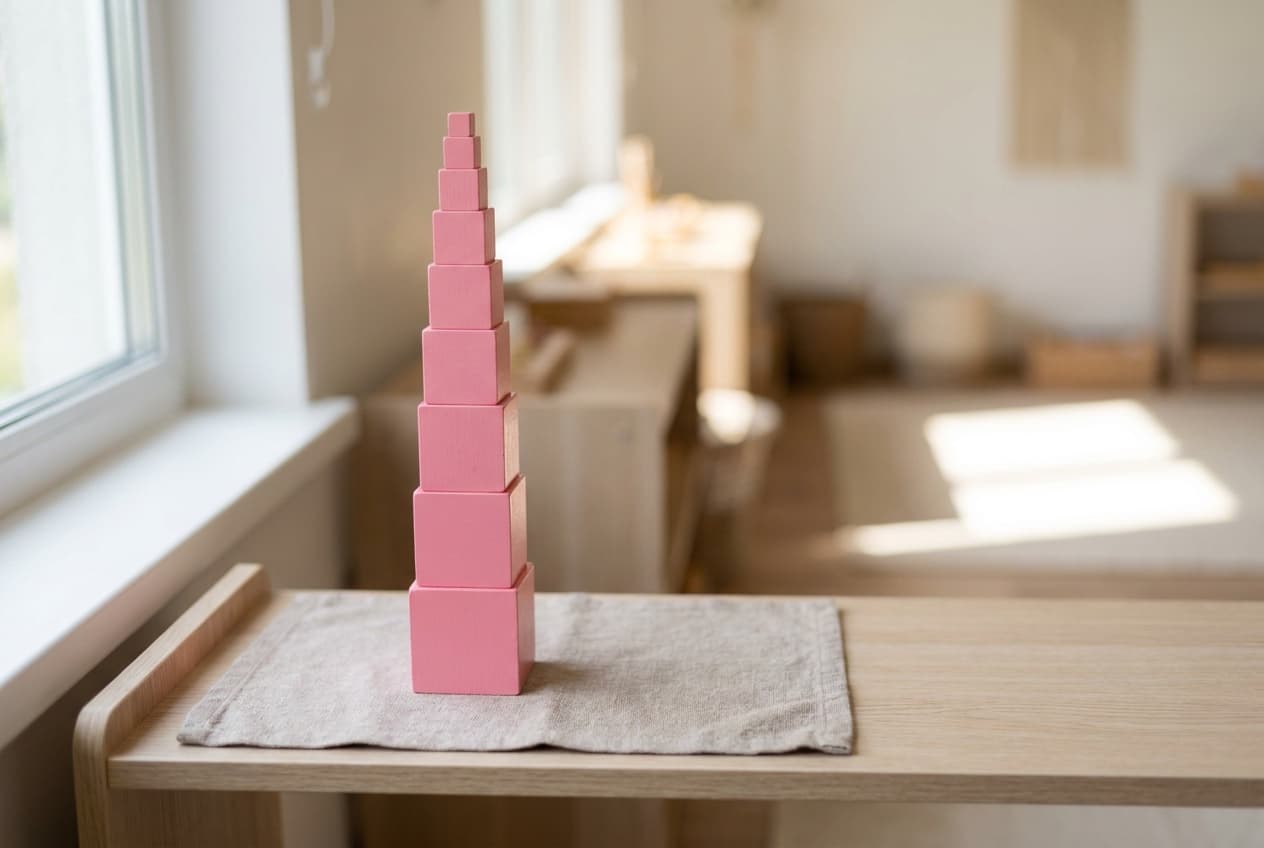
The pink tower is ten pink wooden cubes, 1 cm to 10 cm on a side, that a child builds into a tower from the largest cube up. It's the Sensorial lesson in judging size by eye. Montessori saw children take to it from about 2.5, after the knobbed cylinders, and it stays on the shelf until about 4.
Sourced from the texts, not yet presented at home
| Typical age | 2.5 to 4 years |
|---|---|
| Area | Sensorial |
| Before this | |
| Materials | |
| Direct aim | To discriminate differences in size in three dimensions and build a graded series. |
| Control of error | The child's eye. A cube placed out of order breaks the even line of the tower, so a careful look shows the mistake. Montessori noted that the cubes have no mechanical check of the kind the cylinder blocks give; the eye supplies it. |
| Leads to | |
| Time | About 10 minutes to present (our estimate: ten carries and one build). Repeats run as long as the child wants. |
| Grouping | One child at a time |
| Parent prep | Low. A plain rug and a clear patch of floor next to the shelf. |
| Cost | Buy about $55 to $148. Make: hard to make accurately. |
| Other names | Pink cubes, The tower, Pink tower cubes |
What the work teaches
Direct aim. To discriminate differences in size in three dimensions and build a graded series.
Indirect aims, the ones you will not see at once
- Coordination and control of movement while carrying and placing
- Indirect preparation for the decimal system and the cube of numbers
- Words for size: large and small first, the comparative forms later
- A first series of ten, the pattern the brown stair and the number rods repeat
Set it out before you invite the child
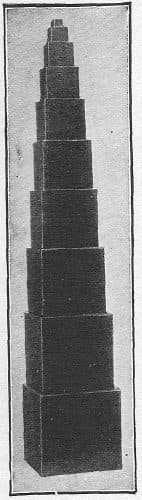
Ten cubes painted pink, measuring 10, 9, 8, 7, 6, 5, 4, 3, 2 and 1 cm on a side. Each cube is exactly 1 cm smaller than the one below it.
Built, the tower stands 55 cm tall, the ten edges added together.
A plain rug in a color that makes pink stand out. Montessori used a small green carpet and said oilcloth or cardboard would do.
Keep the tower built on the lowest shelf, near the spot where the rug goes down. The 10 cm cube takes two hands, so the child should not have to lift it high.
Presentation, step by step
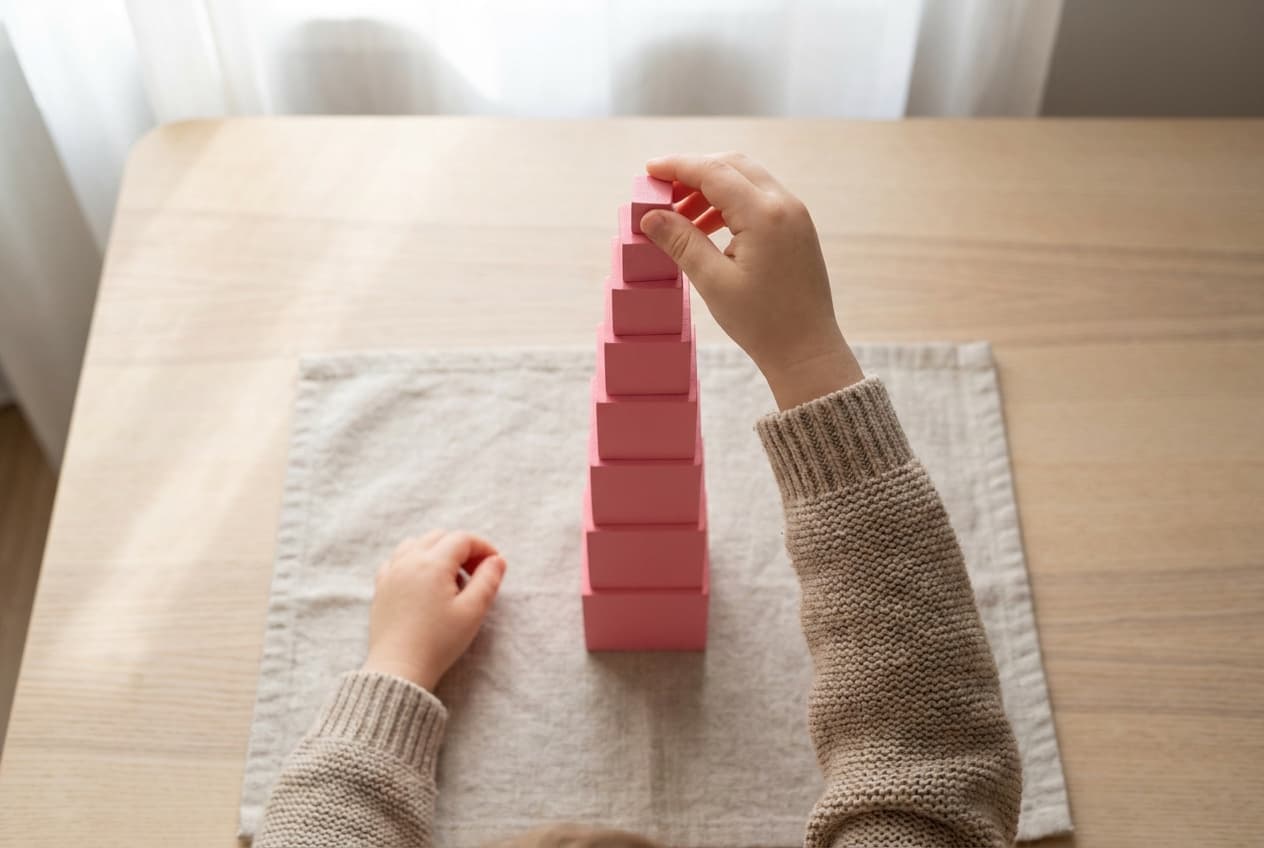
- 1Unroll a work rug. Carry the cubes one at a time from the shelf to the rug. Carry the smaller cubes in one hand and the largest with two hands, spread wide from underneath.
- 2Place the cubes randomly on the rug.
- 3Look over all the cubes and choose the largest. Place it in the center of the rug.
- 4Choose the next largest, holding it by the top with the fingers spread, and set it carefully in the center of the first cube.
- 5Continue until the tower is complete, pausing over each choice so the child can see you compare.
- 6Hold the smallest cube between thumb and finger and admire the tower from the side.
- 7Take the tower down one cube at a time, from the top, placing them randomly on the rug again. Invite the child to build.
- 8Return the cubes to the shelf one at a time, then roll up the rug.
Details that hold the child's attention
The 1 cm cube going on top. It is the smallest piece in the set and the hardest to set down straight.
Knocking it down. Montessori describes children toppling the finished tower with a blow of the hand and building it again, many times over.
The weight change from the 10 cm cube, which needs two hands, to the 1 cm cube, which sits between two fingers.
The even step of 1 cm that shows on every side of a tower built straight.
How the child sees a mistake
The child's eye. A cube placed out of order breaks the even line of the tower, so a careful look shows the mistake. Montessori noted that the cubes have no mechanical check of the kind the cylinder blocks give; the eye supplies it.
The words come after the hands
| Words | Shown with |
|---|---|
| large, small | The 10 cm cube and the 1 cm cube, given first as a pair of extremes. |
| larger, smaller | Any two cubes side by side. |
| largest, smallest | The two ends of the series, used when the child picks from the scattered cubes. |
| cube | The shape itself, every face a square. Name it later, once the size words are secure. |
The three-period lesson, scripted
You need the largest and the smallest cube, once the child has built the tower many times on their own.
| Period | What you do and say |
|---|---|
| 1. Naming | Hold up the 10 cm cube and say "This is large." Hold up the 1 cm cube and say "This is small." Repeat each word a few times, clearly, then pause. |
| 2. Recognition | "Give me the large one." "Give me the small one." Change the order and ask again, then pause. |
| 3. Recall | Point to one cube and ask "What is this?" The child answers "Large" or "Small." |
Our suggestion: if the child mixes the words up in the second period, stop there and give the first period again on another day. The comparative words come later, taught the same way.
Extensions and variations
- Building with the cubes aligned to one corner, so every cube shows a 1 cm step that the smallest cube can walk along
- Building horizontally on the rug, largest to smallest
- Bringing a single cube from across the room on request, "Bring me the cube that is just a little smaller than this one"
- Mixing the cubes on one rug and building the tower on another rug or table across the room. Montessori gives this version to children of four or five
- Combining with the brown stair in patterns
Variations
- Three-period lesson with the words large and small, using the two end cubes, then the comparative forms
Make it or buy it
| Material | Make it | Buy, approx. |
|---|---|---|
| Pink Tower | Hard to make accurately | $55 to $148 |
| Work Rug | Easy | $10 to $20 |
Prices noted . Approximate US street prices for home-use versions; they vary by maker and change often, so recheck before buying.
Making it at home
Possible with careful woodworking, but each cube must be accurate to the centimeter for the series to step evenly. Stacking cups are a reasonable stand-in for younger toddlers, though they do not teach the same thing.
What to check when buying a set
Look for solid wood and accurate sizes, with a smooth pink finish. Lightweight versions topple easily. A dropped 10 cm cube is heavy, so supervise early use.
Printables for this lesson
- Pink tower pattern cardsPDF, 2 pages, 178 KBFive cards drawn to scale from the presentation and extensions on this page. Three show the tower from the side and two show it from above.
- Shelf plan for age 2PDF, 1 page, 325 KBEvery work for this age on one page, in order, with a column to date each presentation.
Every printable for one age, by email
The shelf plan and the lesson printables for your child's age in one email, then three short emails on the first lesson, what to make or buy, and what comes next.
Signs the child is ready, and signs it is done
Ready for the first presentation
- Works at least the first knobbed cylinder block through to the end without help.
- Carries a tray or a small chair across the room with both hands and sets it down without dropping it.
- Kneels, stands and kneels again while keeping attention on one object.
- Puts things back where they came from when asked.
Ready for the next lesson
- Builds the tower with the 10 cm cube as the base every time. Swapping the two largest cubes is the most common early mistake Montessori recorded.
- Spots and fixes a misplaced cube without being told.
- Fetches the next smaller cube from across the room on request.
- Uses the words large and small without prompting.
Fitting it into a home, not a classroom
| If you have | Do this |
|---|---|
| Two children close in age | Let the younger one watch the older one build. Montessori noticed that children often learn the tower from a companion rather than from the adult. Keep it to one builder at a time. |
| A small apartment | A bath towel on the floor is a fine rug. The finished tower is 55 cm tall, so a low coffee table also works if the child can reach the top. |
| A tight budget | Someone with a table saw and patience can make the tower. If you buy only one Sensorial material, the knobbed cylinders are the harder one to make at home. |
| No pink tower yet | Nesting boxes or cups give the idea of graded size. They nest rather than stack, so they don't train the eye on the same 1 cm steps. |
| A child who needs to move | Use the two-rug version from the extensions: cubes on one rug, tower on the other, one cube carried at a time. |
When it does not go to plan
| When | Try this |
|---|---|
| The 9 cm cube ends up at the bottom. | Leave it. Montessori saw this mistake often and found that children fix it themselves with repetition. Present again on another day and slow down over the first choice. |
| The child only knocks it down. | Toppling the tower and building it again is part of the work. If cubes are thrown rather than toppled, end the turn calmly and put the tower away together. Montessori aimed her corrections at rough handling, not at mistakes in order. |
| The child builds once and walks away. | Offer it again in a few days. Check the readiness list above; a child still unsure of the knobbed cylinders may need more time there first. |
| The tower wobbles. | Show the build again and center each cube with spread fingers. Don't mention the wobble. |
Hazards to check before each session
The 1 cm cube is small enough to choke on, and flaking paint on a secondhand set goes straight to the mouth. Supervise a child who still mouths things, and count ten cubes back onto the shelf after each turn.
The 10 cm cube can hurt a foot or a sibling if it falls or is thrown. Build on a rug on the floor, never at a table edge.
Where other sequences and standards place it
We have not bought the paid homeschool curricula, so they are not listed here.
| Framework | Where it sits |
|---|---|
| This site's Sensorial sequence | Lesson 2 of 12 published, after Knobbed Cylinders, before Brown Stair (Broad Stair). Checked in: the scope and sequence |
| Montessori, The Montessori Method (1912) | Second grade of the sense exercises, with the long stair and the prisms. The cylinders come before it, in the first grade. Checked in: Chapter XX, Sequence of Exercises |
| Montessori, Dr. Montessori's Own Handbook (1914) | The first of three sets of solids that follow the cylinders: the cubes, then the brown prisms, then the rods. Checked in: Sensory Education, Fig. 9 |
| Common Core, Kindergarten math | K.MD.A.2: directly compare two objects with a measurable attribute in common and describe the difference. The tower asks for that comparison nine times per build. Children usually meet it a year or more before kindergarten. Checked in: tasks.illustrativemathematics.org |
| Head Start Early Learning Outcomes Framework, preschool | P-MATH 8: the child measures objects by their attributes and uses differences in attributes to make comparisons. Checked in: www.in.gov |
Pink Tower: questions parents ask
What does the pink tower in Montessori teach?
It trains the eye to judge differences in size, one 1 cm step at a time, in all three dimensions at once. Along the way the child practices careful carrying and gets the experience the words large and small will later name. Montessori grouped it with the brown stair and the long rods as her materials for dimension.
What age is the pink tower for?
Montessori saw children start at about 2.5. She wrote that building the tower attracts children under three, that arranging pieces on the same carpet suits children of three to four, and that the fetch-from-across-the-room version suits four and five year olds.
Do I need the brown stair as well?
Not to start. The brown stair is the next lesson here, and its prisms share the tower's 1 cm to 10 cm square ends, which is why the two are often sold together. Buy the tower first and see how your child takes to it.
Can I make a pink tower at home?
Yes, if you can cut ten cubes accurately. The 10 cm and 9 cm cubes differ by only a tenth, the step Montessori found children confuse longest, so a cube cut a few millimeters off spoils the series. The cut list itself is short: ten cubes, 10 cm down to 1 cm on a side, each exactly 1 cm smaller than the last.
Sources cited by book and chapter
- Maria Montessori, Dr. Montessori's Own Handbook (1914)
Sensory Education, Fig. 9 and 10
Ten wooden cubes colored pink, with sides from ten centimeters down to one centimeter, which the child builds into a tower on a carpet with the largest cube at the bottom, knocks down with a blow of the hand and builds up again.
Sensory Education
The cubes, the brown prisms and the rods are the three sets of solids that follow the cylinders in the series of sensory material.
There is no control of the error in the cubes themselves; the child's eye alone furnishes the control, so the pieces are large enough for the differences to strike the eye.
The teacher first shows how the pieces are arranged, children often learn by watching their companions, and her corrections aim at rough or disorderly use of the material rather than at mistakes in the order.
Language and Knowledge of the World
Once the child has built the tower many times, the teacher shows the largest and smallest cubes and says "This is large" and "This is small", then asks "Give me the large one", then "What is this?".
- Maria Montessori, The Montessori Method (1912)
Chapter XIII, Education of the Sense of Vision
Ten cubes in rose-coloured enamel from 10 centimetres to 1 centimetre, built into a tower on a small green carpet; a misplaced cube reveals itself because it breaks the line.
The most common error children make at first is placing the second cube as the base, confusing the two largest blocks.
Building the pink tower attracts children of less than three, arranging pieces on the same carpet suits children of three to four, and carrying pieces to be put in order at a distance suits children of four or five.
Chapter XX, Sequence of Exercises
The cylinders belong to the first grade of exercises; the cubes belong to the second grade with the prisms and the long stair, where the child carries heavy objects between table and carpet.
The tower must always have the largest cube as its base, and a child who corrects the confusion of the two largest cubes of his own accord has trained his eye to perceive the slightest differences.
Reviewed by
What to offer next
Once the child chooses this work unprompted and finishes it without help, the next lesson to prepare is Brown Stair (Broad Stair).
- Knobbed Cylinders2 to 4 years
- Pink Tower2.5 to 4 years
- Brown stair2.5 to 4.5 years
- Touch boards2.5 to 4.5 years
- Red rods3 to 5 years