Color Tablets: Boxes 1, 2 and 3
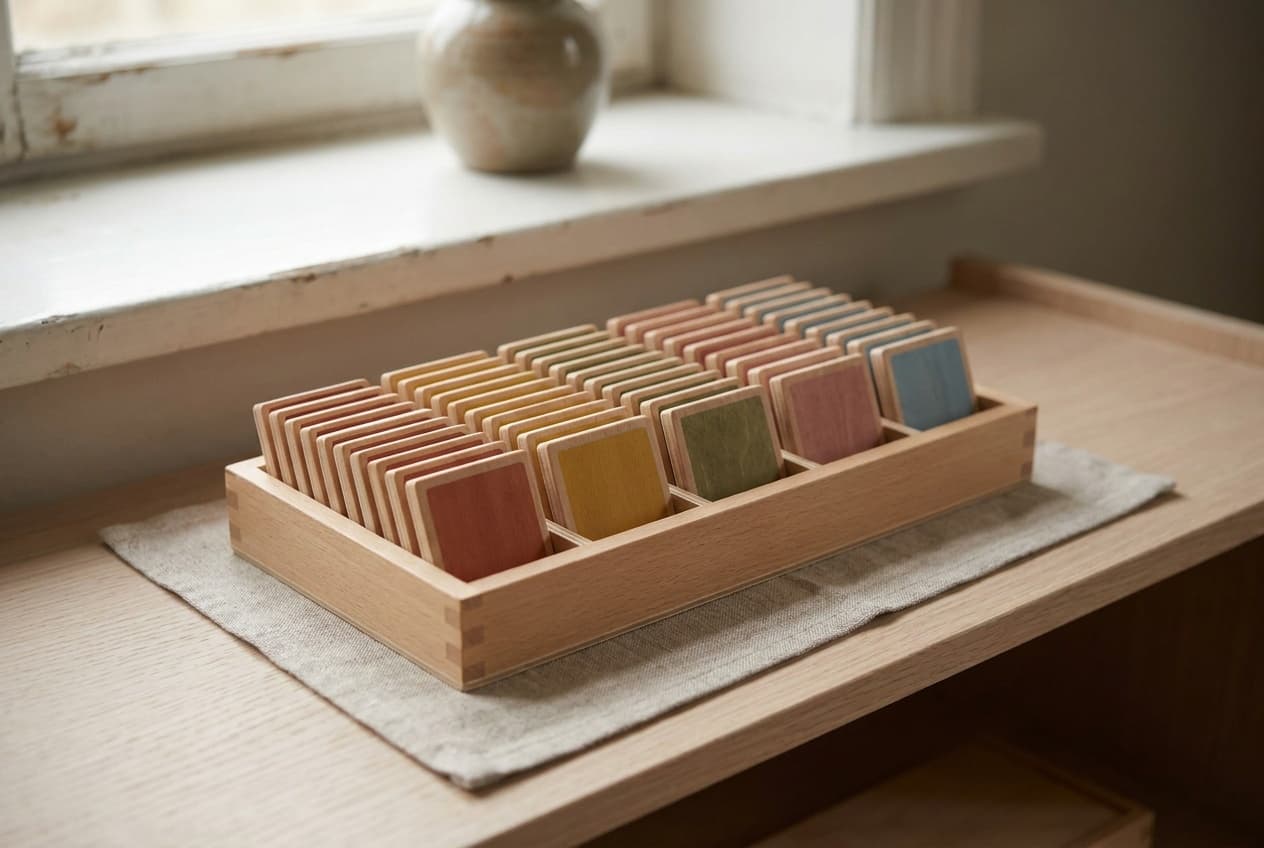
Color tablets are small flat tablets in matching pairs. A child of about 3 pairs red, yellow and blue from box 1, then eleven colors from box 2, and at around 4 grades seven shades of each color from box 3. Montessori saw children of three pair ten or a dozen couples of their own accord.
Sourced from the texts, not yet presented at home
| Typical age | 3 to 5 years |
|---|---|
| Area | Sensorial |
| Before this | |
| Materials | |
| Direct aim | To match colors by sight, and then to see small differences of shade and put them in order. |
| Control of error | The eye. In boxes 1 and 2 every tablet has exactly one match, so a wrong pair leaves two odd tablets at the end. Box 3 has a looser check: a shade out of order breaks the even run from dark to light, and only a careful look shows it. |
| Leads to | |
| Time | About 5 minutes for box 1 (our estimate). Grading one box 3 color takes longer. |
| Grouping | One child. Montessori's grading game works with three children at one table. |
| Parent prep | Low. A table and chair, and the box. |
| Cost | Buy about $12 to $163. Make: easy to make at home. |
| Other names | Color boxes, Colour tablets, Color spools, Color box 1, 2 and 3 |
What the work teaches
Direct aim. To match colors by sight, and then to see small differences of shade and put them in order.
Indirect aims, the ones you will not see at once
- A careful hand: tablets are held by their edges, never by the colored face
- Color names, given once pairing is easy
- Preparation for drawing and painting with chosen colors
- Color memory: finding a match without the sample in view
Set it out before you invite the child
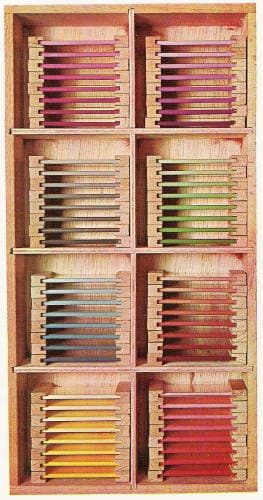
Box 1: three pairs in red, yellow, blue. Box 2: eleven pairs, adding orange, green, purple, brown, pink, gray, black, white. Box 3: 63 tablets, nine colors in seven shades each. Those are the contents Nienhuis and Montessori Outlet list today.
Montessori's own set was different. Her 1912 tablets were wound with colored silk: eight colors (black shading to white, red, orange, yellow, green, blue, violet, brown), eight shades of each, 64 to a box, and two identical boxes, 128 tablets in all.
The three-box arrangement is the later standard. It keeps her order of work: a few pairs of strong colors, then more pairs, then the shades of one color.
A table and chair. For box 1, the tablets go in a loose group on one side, with clear table space on the other for the pairs.
Presentation, step by step
- 1Bring box 1 to the table and open it. Take out the six tablets one at a time, holding each by its edges, and mix them in a group.
- 2Pick up one tablet, perhaps red, and set it apart on the clear side of the table.
- 3Look over the group and find its match. Lay the two side by side, edges touching.
- 4Do the same with blue, then yellow, until three pairs sit in a column.
- 5Mix the tablets again and invite the child to pair them.
- 6Put the tablets back in the box one at a time and return it to the shelf.
Details that hold the child's attention
A tablet set squarely next to its twin.
Holding a tablet by its edges, the color untouched.
A box 3 color laid out darkest to lightest. Montessori compared the finished row to a strip of shaded ribbon.
Looking hard at one color, then crossing the room to find its match from memory.
How the child sees a mistake
The eye. In boxes 1 and 2 every tablet has exactly one match, so a wrong pair leaves two odd tablets at the end. Box 3 has a looser check: a shade out of order breaks the even run from dark to light, and only a careful look shows it.
The words come after the hands
| Words | Shown with |
|---|---|
| red, yellow, blue | The box 1 colors, named only after pairing is easy. |
| orange, green, purple, brown, pink, gray, black, white | The rest of box 2, a pair of names at a time. |
| dark, light | The two ends of a box 3 color. |
| darker, lighter; darkest, lightest | For comparing two shades, and for choosing from the pile. |
| pair | Two tablets that are the same. |
The three-period lesson, scripted
You need one red and one blue tablet from box 1, once the child pairs all three colors easily.
| Period | What you do and say |
|---|---|
| 1. Naming | Hold up the red: "This is red." Then the blue: "This is blue." Leave both on the table under the child's eyes for a moment. |
| 2. Recognition | "Give me the red." "Give me the blue." Swap their places and ask again. |
| 3. Recall | Point to one and ask "What is this?" |
Montessori followed Seguin's advice to give two colors at a time, never one alone, because the contrast helps the memory. Our suggestion: add yellow on another day.
Extensions and variations
- Box 2: a few pairs at first, then all 22 tablets mixed in one heap
- Box 3: grading the seven shades of one color. Montessori's tip was to pick the darkest of those left, every time
- Grading two colors at once, then two close colors, such as blue and violet
- Color memory: look at a tablet, walk to a table across the room, and bring back its match
- Finding something in the house or garden that matches a tablet
- Montessori's group game: each of three children takes one color's shades from a mixed heap and grades them
Variations
- Laying all nine graded colors of box 3 out at once in a ring. An album variation, later than Montessori's books
Make it or buy it
| Material | Make it | Buy, approx. |
|---|---|---|
| Color Tablets | Easy | $12 to $163 |
Prices noted . Approximate US street prices for home-use versions; they vary by maker and change often, so recheck before buying.
Making it at home
Glue matched paint sample cards to stiff card cut about 6 by 4 cm, two of each color. For box 3, cut one graded paint strip into its shades.
What to check when buying a set
Boxes are sold separately. Box 1 alone is enough to start, and box 3 can wait a year. Check that pairs really match; cheap sets sometimes drift in shade.
Printables for this age
This work needs only the material, so it has no printable of its own. The shelf plan below places it among the other works for the same age.
- Shelf plan for age 3PDF, 1 page, 250 KBEvery work for this age on one page, in order, with a column to date each presentation.
Every printable for one age, by email
The shelf plan and the lesson printables for your child's age in one email, then three short emails on the first lesson, what to make or buy, and what comes next.
Signs the child is ready, and signs it is done
Ready for the first presentation
- Completes a knobbed cylinder block without help.
- Picks up a flat object by its edges when shown.
- Sits at a table for five minutes with one thing.
- Notices when two things are the same, and says so.
Ready for the next lesson
- Pairs all eleven colors of box 2 from a mixed heap without a mistake.
- Grades the seven shades of one box 3 color and fixes a swapped pair alone.
- Names the box 1 and box 2 colors.
- Brings back a color's match from across the room, from memory.
Fitting it into a home, not a classroom
| If you have | Do this |
|---|---|
| A tight budget | Boxes 1 and 2 are easy to make: pairs of paint sample cards glued to stiff card. Box 3 is harder, because the seven shades have to step evenly; one paint-store strip cut apart comes close. |
| A toddler sibling | Work at a table the toddler can't reach and count the tablets back into the box. Card tablets get bent and chewed; wooden ones last. |
| Two children | Play Montessori's grading game: give each child one color, mix all the shades together, and let each pull out and grade their own. |
| A child who already knows color names | Move quickly to box 2 and box 3. Naming red is easy; seeing seven reds in order is the work. |
When it does not go to plan
| When | Try this |
|---|---|
| The child grabs the tablets by the colored face. | Show the edge grip again, slowly. Montessori asked children to hold the tablets by the wood at the ends, partly to train a delicate hand. |
| Shades end up out of order in box 3. | Leave them. Montessori read a mistake as a sign the eye wasn't ready yet, and left the child to practice. Offer her hint once: always take the darkest one left. |
| The child names colors but won't pair them. | Pairing is the lesson. Go back to two pairs and add one pair at a time. |
| Box 2 is too many at once. | Take out four or five pairs. Montessori's teachers added couples gradually until the child paired ten or twelve. |
Hazards to check before each session
Most bought tablets are about 6 by 4 cm and flat. Check homemade ones: anything small enough to swallow stays off the shelf if a toddler is around.
For homemade tablets, use non-toxic glue and seal any paper edges that a child might peel and chew.
Where other sequences and standards place it
We have not bought the paid homeschool curricula, so they are not listed here.
| Framework | Where it sits |
|---|---|
| This site's Sensorial sequence | Lesson 6 of 12 published, after Knobbed Cylinders, before Sound Cylinders (Sound Boxes). Checked in: the scope and sequence |
| Montessori, The Montessori Method (1912) | Pairing the colors begins alongside the cylinders and the size materials, as the first exercise of the color sense. Grading the shades comes in the third grade. Checked in: Chapter XX, Sequence of Exercises |
| Montessori, Dr. Montessori's Own Handbook (1914) | Two boxes of 64 tablets, eight colors in eight shades: pairing first, then the shades of one color, then all 64 sorted into eight rows, then color memory. Checked in: Sensory Education |
| Head Start Early Learning Outcomes Framework, preschool | P-SCI 3: the child compares and categorizes observable phenomena. Here the phenomenon is color, compared tablet against tablet. Checked in: www.in.gov |
Color tablets: questions parents ask
What are color tablets in Montessori?
Small flat tablets in pairs and graded shades, used to train the eye to see color. The child first finds matching pairs, then puts the shades of one color in order from dark to light. Montessori's own tablets were wound with silk; today's are painted wood or plastic.
What is the difference between color box 1, 2 and 3?
Box 1 holds three pairs in the primary colors, for a first pairing lesson. Box 2 holds eleven pairs. Box 3 holds 63 tablets, nine colors in seven shades, for grading. The three boxes are a later arrangement of Montessori's two boxes of 64.
What age are color tablets for?
Box 1 from about 3, box 2 soon after, and box 3 at about 4. That follows Montessori, who saw children of three pair ten or twelve couples unaided and wrote that children of three could grade all the tints in her 1912 set. Many albums start box 1 a little earlier, at 2.5.
Can I make color tablets at home?
Boxes 1 and 2, yes: pairs of paint sample cards glued to stiff card. Box 3 is harder because seven shades have to step evenly, but a single paint-store strip cut apart gets close. Match the pairs in daylight before you glue.
Sources cited by book and chapter
- Maria Montessori, The Montessori Method (1912)
Chapter XIII, Education of the Sense of Vision
Eight tints, black, red, orange, yellow, green, blue, violet and brown, each in eight gradations, make sixty-four colour-tablets, and duplicate boxes make one hundred twenty-eight in all.
For the earliest exercise three strong colours such as red, blue and yellow are given in pairs; the child finds the duplicate of each among the mixed tablets and arranges them two by two.
Children empty the box of sixty-four colour-tablets, mix them, collect them into groups and arrange them in gradation, and children of three years are able to put all of the tints into gradation.
In the directress's game, each child at the table takes all the gradations of an assigned colour from the mixed heap and arranges them in a line like a strip of shaded ribbon.
Chapter XII, Education of the Senses
Seguin advises never to present a colour singly but always two at a time, since the contrast helps the chromatic memory.
Chapter XX, Sequence of Exercises
The pairing of the colours is the first exercise of the chromatic sense, begun together with the dimension exercises, and only the eye of the child intervenes in the judgment.
In the third grade the child is introduced to gradations of stimuli, tactile and chromatic, and is allowed to exercise himself freely.
- Maria Montessori, Dr. Montessori's Own Handbook (1914)
Sensory Education
The teacher mixes three or four pairs of bright colors such as red, blue and yellow for the child to pair, and little children of three years old end by pairing ten or a dozen couples of their own accord.
Given the eight shades of one color, the child grades them; the teacher suggests he always select the darkest from the pile and compare tablets that stand next to each other.
The child must hold the tablets by the pieces of wood at the top and bottom, avoid touching the colored silk, and lay them in a straight line like a shaded ribbon.
In the color memory exercise the child looks carefully at a color and then finds its companion in a mixed group without the color in view.
Reviewed by
What to offer next
Once the child chooses this work unprompted and finishes it without help, the next lesson to prepare is Sound Cylinders (Sound Boxes).
- Touch boards2.5 to 4.5 years
- Red rods3 to 5 years
- Color tablets3 to 5 years
- Sound cylinders3 to 5 years
- Geometric cabinet3 to 5 years