Stamp Game: Static Addition
In the stamp game a child adds numbers such as 1,312 + 2,454 by laying out small tiles marked 1, 10, 100 and 1000, column by column, then counting each column. The tiles are all one size, colored by value. It follows golden bead addition, from about 4.5, and leads to sums on paper.
Sourced from the texts, not yet presented at home
| Typical age | 4.5 to 7.5 years |
|---|---|
| Area | Math |
| Before this | |
| Materials | |
| Direct aim | To add multi-digit numbers without carrying, using the stamp game. |
| Control of error | Recounting the stamps in each column, and later checking against a control chart or with the golden beads. |
| Leads to | |
| Time | About 15 minutes for one sum (our estimate). |
| Grouping | One child |
| Parent prep | Low. Write three or four sums on slips first, chosen so no column passes 9. |
| Cost | Buy about $33 to $107. Make: easy to make at home. |
| Other names | Stamp game, Static addition with the stamp game, Addition without exchanging |
What the work teaches
Direct aim. To add multi-digit numbers without carrying, using the stamp game.
Indirect aims, the ones you will not see at once
- Moving from concrete quantities toward abstract calculation
- Reinforcing place value through color and position
- Preparation for carrying and for written sums
- Writing a four-digit answer in the right order
Set it out before you invite the child
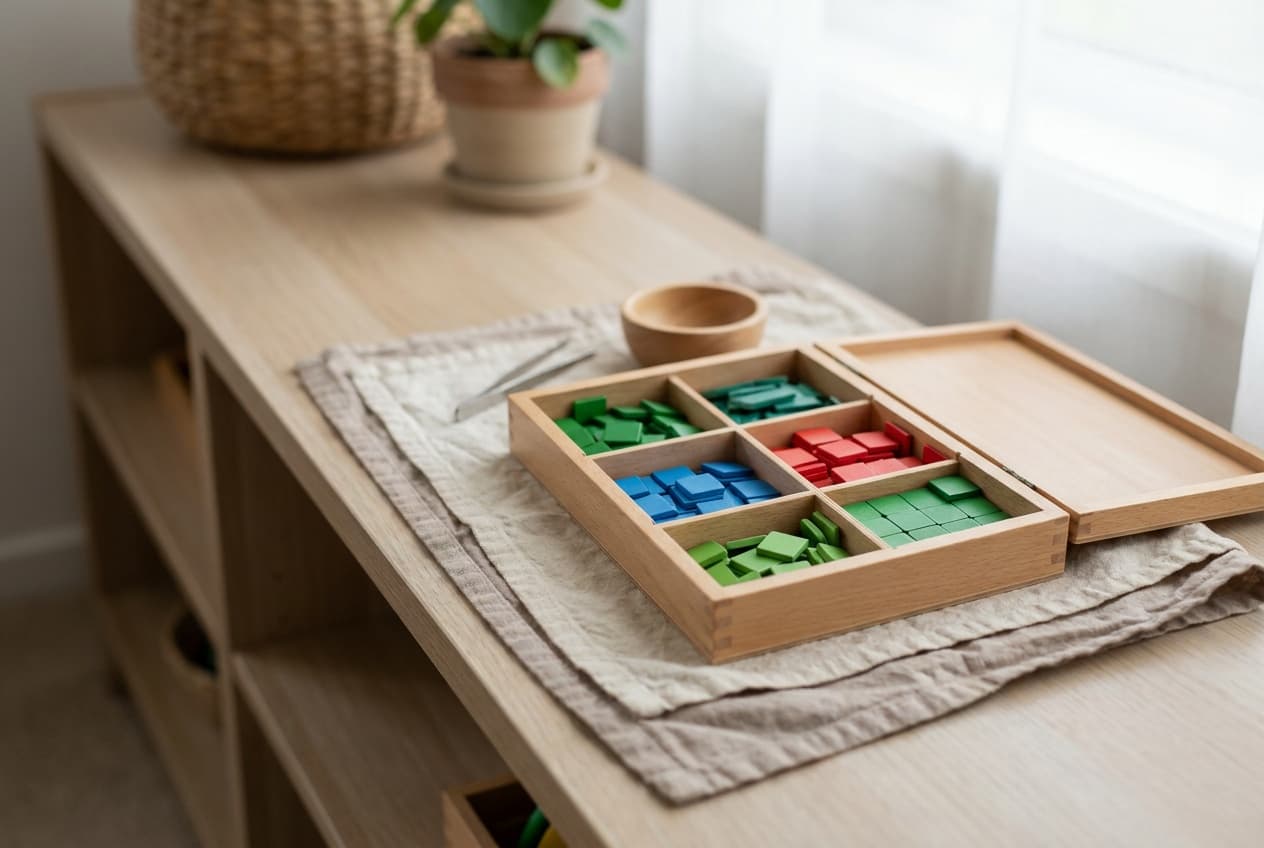
A box of tiles, all one size: green 1s, blue 10s, red 100s and green 1000s. Most boxes also hold small skittles and counters, which are for division later.
Squared paper and a pencil for recording.
Problem slips where no column adds past 9. 1,312 + 2,454 = 3,766 works; 1,318 + 2,454 doesn't, because 8 and 4 make 12 and need an exchange.
A table with room for four columns of tiles side by side, units on the right.
The colors have a history: Montessori's 1917 paper for the counting frame was ruled with a green line for units, blue for tens and red for hundreds.
Presentation, step by step
- 1Show the box: green 1 stamps are units and blue 10 stamps are tens; red 100 stamps are hundreds and green 1000 stamps are thousands. These are the hierarchical place-value colors that recur across later Montessori math materials.
- 2Write an addend on a slip of paper, for example 1,312. Lay out the stamps in columns from right to left: two units, one ten, three hundreds, one thousand.
- 3Write the second addend, for example 2,454, and lay out its stamps beneath the first in the same columns.
- 4Starting with the units, push the stamps together and count them. Write the total for the units.
- 5Do the same for tens, hundreds and thousands. Read the answer: 3,766.
- 6Have the child check by counting each column again.
Details that hold the child's attention
Pushing two groups of tiles together into one.
Every tile the same size, so the value lives in the number printed on it.
Writing the answer starting from the units, right to left.
Reading a four-digit number aloud, perhaps for the first time.
How the child sees a mistake
Recounting the stamps in each column, and later checking against a control chart or with the golden beads.
The words come after the hands
| Words | Shown with |
|---|---|
| addend | Each number being added. |
| sum | The answer. |
| units, tens, hundreds, thousands | The four columns, the same names as the golden beads. |
| column | One category, laid out top to bottom. |
| static | The adult word for sums with no exchanging. |
The three-period lesson, scripted
You need a 1 tile, a 10 tile and a 100 tile.
| Period | What you do and say |
|---|---|
| 1. Naming | "This is one unit." "This is one ten." "This is one hundred." |
| 2. Recognition | "Give me a hundred." "Put a ten in the tens column." |
| 3. Recall | Point to a tile and ask "What is this?" |
Our suggestion: the child knows these names from the golden beads, so this is a quick check that the names moved from bead to tile. If the child says "the blue one" for a ten, give a week more with the beads.
Extensions and variations
- Addition with exchanging: ten unit stamps traded for one ten stamp
- Subtraction, multiplication and division with the stamp game
- Recording problems and answers on squared paper
- Sums the child writes for themself, checked with the beads
Variations
- Paper stamps cut from printed sheets, which work but are fiddly for small hands
- The small bead frame, Montessori's 1917 counting frame with four wires of ten beads, for the same sums
Make it or buy it
| Material | Make it | Buy, approx. |
|---|---|---|
| Stamp Game | Easy | $33 to $107 |
Prices noted . Approximate US street prices for home-use versions; they vary by maker and change often, so recheck before buying.
Making it at home
Small wooden tiles or thick cardstock squares labeled 1, 10, 100 and 1000 in the matching colors work well. Make at least 20 of each.
What to check when buying a set
Stamp game boxes are inexpensive and long-lasting. Check that the colors match your other materials.
Printables for this lesson
- Stamp game addition problem cardsPDF, 2 pages, 209 KBTwenty-four four-digit sums where no column adds past 9. The digits are colored like the stamps, and the answers are on page 2.
- Shelf plan for age 4PDF, 1 page, 248 KBEvery work for this age on one page, in order, with a column to date each presentation.
Every printable for one age, by email
The shelf plan and the lesson printables for your child's age in one email, then three short emails on the first lesson, what to make or buy, and what comes next.
Signs the child is ready, and signs it is done
Ready for the first presentation
- Adds with the golden beads and reads the answer from the number cards.
- Reads and writes numbers up to 9,999.
- Knows the four category names without the beads in front of them.
- Writes digits clearly enough to read back.
Ready for the next lesson
- Lays out both addends in the right columns without help.
- Adds any static four-digit sum and writes the answer correctly.
- Rechecks a column without being asked.
- Asks what happens when a column passes nine, which is the cue for addition with exchanging.
Fitting it into a home, not a classroom
| If you have | Do this |
|---|---|
| A tight budget | Card tiles, 2 cm squares, about 30 of each value. Three sheets of card stock and a pen cover a full set. |
| A younger sibling nearby | Tiles are small. Work at a table and count them back into the box at the end. |
| Two children | One lays out and adds; the other checks with the golden beads. Swap for the next sum. |
| A child already doing column sums on paper | Use the stamp game to show why the paper method works, then move on fast. It's a bridge, and a confident child can cross it in a week. |
When it does not go to plan
| When | Try this |
|---|---|
| Tiles land in the wrong column. | Lay a strip of paper with the four headings across the top of the table. Remove it once the columns are automatic. |
| The answer is written backwards, 6673 for 3,766. | Write from the units column as you count it, placing each digit under its own column. Then read it from the left. |
| Boredom with sums that never carry. | That's a good sign. Move on to sums that need an exchange. |
| The child counts a 100 tile as one. | It is one: one hundred. Ask "one what?" and go back to the beads for one session to see the hundred again. |
Hazards to check before each session
Tiles of about 2 cm are choking-size for a child under 3. Count them back into the box after each session.
Where other sequences and standards place it
We have not bought the paid homeschool curricula, so they are not listed here.
| Framework | Where it sits |
|---|---|
| This site's Math sequence | Lesson 7 of 12 published, after Golden Beads: Introduction to the Decimal System, before Addition Strip Board. Checked in: the scope and sequence |
| Montessori, The Montessori Elementary Material (1917) | The stamp game does not appear in the book. Its closest relative there is the counting frame, used for addition in several figures: beads for the first number, beads for the second on the same wires, then write what the frame shows. Checked in: Part III, Addition |
| Common Core, Grade 2 math | 2.NBT.B.7: add and subtract within 1000 using concrete models and strategies based on place value, adding like units to like units. Checked in: tasks.illustrativemathematics.org |
| Common Core, Grade 4 math | 4.NBT.B.4: fluently add and subtract multi-digit whole numbers using the standard algorithm, the written method the stamp game leads to. Checked in: tasks.illustrativemathematics.org |
Stamp game: questions parents ask
What is the stamp game in Montessori?
A box of small tiles, all the same size, marked 1, 10, 100 and 1000 and color-coded by value. Children use it to add, subtract, multiply and divide with four-digit numbers after the golden beads. It's the step where quantity is shown by a printed number instead of by the size of the object.
What are some good stamp games for kids?
In Montessori the stamp game is one material, used for all four operations. Start with static addition (no carrying), then addition with exchanging, then subtraction with and without borrowing. Short multiplication and division come after.
What are some examples of Montessori math activities?
Number rods for one to ten, sandpaper numerals, golden beads for the decimal system, the stamp game for four-digit sums, bead chains for skip counting. Each works with quantities a child can handle before writing them down.
Is the stamp game the same as the golden beads?
It does the same sums with less bulk. The beads show a thousand as a heavy cube; the stamp game shows it as a tile with 1000 printed on it. The move from size to symbol is the lesson.
Sources cited by book and chapter
- Maria Montessori, The Montessori Elementary Material (1917)
Part III, Addition
Addition on the counting frame: slide over beads for the first number, place the beads for the second number next to them on the same wires, then write the number the beads now show.
When the tens wire is full, the ten tens are returned to their original position and another bead is moved over on the hundreds wire to represent them.
Part III, Counting-frames
The paper for the counting frame is ruled with a green line for units, a blue line for tens and a red line for hundreds.
The value of a figure comes from its position in respect to the other figures, so the same nine figures make every number.
After the counting frames, children add and subtract numbers of several figures written in columns with astonishing facility.
Reviewed by
What to offer next
Once the child chooses this work unprompted and finishes it without help, the next lesson to prepare is Addition Strip Board.
- Teen boards4 to 6 years
- Cards and counters4 to 5.5 years
- Stamp game4.5 to 7.5 years
- Short bead chains4.5 to 6.5 years
- Tens boards4.5 to 6.5 years