Stamp Game
The stamp game is a box of small tiles in four values, green 1s, blue 10s, red 100s and green 1000s, that a child uses for addition, subtraction, multiplication and division from about 4.5. Sets cost $32.95 to $107.20 at the three US sellers we checked on October 2, 2026. Card-stock tiles make a working homemade set.
It is used in 5 lessons, starting with static addition; that one is published and the other 4 are in preparation. Not sure your child is ready for it? Two minutes of questions place your child on the sequence.
| Area | Math |
|---|---|
| Used in | |
| From age | 4.5 to 7.5 years |
| Make it | Easy to make at home |
| Buy it | About $33 to $107 (noted ) |
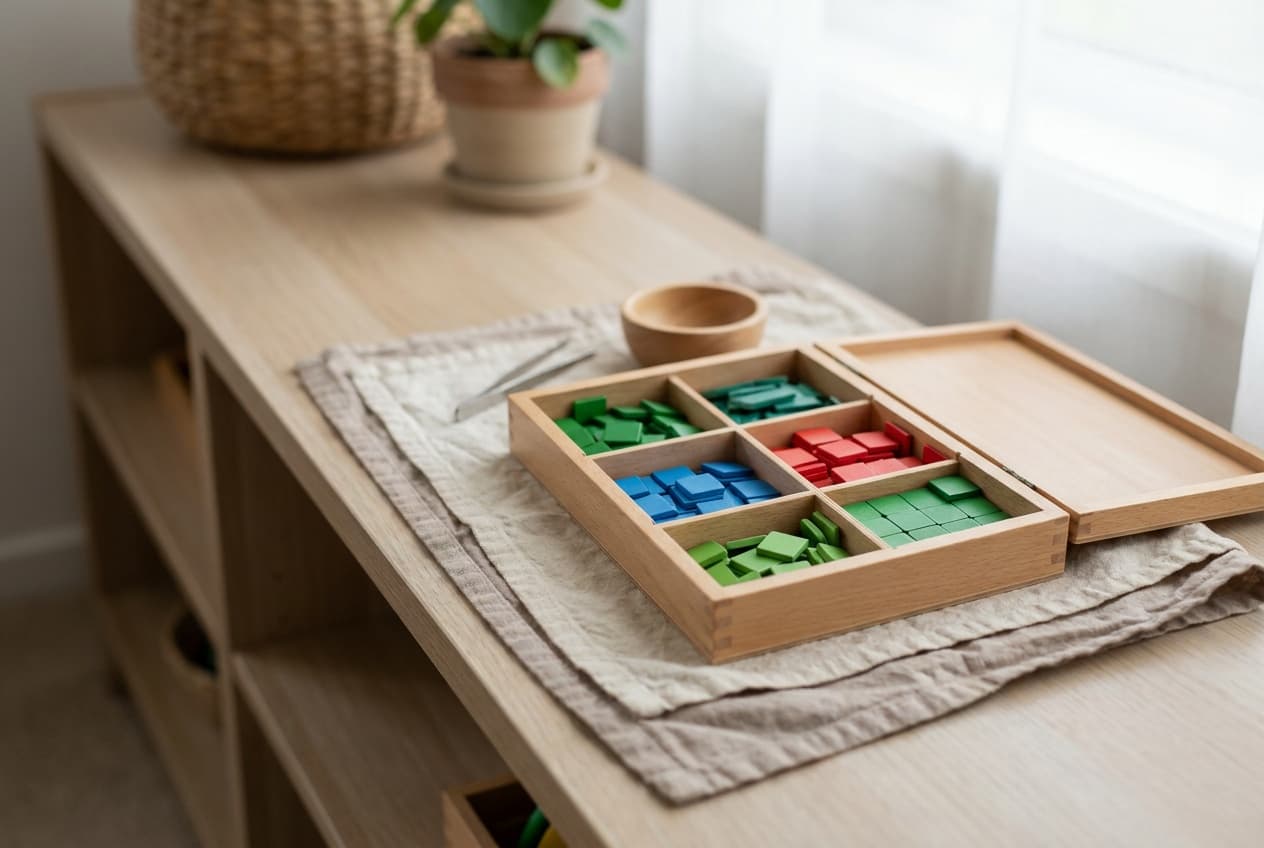
What the stamp game is for
The stamp game takes the quantities of the golden bead material and turns them into flat tiles that are all the same size. A 100 tile is no bigger than a 1 tile; only the color and the printed numeral say what it is worth. That is the step from holding a quantity toward writing a symbol.
It is made for one child working alone at a table. Nienhuis, the Dutch maker, describes it as individual practice in all four operations, coming after the golden beads.
| Part | What it looks like |
|---|---|
| Unit tiles | Green, marked 1 |
| Ten tiles | Blue, marked 10 |
| Hundred tiles | Red, marked 100 |
| Thousand tiles | Green, marked 1000 |
| Skittles and counters | Small wooden pieces used for division |
| Box | Wooden, with one compartment per value; Montessori Outlet's has six |
The lessons that use the stamp game
Stamp Game: Static Addition
4.5 to 7.5 yearsAdding four-digit numbers with color-coded tiles for units, tens, hundreds and thousands, the step between golden beads and paper.
- Stamp game: addition with exchangingIn preparation
- Stamp game: subtractionIn preparation
- Stamp game: multiplicationIn preparation
- Stamp game: divisionIn preparation
Buying one: 5 listings checked October 2, 2026
| Seller and set | Made of | Price |
|---|---|---|
| Montessori OutletStamp GameSix-compartment box; skittles and counters included. In stock. | Wood | $32.95 |
| Alison's MontessoriStamp Game (M28)Sale price; regular $45.15. Made in China. | Not stated | $40.64 |
| Alison's MontessoriStamp Game, Premium Quality (PM46)Skittles and counters included. Made in Sri Lanka. | Not stated | $97.00 |
| NienhuisStamp GameUS store price. | Birch plywood and beech | $107.20 |
| The Montessori RoomStamp GameCanadian store. Sold as a budget version; skittles and counters included. | Beechwood | $49.99 CAD |
- Every listing above is sold for the same four operations. The $74.25 between the cheapest and dearest US set buys better wood and finish. It doesn't buy extra lessons.
- Kid Advance and Pink Montessori also list a stamp game. Kid Advance's page would not load for us and Pink Montessori's was sold out, so neither is in the table.
Making the stamp game at home
What to gather
- Card stock in the three tile colors, or white card and markers
- A ruler, a pencil and a fine black pen
- A paper cutter or sharp scissors
- A box with four compartments: a tackle box, an egg carton or four small dishes
- Clear packing tape or laminating sheets, if the set has to last
- A handful of small game pawns to stand in for the skittles in division
| Piece | Size and marking | How many |
|---|---|---|
| Unit tiles | 2 cm squares, green, marked 1 | 30 |
| Ten tiles | 2 cm squares, blue, marked 10 | 30 |
| Hundred tiles | 2 cm squares, red, marked 100 | 30 |
| Thousand tiles | 2 cm squares, green, marked 1000 | 30 |
- 1Rule each sheet into a 2 cm grid. A letter-size sheet, 21.6 by 27.9 cm, gives 10 squares across and 13 down: 130 tiles.
- 2Write the value on every square before you cut, large enough to read across a table: 1 on green, 10 on blue, 100 on red, 1000 on green. One green sheet holds all the 1s and the 1000s.
- 3Cover the sheets with clear tape or laminate them if the set must outlast a few months.
- 4Cut along the grid lines.
- 5Sort the tiles into the box with 1000 on the left, then 100, 10 and 1, the order the digits take in a written number.
Keeping a full set on the shelf
- Count the tiles back into their compartments at the end of every turn, and write the full count inside the lid the day the set arrives. A short compartment shows up later as a wrong answer.
- Wipe wooden tiles with a barely damp cloth and let them dry flat; don't soak them. Replace any card tile that bends or peels, because a tile that looks different gets picked, or avoided, for that reason alone.
Questions parents ask about the stamp game
What is the stamp game in Montessori?
A box of small tiles marked 1, 10, 100 and 1000, each value in its own color, that a child uses to build numbers and work all four operations alone. It comes after the golden beads and before doing the same sums on paper.
What are some good stamp games for kids?
If you were looking for a game with postage stamps, the Montessori stamp game is something else: a math material of small printed tiles. For the math material, every set in the table above covers the same four operations, and the cheaper sets are fine for one child at home.
Does my child need the golden beads first?
Yes, in the usual order. The golden beads let a child hold a thousand and see that it is ten hundreds. The stamp game assumes that understanding and lets one small tile stand for the whole amount.
Can I make a stamp game instead of buying one?
Yes. The build above takes three sheets of card stock and about half an hour. Thirty tiles of each value is enough to add three numbers with up to 9 in every column, which is 27 tiles at most.
Before the stamp game, make sure the work before it is solid. The golden beads lesson lists the signs that a child is ready to move on.