Golden Bead Material
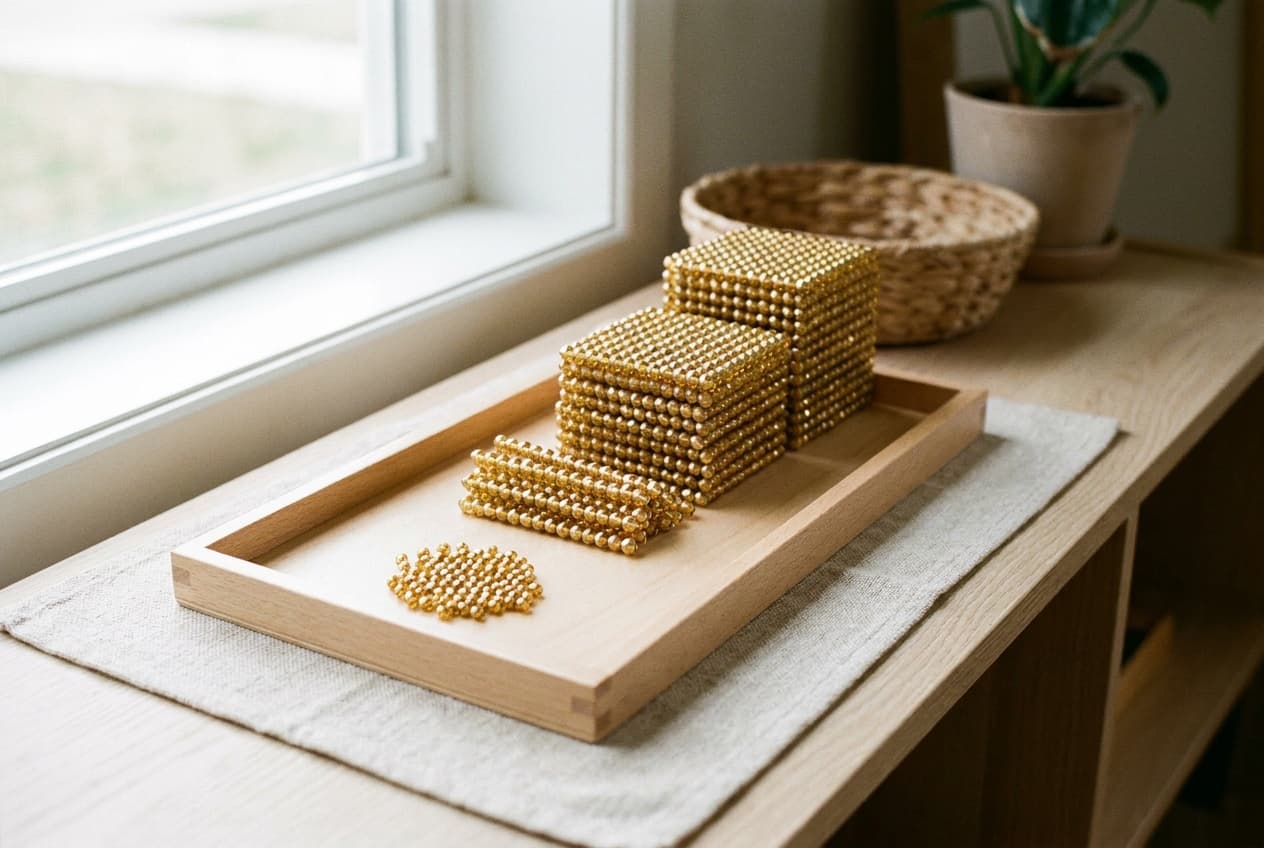
Golden bead material is gold beads in four forms: a single unit, a bar of 10, a square of 100 and a cube of 1,000, for children from about 4. An introduction tray with one of each costs $54.95, and full sets $299.95 to $1,117.98, at US sellers on October 2, 2026. Buy it; the counts are the lesson.
It is used in 7 lessons, starting with golden beads: introduction to the decimal system; 3 are published and the other 4 are in preparation. Not sure your child is ready for it? Two minutes of questions place your child on the sequence.
| Area | Math |
|---|---|
| Used in | |
| From age | 4 to 5.5 years |
| Make it | Hard to make accurately |
| Buy it | About $55 to $1118 (noted ) |
What the golden bead material is for
Each form is ten of the one before. Ten units make a bar, ten bars a square, ten squares a cube. A child can pick up a thousand, feel its weight and count that it is ten hundreds. That is the decimal system in the hands before it is on paper.
Montessori's 1917 book describes ten-bead bars about 7 cm long and a cube built of ten squares. Her bars of ten were orange until wartime shortages, when she approved gold for the ten bar and the unit bead. The tray and bank sets sold today, with wooden stand-ins for the extra thousands, came later.
| Part | What it looks like |
|---|---|
| Unit | One gold bead, about 7 mm across |
| Ten bar | Ten beads on a wire, about 7 cm long |
| Hundred square | Ten bars wired side by side, about 7 by 7 cm |
| Thousand cube | Ten squares stacked, about 7 cm on every edge |
| Bank extras | Wooden squares and cubes standing in for the extra hundreds and thousands |
| Trays and cups | For carrying; a cup keeps the unit beads from rolling |
The lessons that use the golden bead material
Golden Beads: Introduction to the Decimal System
4 to 5.5 yearsNaming a unit bead, a ten bar, a hundred square and a thousand cube, so the child can hold and compare the categories of the decimal system.
Teen Boards (Seguin Board A)
4 to 6 yearsSliding number cards 1 to 9 over the zero of a printed 10 to make and read 11 to 19, with a ten bar and a colored bead bar beside each.
Tens Boards (Seguin Board B)
4.5 to 6.5 yearsCounting by tens from 10 to 90 with golden ten bars, then sliding unit cards over the zeros to build and read every number from 11 to 99.
- Golden beads: fetching a quantity from the bankIn preparation
- Golden beads: matching quantities to number cardsIn preparation
- Golden beads: addition with exchangingIn preparation
- Golden beads: subtractionIn preparation
Buying one: 5 listings checked October 2, 2026
| Seller and set | Made of | Price |
|---|---|---|
| Montessori OutletIntroduction to Decimal Quantity w/ Trays (510500910)One piece of each of the four forms. Market price shown $158.55. In stock. | Golden beads, wooden tray | $54.95 |
| Montessori OutletGolden Bead Material (510500950)A bank of 100 units and 45 bars, with 10 bead squares plus 45 wooden ones and 1 bead cube plus 9 wooden ones. Market price shown $706.00. In stock. | Not stated | $299.95 |
| NienhuisGolden Bead Material: Individual Beads (Nylon) (0083MC)The same bank counts as Montessori Outlet's set, with number cards and three trays. | Beech, copper | $720.10 |
| Alison's MontessoriGolden Bead Material (Complete Set) (M92.SET)A bigger bank of 180 units and 225 bars, with number cards and seven activity sets. | Not stated | $1,117.98 |
| The Montessori RoomGolden Bead Material, budget version (C364-2)Canadian store. 100 units and 45 bars, with 45 squares and 9 cubes. | Not stated | $699.99 CAD |
- The first lesson needs only the introduction tray, one piece of each kind. At $54.95 it covers the introduction lesson. The teen boards need nine ten bars, which an introduction tray doesn't have.
- The bank is for the lessons after it, where the child fetches and exchanges. Full sets differ mostly in how many bead pieces you get against wooden stand-ins, and in the number cards and trays.
- We'd buy rather than make. The counts are the lesson, and a bank is hundreds of beads that must be exactly ten to a bar and a hundred to a square.
Keeping a full set on the shelf
- Keep the unit beads in their cup on the tray and the tray off the floor. A loose bead is choking-size for a younger sibling.
- Check wire ends on the bars now and then. A bent end catches a finger, and a bar that loses a bead silently becomes a nine.
Questions parents ask about the golden bead material
What do the golden beads symbolize?
Place value. A unit bead is one, a bar is ten, a square is a hundred and a cube is a thousand, each made of ten of the one before. A child sees and lifts the difference before writing 1, 10, 100 and 1,000.
When to introduce golden beads?
At about 4, once the child counts the number rods to 10 with confidence. The lesson on this site lists the signs; the introduction tray is all it needs.
What is the purpose of golden beads in Montessori teaching?
To give the decimal system a size and a weight. A thousand cube is heavy in a small hand, a unit bead is light, and a child who has carried both doesn't need to be told which is bigger.
Before the golden bead material, make sure the work before it is solid. The number rods lesson lists the signs that a child is ready to move on.