Moveable Alphabet: Building First Words
With a moveable alphabet a child writes before their hand can: they say a word slowly, hear each sound, and lay out the matching cut-out letters, c-a-t, on a rug. It follows the sandpaper letters, from about 3.5 to 4. Montessori found her children wrote words this way before they could read them.
Sourced from the texts, not yet presented at home
| Typical age | 3.5 to 6 years |
|---|---|
| Area | Language |
| Before this | |
| Materials | |
| Direct aim | To compose words by sounding them out and choosing the matching letters. |
| Control of error | Mostly the adult and the child's own ear at first. Later, matching to labels in the object box gives an independent check. |
| Leads to | |
| Time | About 10 minutes for two or three words (our estimate). |
| Grouping | One child |
| Parent prep | Medium. Gather four to six small objects with short phonetic names before you begin. |
| Cost | Buy about $20 to $122. Make: easy to make at home. |
| Other names | Movable alphabet, Large moveable alphabet, Cut-out alphabet |
What the work teaches
Direct aim. To compose words by sounding them out and choosing the matching letters.
Indirect aims, the ones you will not see at once
- Analysis of words into their individual sounds
- Preparation for reading, which follows writing in the Montessori sequence
- Self-expression in written language
- Spelling. Montessori saw word building as a foundation for accurate spelling
Set it out before you invite the child
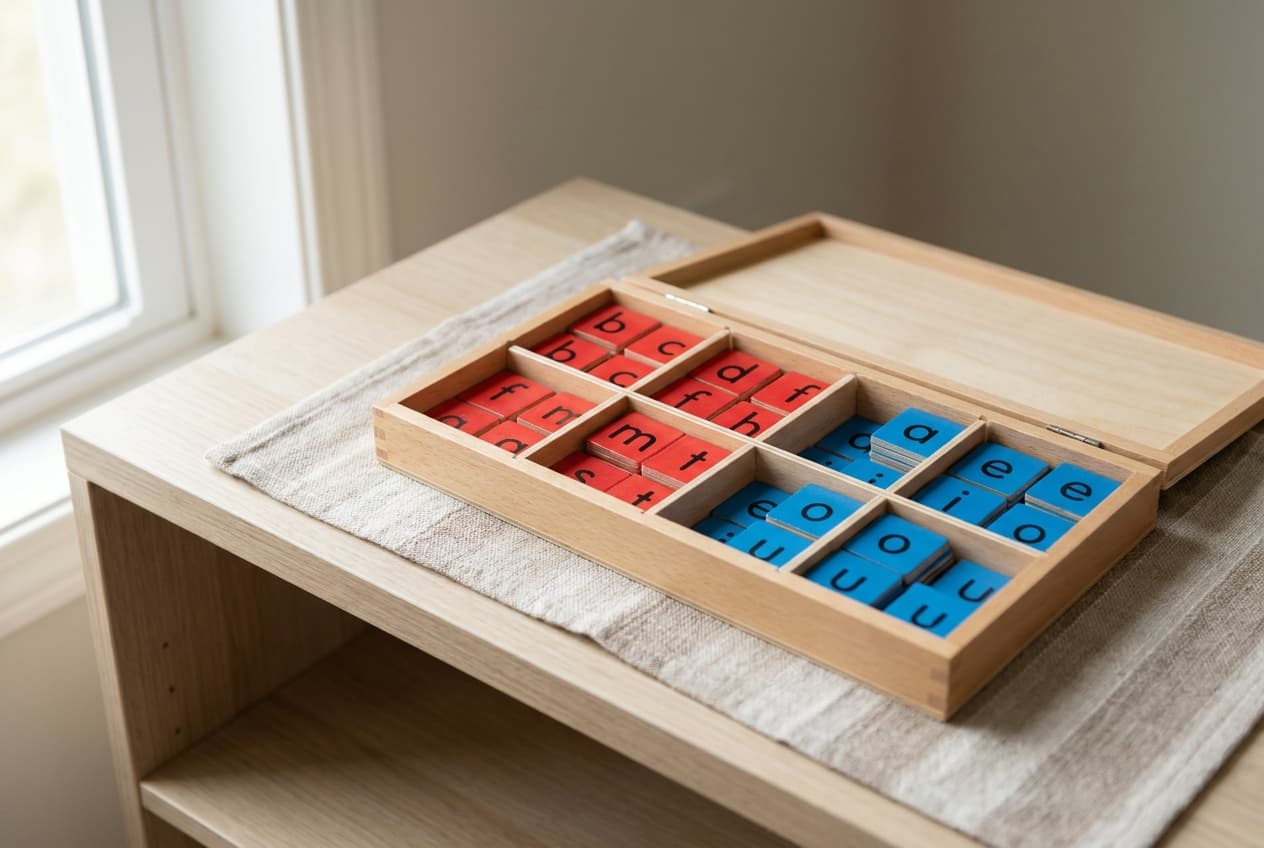
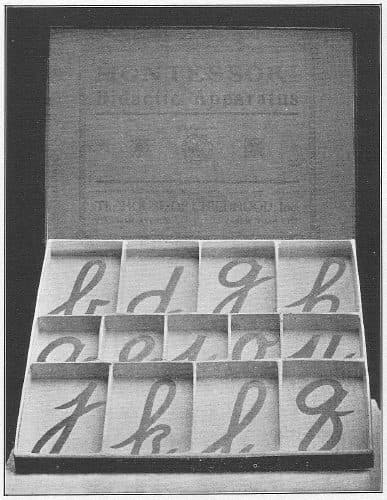
A shallow box with a compartment for each letter. Montessori kept four copies per compartment and glued a black letter at the bottom of each, so a child putting letters away knows where each one goes.
Letters the same shape and size as the sandpaper letters, cut from card or wood. Her 1912 set cut vowels from blue card and consonants from red; the 1914 Handbook says pink and blue.
Two sizes: a large alphabet for the first words and a smaller one once the child knows every letter.
A rug or long table, so words can run left to right with space between them.
Four to six objects with three-sound names, cat or pig for example.
Presentation, step by step
- 1Lay out a rug and bring the moveable alphabet box and a small object, such as a toy cat.
- 2Name the object: "Cat." Say it slowly, stretching each sound: "c-a-t."
- 3"What's the first sound you hear?" When the child says /c/, have them find the c in the box and place it on the rug.
- 4Continue: "What sound comes next?" for /a/ and then /t/, placing each letter to the right.
- 5Read back what the child built, running your finger under the letters.
- 6Build another word, then return the letters to their compartments.
Details that hold the child's attention
Building their own name, which children ask for early.
Hearing the word again at speaking speed after building it sound by sound.
Putting each letter back on its matching letter in the box.
A word an adult can read that the child built alone.
How the child sees a mistake
Mostly the adult and the child's own ear at first. Later, matching to labels in the object box gives an independent check.
The words come after the hands
| Words | Shown with |
|---|---|
| sound | Each separate sound in a spoken word. |
| word | What the sounds make together. |
| build | The verb for the work: "build cat". |
| vowel | The blue letters. Most words need one. |
The three-period lesson, scripted
You need two letters the child swaps while building, such as b and d.
| Period | What you do and say |
|---|---|
| 1. Naming | Trace each on its sandpaper board and say the sound: "/b/." "/d/." |
| 2. Recognition | "Give me /d/." "Put /b/ by the cat." Use the cut-out letters from the box. |
| 3. Recall | Point to one and ask "What sound is this?" |
Our suggestion: the moveable alphabet needs no three-period lesson of its own, since the child knows the sounds already. Use one only to settle a pair of letters that keep getting swapped.
Extensions and variations
- Building words for pictures, then for words the child chooses
- Short phrases and sentences
- Copying built words onto paper
- Dictation of well-known words only, so each built word ends in an idea the child recognizes
- A label for a drawing the child has made
Variations
- A smaller alphabet set for home use with fewer copies of each letter
- A second color set for children who want to build longer sentences
Make it or buy it
| Material | Make it | Buy, approx. |
|---|---|---|
| Moveable Alphabet | Easy | $20 to $122 |
| Pink Series Object Box | Easy | $15 to $45 |
Prices noted . Approximate US street prices for home-use versions; they vary by maker and change often, so recheck before buying.
Making it at home
Letters cut from colored card (consonants in one color, vowels in another) and stored in a tackle box or egg carton work well. Make five or more of each vowel.
What to check when buying a set
Wooden sets with a compartment box are durable. Match the font and colors to your sandpaper letters.
Printables for this lesson
- Short-vowel word list for building and readingPDF, 1 page, 114 KBForty three-sound words spelled the way they sound, eight for each short vowel. Each one names a thing a child can hold or point to.
- Shelf plan for age 3PDF, 1 page, 250 KBEvery work for this age on one page, in order, with a column to date each presentation.
Every printable for one age, by email
The shelf plan and the lesson printables for your child's age in one email, then three short emails on the first lesson, what to make or buy, and what comes next.
Signs the child is ready, and signs it is done
Ready for the first presentation
- Knows the sounds of a handful of vowels and consonants. Montessori started word building as soon as a child knew some of each.
- Hears all three sounds in a spoken word like cat.
- Has traced sandpaper letters in the writing direction.
- Wants to write but tires quickly with a pencil.
Ready for the next lesson
- Builds three-sound words alone, choosing each letter by sound.
- Reads back what they built.
- Puts every letter back in its compartment.
- Builds longer words and short phrases of their own choosing.
Fitting it into a home, not a classroom
| If you have | Do this |
|---|---|
| A tight budget | Card letters in two colors, stored in a tackle box or an egg carton. Make five or more of each vowel. |
| A toddler sibling | Small letters scatter and some fit a mouth. Build on a table, and count the vowels back in at the end. |
| English spelling | Choose words spelled the way they sound for now. Montessori noted that in a language that isn't phonetic, the teacher builds the word and says it, and the child repeats the arranging and reading. |
| A child ready to write with a pencil | Keep both. The alphabet lets ideas run ahead of the hand; the pencil catches up. |
When it does not go to plan
| When | Try this |
|---|---|
| The child lays out random letters and asks what they say. | Read them, sound by sound, exactly as built. That turns the game toward matching sounds to letters. |
| The vowel goes missing: "ct". | Say the word again very slowly and stretch the middle: "c-aaa-t." |
| Letters end up all over the rug and in the wrong compartments. | Show putting away again, one letter at a time on its matching letter. Montessori counted it as part of the work. |
| Building is fine, but reading back is a struggle. | Expected. Montessori's children read back their own words only with effort at first; reading other people's words came later still. |
Hazards to check before each session
Small cut-out letters are choking-size for a child under 3. Keep the box out of a toddler's reach.
Where other sequences and standards place it
We have not bought the paid homeschool curricula, so they are not listed here.
| Framework | Where it sits |
|---|---|
| This site's Language sequence | Lesson 3 of 12 published, after Sandpaper Letters, before Pink Series: Object Box Reading. Checked in: the scope and sequence |
| Montessori, The Montessori Method (1912) | The third period of writing, the composition of words. The fourth-grade summary goes as far as the letters and composition with the movable alphabet. Checked in: Chapter XVII, Third Period; Chapter XX, Sequence of Exercises |
| Montessori, Dr. Montessori's Own Handbook (1914) | The alphabet of movable letters serves for the composition of words, and the first written words often follow without warning. Checked in: Writing |
| Common Core, Kindergarten | RF.K.2.d: isolate and pronounce the initial, medial vowel and final sounds in CVC words. L.K.2.d: spell simple words phonetically, drawing on knowledge of sound-letter relationships. Checked in: corestandards.org |
| Head Start Early Learning Outcomes Framework, preschool | P-LIT 1: awareness that spoken language is made of smaller segments of sound. Checked in: www.in.gov |
Moveable alphabet: questions parents ask
What is the moveable alphabet in Montessori?
A box of cut-out letters, several of each, in the same shapes as the sandpaper letters. The child builds words with it by sound, laying letters left to right on a rug, before writing them by hand.
What is the purpose of the Montessori Moveable alphabet?
To separate writing from handwriting. A four-year-old can analyze "cat" into three sounds long before their hand can form three letters neatly. The alphabet lets them write the word now and practice the hand separately.
Why does writing come before reading in Montessori?
Montessori found that building a word you've just said is easier than working out a word someone else wrote. Her children composed words first and read other people's words later, about a fortnight after writing on average, she reported.
How many letters does a moveable alphabet need?
Montessori kept four of each letter. For home, five or more of each vowel and three or four of each consonant cover most short words and names.
Sources cited by book and chapter
- Maria Montessori, The Montessori Method (1912)
Chapter XVII, Third Period
Alphabets identical in form to the sandpaper letters but cut out of cardboard, kept in shallow cases with a compartment of four copies for each letter and a black letter glued at the bottom; vowels cut from blue cardboard and consonants from red.
The child composes a spoken word such as "mama" sound by sound with cut-out cardboard letters, then reads back the word he has built.
Only well-known words are dictated, so the composition results in an idea, and the child rereads the word he has composed many times.
After composing a word the child puts away every letter, each in its own compartment, so comparison and selection of the signs are practised twice.
Chapter XVII, Reading
Writing precedes reading; translating his own written word back into sounds is not yet reading, which is the interpretation of an idea from written signs.
- Maria Montessori, Dr. Montessori's Own Handbook (1914)
Writing, Fig. 31
The alphabet of movable letters cut out in pink and blue cardboard, kept in a box with compartments, serves for the composition of words; in a language that is not phonetic the teacher composes the words and pronounces them.
Writing
There are two movable alphabets, one of larger letters for the first exercises and one of smaller letters for children who already know the complete alphabet.
Reviewed by
What to offer next
Once the child chooses this work unprompted and finishes it without help, the next lesson to prepare is Pink Series: Object Box Reading.
- Sandpaper Letters2.5 to 5 years
- Sound games2.5 to 4.5 years
- Moveable alphabet3.5 to 6 years
- Metal Insets3.5 to 6 years
- Pink series4 to 6 years