Grammar Symbols: The Noun and the Verb
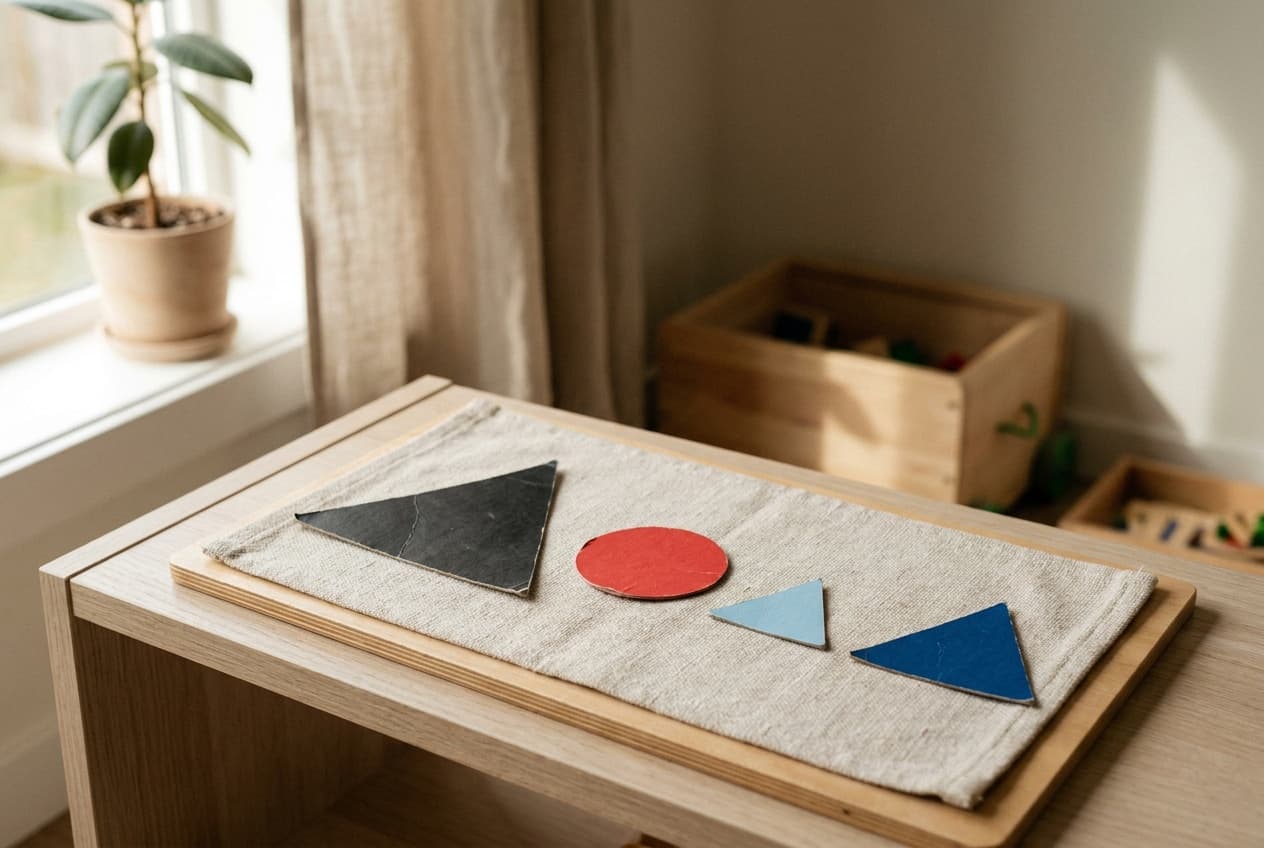
Grammar symbols are shapes that stand for parts of speech: a large black triangle for the noun, a red circle for the verb, and seven more. A child of about 4.5 to 5 who reads short words meets them through games. They fetch the object a slip names, act out a word, then lay the symbol above it.
Sourced from the texts, not yet presented at home
| Typical age | 4.5 to 7 years |
|---|---|
| Area | Language |
| Before this | |
| Materials | |
| Direct aim | To find out what a noun and a verb do in a sentence, and to mark each with its symbol. |
| Control of error | The game itself. A noun can be fetched and a verb can be done; a word that can be neither shows something is off. At this stage the adult watches and plays the game again rather than correcting. |
| Leads to | |
| Time | About 15 minutes for the noun game (our estimate). |
| Grouping | One child, or two or three together. The games work well with a few. |
| Parent prep | Medium. Slips of paper, a pencil, a tray of small objects and the symbols. |
| Cost | Buy about $10 to $203. Make: easy to make at home. |
| Other names | Function of words, Parts of speech symbols, Noun game, Verb game, Montessori grammar shapes |
What the work teaches
Direct aim. To find out what a noun and a verb do in a sentence, and to mark each with its symbol.
Indirect aims, the ones you will not see at once
- Reading for meaning: a slip says what to fetch or what to do
- A first sense that words fall into kinds
- Preparation for the grammar boxes and for writing sentences
- Reading silently and acting on what was read
Set it out before you invite the child
A set of grammar symbols. The usual modern set: noun, large black triangle; article, small light-blue triangle; adjective, medium dark-blue triangle; verb, large red circle; adverb, small orange circle; pronoun, purple triangle; preposition, green crescent; conjunction, pink bar; interjection, gold, in a shape that varies by set.
Flat symbols cut from card or wood for labeling words, and, in some sets, solid ones: a black pyramid and a red sphere for the first lesson.
A tray of five or six small objects the child can name and carry: a cup, a pencil, a shell, a spoon, a ball.
Slips of paper and a pencil, so you can write words in front of the child.
The symbols aren't in Montessori's books from 1912 to 1917; they come from later Montessori practice. Her 1917 grammar cards already used black for nouns and red for verbs.
Presentation, step by step
- 1Put the tray of objects on a table across the room. Sit with the child at another table with the slips.
- 2Write the name of one object on a slip, such as "cup", and hand it to the child to read silently.
- 3The child fetches the object and lays it beside the slip. Repeat with three or four more.
- 4Point to the slips. Each word names a thing. Lay a black triangle above each slip.
- 5Collect the slips and play the other way: hand over an object and let the child write or choose its slip.
- 6On another day, write an action on a slip, such as "hop". The child reads it silently and does it.
- 7Repeat with a few actions, then lay a red circle above each action word.
- 8Write a short command, such as "bring cup". The child carries it out, then lays a red circle above bring and a black triangle above cup.
Details that hold the child's attention
A slip that asks for something that isn't there, so there's nothing to bring.
A word like "hop" that can't be fetched, only done.
The black triangle sitting heavy and still, the red circle that looks as if it could roll.
A row of words with a symbol above each one.
How the child sees a mistake
The game itself. A noun can be fetched and a verb can be done; a word that can be neither shows something is off. At this stage the adult watches and plays the game again rather than correcting.
The words come after the hands
| Words | Shown with |
|---|---|
| noun | A word that names a thing or a person. |
| verb | A word that names an action, something you can do. |
| symbol | The shape laid above a word to show its kind. |
| triangle, circle | The two first shapes, already known from the geometric cabinet. |
The three-period lesson, scripted
You need a black triangle and a red circle, after the noun and verb games.
| Period | What you do and say |
|---|---|
| 1. Naming | "This is the noun symbol." "This is the verb symbol." |
| 2. Recognition | "Put the verb symbol above the word that tells you what to do." |
| 3. Recall | Point to a symbol and ask "What is this for?" |
Our suggestion. The games carry the meaning; the three periods only fix the names of the symbols.
Extensions and variations
- The article, a small light-blue triangle: "a cup", "the cup"
- The adjective game: "Bring me the red pencil", when two pencils are on the tray
- Symbol strips: a short phrase written out and a symbol placed above each word
- Commands on folded cards read silently and acted out, then marked with symbols
- Finding nouns and verbs in a sentence from a favorite book
Variations
- Solid symbols first: a black pyramid for the noun and a red sphere for the verb
- A group game, each child acting out a different verb card
Make it or buy it
| Material | Make it | Buy, approx. |
|---|---|---|
| Grammar Symbols | Easy | $10 to $203 |
Prices noted . Approximate US street prices for home-use versions; they vary by maker and change often, so recheck before buying.
Making it at home
Cut black triangles, red circles and smaller light-blue and dark-blue triangles from card. Ten of each is plenty to label a few sentences.
What to check when buying a set
Flat wooden symbols are the useful kind for labeling words. Solid three-dimensional sets are for the first noun and verb lesson and cost more.
Printables for this age
This work needs only the material, so it has no printable of its own. The shelf plan below places it among the other works for the same age.
- Shelf plan for age 4PDF, 1 page, 248 KBEvery work for this age on one page, in order, with a column to date each presentation.
Every printable for one age, by email
The shelf plan and the lesson printables for your child's age in one email, then three short emails on the first lesson, what to make or buy, and what comes next.
Signs the child is ready, and signs it is done
Ready for the first presentation
- Reads pink series words easily, and some blue.
- Reads a word silently and acts on it.
- Names the circle, square and triangle.
- Enjoys word games and jokes.
Ready for the next lesson
- Marks nouns and verbs in short commands without help.
- Says why a word is a noun: it names a thing.
- Uses the article and adjective symbols in a phrase such as "the red cup".
- Asks about the other symbols. That's the cue for the grammar boxes.
Fitting it into a home, not a classroom
| If you have | Do this |
|---|---|
| A tight budget | Cut the symbols from colored card: black triangles, red circles, light-blue small triangles. The games need nothing else. |
| One child at home | Play the noun game across rooms. Fetching from the kitchen is as good as fetching from a tray. |
| A younger sibling who can't read | Let them be the one who carries out the verbs. The reader reads the slip aloud. |
| A child who knows the words noun and verb from school | Play the games anyway. Knowing a definition isn't the same as feeling the difference. |
When it does not go to plan
| When | Try this |
|---|---|
| The child reads the slip aloud. | Fine at first. Fold the slips later so reading becomes a secret. |
| Adjectives get the noun symbol. | Play the "bring me red" joke: there's nothing called red to bring, so red can't be a noun. |
| Symbols get placed at random. | Go back to the games for a few days. The symbol comes after the child has fetched or done the word. |
| Interest fades. | Make the verbs sillier: wiggle, tiptoe, whisper. Montessori's grammar lessons were full of laughter. |
Hazards to check before each session
Small symbols and objects are choking hazards for a child under 3. Keep the tray up between games if a toddler is near.
Clear a path for the fetching. A child walking with eyes on a slip doesn't watch the floor.
Where other sequences and standards place it
We have not bought the paid homeschool curricula, so they are not listed here.
| Framework | Where it sits |
|---|---|
| This site's Language sequence | Lesson 8 of 12 published, after Pink Series: Object Box Reading, before Grammar Boxes and Grammar Box Cards. Checked in: the scope and sequence |
| Montessori, The Montessori Elementary Material (1917) | The noun lesson from her 1900 work: objects are called by their name, which is a noun, and a word that names no object is not one. Words of each kind are written on cards of one color. Checked in: Part I, Grammar |
| Common Core, Kindergarten language | L.K.1.b: use frequently occurring nouns and verbs. Checked in: corestandards.org |
| Head Start Early Learning Outcomes Framework, preschool | P-LC 7: the child shows an understanding of word categories and relationships among words. Checked in: www.in.gov |
Grammar symbols: questions parents ask
What are the Montessori grammar symbols?
Nine shapes, one for each part of speech. The noun is a large black triangle and the verb a red circle. The article and adjective are smaller blue triangles, the adverb a small orange circle, the pronoun a purple triangle, the preposition a green crescent and the conjunction a pink bar. The interjection is gold.
Why is the noun a black triangle?
The albums explain it with a picture: the noun is steady and solid like a pyramid, so it's a triangle, and black for carbon, an ancient material. The verb is a red circle, like the sun or a ball that moves. These stories are later tradition, not from Montessori's early books.
What age are grammar symbols for?
The first ones, noun and verb, at about 4.5 to 5, once a child reads short words. Montessori's 1917 book says a child usually starts using written language to think at about five. The rest come over the next years.
Do I need wooden grammar symbols?
No. Colored card cut into triangles and circles works for the games and the labeling. Wooden and solid sets look lovely but add nothing to the lesson.
Sources cited by book and chapter
- Maria Montessori, The Montessori Elementary Material (1917)
Part I, Grammar
People and animals answer when called but inanimate objects cannot; every object is represented by a word which is its name, and this name is a noun.
When the teacher asked for sweet, the children brought candy and sugar, and came to realize that sweet was not a name, not a noun.
The commands are written on cards that are read in silence and interpreted through actions, a method that grew out of the work in the Children's House.
The words of each part of speech are written on cards of one size in different colors: black for the noun, tan for the article, brown for the adjective and red for the verb.
The child begins to use written language to express his thinking normally at the age of five, a question of mental maturity rather than age.
In the first grammar lessons of 1900 the children passed delightful half hours of joyous laughter over their exercises in grammar.
The lessons the teacher gives are so simple and need so few words that they become lessons of gesture and action rather than of words.
Reviewed by
What to offer next
Once the child chooses this work unprompted and finishes it without help, the next lesson to prepare is Grammar Boxes and Grammar Box Cards.
- Three-part cards4 to 6.5 years
- Blue series4.5 to 7 years
- Grammar symbols4.5 to 7 years
- Puzzle words4.5 to 7 years
- Green series5 to 7.5 years